
Impersonation is the sincerest form of flattery
But did Nora really appreciate her impersonators? She certainly did. However, she did talk to most of them to draw the line between funny and raunchy. Impersonation may be the sincerest form of flattery, but not when it already borders on vulgarity.
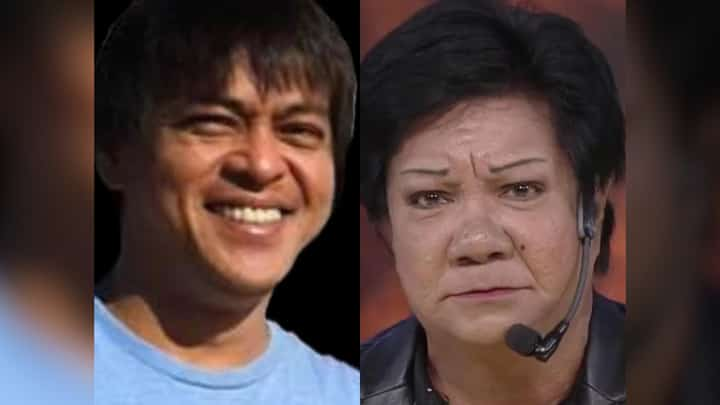
In Philippine entertainment, impersonators started to mushroom when a group of drag queens formed the Paper Dolls. Led by Fanny Serrano, the Paper Dolls impersonated mostly Pilita Corrales and her back-bending style of singing.
But the one local celebrity who had the most impersonators was National Artist for Film and Broadcast Arts Nora Aunor. They did not all look like Nora, but they were able to copy both her speaking and singing voice, especially her acting style.
If there was something Vilma Santos envied about Nora, it was the fact that nobody else sounded like the star for all seasons. Having a sound-alike had its advantages. Whenever Nora, for instance, had no time to dub her scenes during the post-production phase of her films, there was always somebody who could fill in for her. But Vilma always had to drag herself to the dubbing studio even if she was running a fever because there was no one who could copy her voice.
A film company tried to get a dubber for Vilma once. Was it Goodwill Productions that churned out Makahiya at Talahib in 1976? For some reason, Vilma could not attend to the dubbing sessions of this film she did with the late Rudy Fernandez. And so, the producer got somebody to dub all her lines in the movie, but the viewers knew it was not Vilma’s voice.
Not in Nora’s case. There was always some member of the LGBTQ who could mimic her deep speaking voice. In some Nora scenes that needed dubbing and the superstar was not available, one call to any of her impersonators and the problem was solved. “Plakado.” Accurate. Spot-on.
Ate Gay was one of the more popular Nora impersonators. Sadly, she died last 1 November, but is still in the news for reasons that are best no longer discussed here out of respect for somebody who is already gone.
There is another Nora impersonator who is very much familiar with today’s generation: the comedian-turned-politician Teri Onor. Unknown to many, had been other less-known Nora Aunor impersonators. With the death of Ate Gay, now is the time to get to know the other comics who impersonated the late superstar.
Was Nora flattered with all her impersonators? Again, impersonation may be the sincerest form of flattery, but some went overboard in the case of Aunor. Read till the end to find out how she felt being imitated for comic relief.
The first known Nora impersonator was a Lady Guy. No one knew his real name, but he was a constant presence in radio during the 1970s. Listeners who had just tuned in actually thought it was Nora who was the guest in a particular radio show. Of course, somewhere along the way, they would find out that it was not the real McCoy they were listening to, but a Nora Aunor impersonator.
To this day, no one could tell what happened to Lady Guy. Some say, he got ill and went back to the province. Nobody even knows which province.
There was also another Nora impersonator who was known as Alex. There are no details about his complete name. But Alex was a regular in comedy bars, like Music Box on Timog Avenue in Quezon City in the late 1980s. He also made a living appearing in provincial shows, particularly in town fiestas, impersonating, but — who else? — Nora Aunor.
Alex did not at all resemble Nora. He was stocky. In fact, other performers at comedy bars would constantly tease him because of his build: “Hindi naman boksingera si Nora, ah! (But Nora is not a boxer!)” Alex, however, was always able to render a perfect rendition of Nora’s Ang Tindera song, which was released by Alpha Records from way back. It was his performance of Nora’s Ang Tindera that always brought the house down.
There’s also Bona, another Nora impersonator. Bona, of course, is the title of one of Nora’s most iconic films. Born Manuel Papillera in 1966, Bona grew up in an informal settlers’ area where SM City in North EDSA now stands.
Basically unschooled (he only reached fifth grade), he initially worked as a parlor assistant. He later made use of his comic gift by doing the rounds of comedy bars, where he was always a hit as a Nora Aunor impersonator. Most of the time, he shared the stage with another comic, Shola, whose real name was Rodolfo Luna. Shola was the half-brother of actress Marissa Delgado. He died only a couple of years ago.
It was talent manager Manny Valera who discovered Bona in one of his comedy bar appearances. Valera, who handled the career of Maricel Soriano for a long time, was able to book Bona for TV guesting and, sometimes, even in the movies.
Unfortunately, Bona is one of those so-called one-day millionaires. Anything he earns today — no matter how big the amount — would surely be gone the following day. He is said to be living in some depressed area in Bago-Bantay — almost completely toothless and forever scrounging for food.
But there is one Nora impersonator who became big-time: Ned Legaspi. He was a reluctant Nora impersonator. It all started when TV writer Chris Violago created the show Live AIDS at UP in 1985. Both Chris and Ned were UP Mass Comm students that time and somebody had to do a Nora impression. Ned was asked to spoof the superstar in Ina Ka ng Anak Mo and was a hit — to the point that he was sometimes invited to gag shows on television to do Nora sketches.
Ned was not stuck to doing Nora impressions. A bright boy, he became an academician and even wrote books about culture. He also became an executive for ABS-CBN Global. Nora must have been proudest of him the most.
But did Nora really appreciate her impersonators? She certainly did. However, she did talk to most of them to draw the line between funny and raunchy.
Impersonation may be the sincerest form of flattery, but not when it already borders on vulgarity.