
Mayon eruption triggers mandatory evacuations in Albay
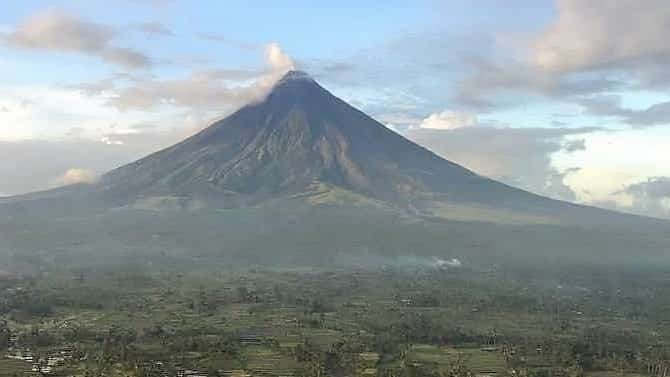
NAGA CITY — Local governments in Albay ordered mandatory evacuations Friday, after Mayon Volcano erupted, sending a 3,000-meter ash plume into the sky and prompting authorities to raise its alert status to Level 3.
Residents within the volcano's six-kilometer permanent danger zone (PDZ) were ordered to evacuate following the moderately explosive eruption at around 11:53 a.m.
Albay Public Safety and Emergency Management Office (APSEMO) head Bobby Cristobal said Camalig, Malilipot and Tabaco City began evacuating residents immediately after the Philippine Institute of Volcanology and Seismology (PHIVOLCS) raised Mayon's status from Alert Level 2 to Alert Level 3 around noon.
Cristobal said authorities expect to accommodate about 1,133 families from eight towns and cities surrounding Mayon in temporary shelters.
Ashfall was reported in Camalig, Guinobatan and upland areas of Legazpi City following the eruption.
As of 2 p.m., the Office of Civil Defense (OCD) Bicol reported that 205 families had been evacuated in Camalig and 152 in Tabaco City.
PHIVOLCS said the eruption signaled “a new phase of magmatic eruption, with increased chances of lava flows and hazardous PDCs (Pyroclastic Density Current) or ‘uson’ affecting the upper to middle slopes of the volcano in the immediate days to weeks.”
The agency warned of possible pyroclastic density currents, lava flows, rockfalls, lahars and sediment-laden streamflows along channels draining the volcano.
It recommended evacuating all residents within the six-kilometer danger zone.
“Civil aviation authorities must also advise pilots to avoid flying close to the volcano’s summit as ash from any sudden eruption can be hazardous to aircraft,” PHIVOLCS said.
Classes suspended, tourist sites restricted
Albay Gov. Noel Rosal suspended classes at all levels in public and private schools to ensure the safety of students and teachers.
In Guinobatan, one of the areas affected by ashfall, personnel from the Bureau of Fire Protection and Municipal Disaster Risk Reduction and Management Office conducted flushing operations to remove volcanic ash from buildings and other surfaces.
The Albay Provincial Health Office also distributed 4,000 surgical masks to Camalig and Guinobatan for residents affected by ashfall.
APSEMO prohibited all activities within the six-kilometer danger zone, including mountain climbing, orchid picking and vegetable harvesting.
All-terrain vehicle rides, a popular tourist activity in Albay, were restricted to the Cagsawa Ruins area, while aircraft were warned against flying directly over the volcano.
Mayon Skyline, another tourist destination, was temporarily closed until further notice.
Mayon, the country's most active stratovolcano, is known for its nearly symmetrical cone and history of explosive eruptions.
It has erupted more than 50 times since its first recorded eruption in 1616.
Its deadliest recorded eruption occurred on Feb. 1, 1814, when pyroclastic flows and volcanic debris buried the Cagsawa settlement in what is now Barangay Busay, Daraga, killing an estimated 1,200 to 2,000 people.