
From idea to action: CarbonPH takes root in Balamban
CarbonPH forms part of Aboitiz Foundation’s 40-year commitment to help restore Cebu’s forests, watersheds and ecosystems at scale.
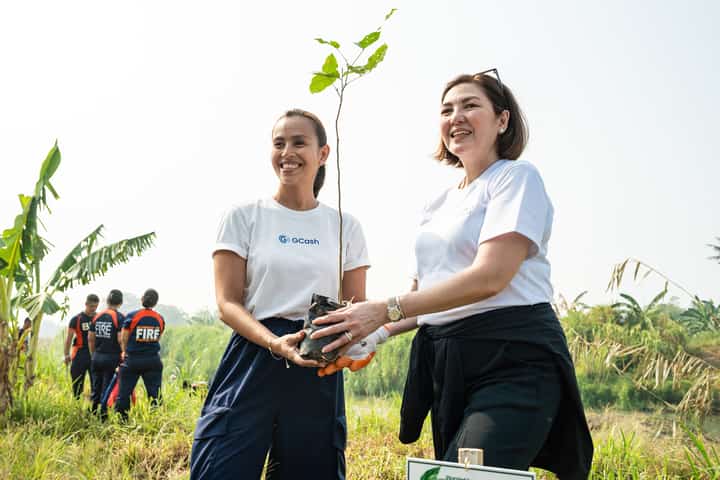
ABOITIZ Foundation, represented by its president Ginggay Hontiveros-Malvar (right), and GCash GForest, represented by Mynt head of corporate sustainability and communications Michelle Fernandez, aim to grow one million trees and help restore 1,200 hectares in Balamban, Cebu.
BALAMBAN, Cebu — CarbonPH began nearly three years ago as an idea developed through Voyage, an internal Aboitiz initiative that provided teams a platform to pitch and develop new ideas.
What started as a proposal for nature-based solutions has since evolved into Aboitiz Foundation’s long-term forest and ecosystem restoration program — designed to go beyond one-time tree planting by restoring landscapes, strengthening watersheds, protecting biodiversity and creating opportunities for communities.
A major step in turning that idea into a long-term commitment came in August 2024, when Aboitiz Group president and CEO and Aboitiz Foundation chairman Sabin Aboitiz signed an agreement with the people of Cebu through the Provincial Government of Cebu, formalizing a shared commitment to the long-term restoration and protection of the province’s forests and watersheds.
The agreement laid the foundation for what would become CarbonPH’s 40-year commitment in Cebu — transforming an idea developed through Voyage into a long-term undertaking built around nature-based solutions, community participation and partnerships.
From there, CarbonPH continued to take shape. The team worked on the science, restoration model, community engagement and partnerships needed to translate that long-term vision into action on the ground.
Then came a partner that shared the same vision.
GCash GForest saw in CarbonPH a common goal and purpose — to turn collective climate action into meaningful and lasting restoration. With that shared commitment, and GCash’s trust and confidence in Aboitiz Foundation’s long-term approach, the two organizations brought together complementary strengths: CarbonPH’s landscape restoration model and GCash GForest’s ability to mobilize millions of Filipinos through digital climate action.
ABOITIZ Foundation president Ginggay Hontiveros-Malvar: CarbonPH is about making sure the trees we plant today become part of healthier ecosystems and stronger communities tomorrow.
DEPARTMENT of Environment and Natural Resources-Forest Management Bureau assistant director Atty. Ray Thomas Kabigting explains the role of the agency in the CarbonPH initiative, which is providing technical and policy framework for sustainable forest and watershed management.
MORE than 3,000 volunteers, including Balamban Mayor Amos Cabahug (left) and Climate Change Commission vice chairman and executive director Robert E. A. Borje, joined communities and partners in planting native trees and bamboo across identified restoration areas, marking CarbonPH’s first major on-ground activation.
A VOLUNTEER conducts a bamboo and tree planting orientation as the CarbonPH event also coincides with World Bamboo Day.
Nearly three years after CarbonPH was first conceived, that shared vision has now come to fruition.
On 19 September, Aboitiz Foundation and GCash GForest formally launched the CarbonPH: Aboitiz Foundation and GCash GForest Greening Program in Balamban, moving the program from years of planning, groundwork and partnership-building into actual restoration on the ground.
More than 3,000 volunteers joined communities and partners in planting native trees and bamboo across identified restoration areas, marking CarbonPH’s first major on-ground activation.
Through the five-year partnership, Aboitiz Foundation and GCash GForest aim to grow one million trees and help restore 1,200 hectares in Balamban. More than reaching planting targets, the partnership seeks to establish a model of restoration built around long-term tree survival, biodiversity, watershed protection, community stewardship and sustainable livelihoods.
For Aboitiz Foundation president Ginggay Hontiveros-Malvar, seeing CarbonPH finally take root represents both the culmination of years of work and the beginning of a much longer journey.
“What we are starting in Balamban is not a one-day planting activity. It is the beginning of years of work with communities to restore forests, protect water sources and create livelihoods that can endure. CarbonPH is about making sure the trees we plant today become part of healthier ecosystems and stronger communities tomorrow.”
From digital action to restoration on the ground
The partnership brings together two complementary strengths: CarbonPH’s long-term approach to ecosystem restoration and GCash GForest’s ability to mobilize millions of Filipinos through digital climate action.
Through GForest, green energy points earned from everyday digital activities can help support actual tree planting and restoration — connecting actions made on a mobile phone with seedlings being nurtured and landscapes being restored with communities on the ground.
Michelle Fernandez, Mynt head of corporate sustainability and communications, said the partnership makes that connection more tangible for GCash GForest users.
“GCash GForest was designed to make climate action accessible in everyday life. What this partnership does is connect that participation to something people can see taking shape on the ground — from seedlings being planted to landscapes being restored together with communities in Cebu.”
GCash GForest has helped plant 4.9 million actual trees to date. The one million trees targeted in Balamban will contribute to GCash’s goal of planting 10 million actual trees by 2030, while supporting CarbonPH’s much longer restoration journey.
Held in time for World Bamboo Day, the 19 September activity brought communities, partners and volunteers together across restoration areas in Balamban.
In parallel, the Municipality of Balamban led coastal cleanup activities for International Coastal Cleanup Day, extending the day’s environmental action from the uplands to the coast and reinforcing the program’s ridge-to-reef approach.
More than planting trees
At the heart of CarbonPH is the recognition that restoring an ecosystem requires more than putting seedlings into the ground.
The program follows a ridge-to-reef and mosaic landscape approach, integrating forest and watershed restoration, biodiversity conservation, agroforestry and community participation.
Native and endemic species such as Cebu Cinnamon (Cinnamomum mercadoi), locally known as Kaningag, Narra, Molave, Katmon, Almaciga and Bagilumbang will be planted alongside bamboo and suitable fruit-bearing and agroforestry species, including cacao, coffee and jackfruit.
On 19 September, bamboo and native trees were also planted along the river corridor to help rehabilitate the watershed, stabilize riverbanks, reduce erosion and support natural flood mitigation — showing how nature-based solutions can help strengthen both ecosystems and the resilience of surrounding communities.
But getting seedlings into the ground is only the first step.
The project targets at least 85 percent tree survival, backed by nurseries, sustained maintenance, monitoring, protection and community stewardship. Local communities and people’s organizations will therefore remain central to the program long after each planting activity ends.
Partnerships for the long haul
Restoring landscapes at this scale cannot be accomplished by one organization alone.
The initiative is supported by the Municipality of Balamban and the Cebu Bamboo Industry Development Council, together with national government institutions whose policies and technical guidance help connect restoration on the ground with the country’s broader environmental and climate goals.
The Department of Environment and Natural Resources-Forest Management Bureau (DENR-FMB) provides the broader technical and policy framework for sustainable forest and watershed management — grounded in science, sound forest governance and collaboration among government, communities and other stakeholders.
The Climate Change Commission, meanwhile, helps connect initiatives such as CarbonPH with the Philippines’ broader climate agenda and its commitments under the Paris Agreement, including the country’s Nationally Determined Contribution (NDC). The current NDC commits the Philippines to a 75 percent projected cumulative reduction and avoidance of greenhouse gas emissions from 2020 to 2030, requiring coordinated action across government, business and society.
These partnerships reflect an idea that has been part of CarbonPH from its earliest days in Voyage: restoration at scale requires collective action and long-term commitment.
Government provides policy, technical guidance and local leadership. Communities and people’s organizations bring local knowledge and stewardship. Businesses bring resources, technology and networks. Individuals can contribute through volunteering and even everyday digital actions.
As CarbonPH’s first private-sector partner, GCash GForest is helping translate that model into tangible restoration on the ground. As the program grows, Aboitiz Foundation aims to bring more partners, communities and restoration areas into the effort.
A 40-year journey takes root
Balamban is only the beginning.
CarbonPH forms part of Aboitiz Foundation’s 40-year commitment to help restore Cebu’s forests, watersheds and ecosystems at scale, looking at a landscape of around 71,000 hectares and the potential to grow millions of trees over the decades ahead.
That long horizon is deliberate. Forests take years to grow. Watersheds require continuous protection. Biodiversity needs functioning ecosystems. And communities need to see lasting environmental and economic value for restoration to endure.
For an idea pitched through Voyage nearly three years ago, seeing more than 3,000 volunteers planting trees and bamboo in Balamban marks an important milestone.
But measured against a 40-year commitment, it is only the first chapter.
What began as an idea through Voyage, grew into a commitment to the people of Cebu, and found a shared purpose with GCash GForest is now taking root on the ground.
From here, the work is to make sure those roots grow deeper — bringing more communities, partners and landscapes into a long-term movement for healthier forests, stronger watersheds, thriving biodiversity, sustainable livelihoods and a more climate-resilient Cebu for generations to come.