
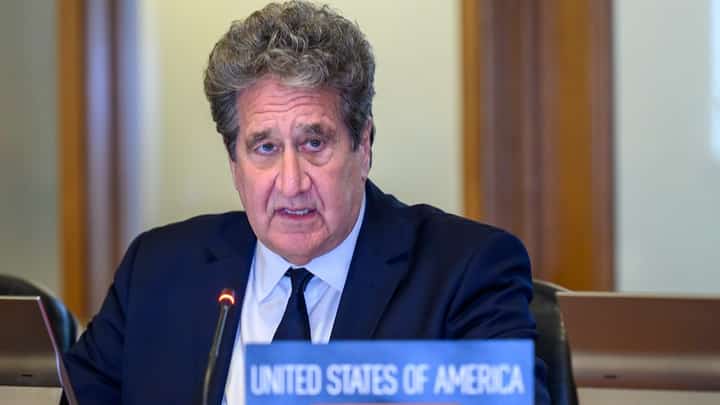
Open Letter to U.S. Ambassador Lee Lipton
Now, more than ever, in the midst of an escalating crisis in the West Philippine Sea, we, the Filipino people, need help from our American allies, not today but yesterday.

Re: China’s incursions and harassment in the West Philippine Sea.
I am sending this article after it is published to US Ambassador Lee Lipton to hopefully be forwarded to the White House on behalf of the Filipino people; to President Marcos Jr., to members of the Lower House and the Senate, to DND Secretary Gibo Teodoro, to the DFA, and to the Embassy of China.
Now, more than ever, in the midst of an escalating crisis in the West Philippine Sea (WPS), we, the Filipino people, need help from our American allies, not today but yesterday. Up front, we perhaps need the following:
1) Quick implementation of the US-Philippine Mutual Defense Treaty, in case it is needed;
2) More high-end weapons, over and above the NMESIS land-based missiles to be installed at Subic Bay and possibly at smaller EDCA bases;
3) “Skirmish” weapons such as lasers and water cannons as an equalizer;
4) The formation of a US-Philippine task force in case war is imminent.
There have been social media posts on an additional 50 new naval vessels for the Philippine Navy but these were just announcements, although some timetables came up, including the training of naval personnel in Baltimore in October. We do not know the status of these.
History
On 12 July 2016, the WPS was declared by the UN Permanent Court of Arbitration in The Hague to be part of the Philippine’s Exclusive Economic Zone. In this landmark decision, China’s “nine-dash line” was declared invalid. China, to this day, refuses to accept this UN decision, which is at the root of the conflict over the WPS today.
China acts as if it is the true owner of the WPS and, as such, began a series of harassments on the Philippine Coast Guard (PCG) and Filipino residents and fishermen, orchestrating food blockades, which did not work because there is plenty of fish all around. In the last few weeks, China employed brinkmanship, ramming smaller Philippine vessels and using water cannons against them. In one incident, two of their larger vessels attempted to sandwich a smaller PCG vessel but ended up ramming each other, with substantial damage.
For some strange reason, China is rapidly escalating the conflict in the WPS. Filipino observers are guessing that China has discovered oil and gas resources and is beefing up its naval capability. Or the move may be related to forward strategies in the Taiwan strait. The US, Japan and Australia are the Philippines’ allies in the WPS cause, feared by China as an emerging geopolitical force.
Lately, the US gave some large vessels to the Philippine Navy to face the much larger Chinese Coast Guard. The Philippines perhaps needs more than just “skirmish weapons.”
We Filipinos fear collateral damage on tens of thousands of residents near the dozen or so EDCA bases in case of a full-blown US-China confrontation. The recommended US-Philippine task force may be needed to respond to this.
Finally, we are forever thankful for US support against China in the WPS and the formation of an alliance of Australia, Japan and the US to counter the Chinese aggression.