




Love at first shot: Santos’ loyalty to the game pays handsome reward
‘I knew in my heart that I wasn’t good enough to become a professional basketball player.’
Text size
‘I knew in my heart that I wasn’t good enough to become a professional basketball player.’
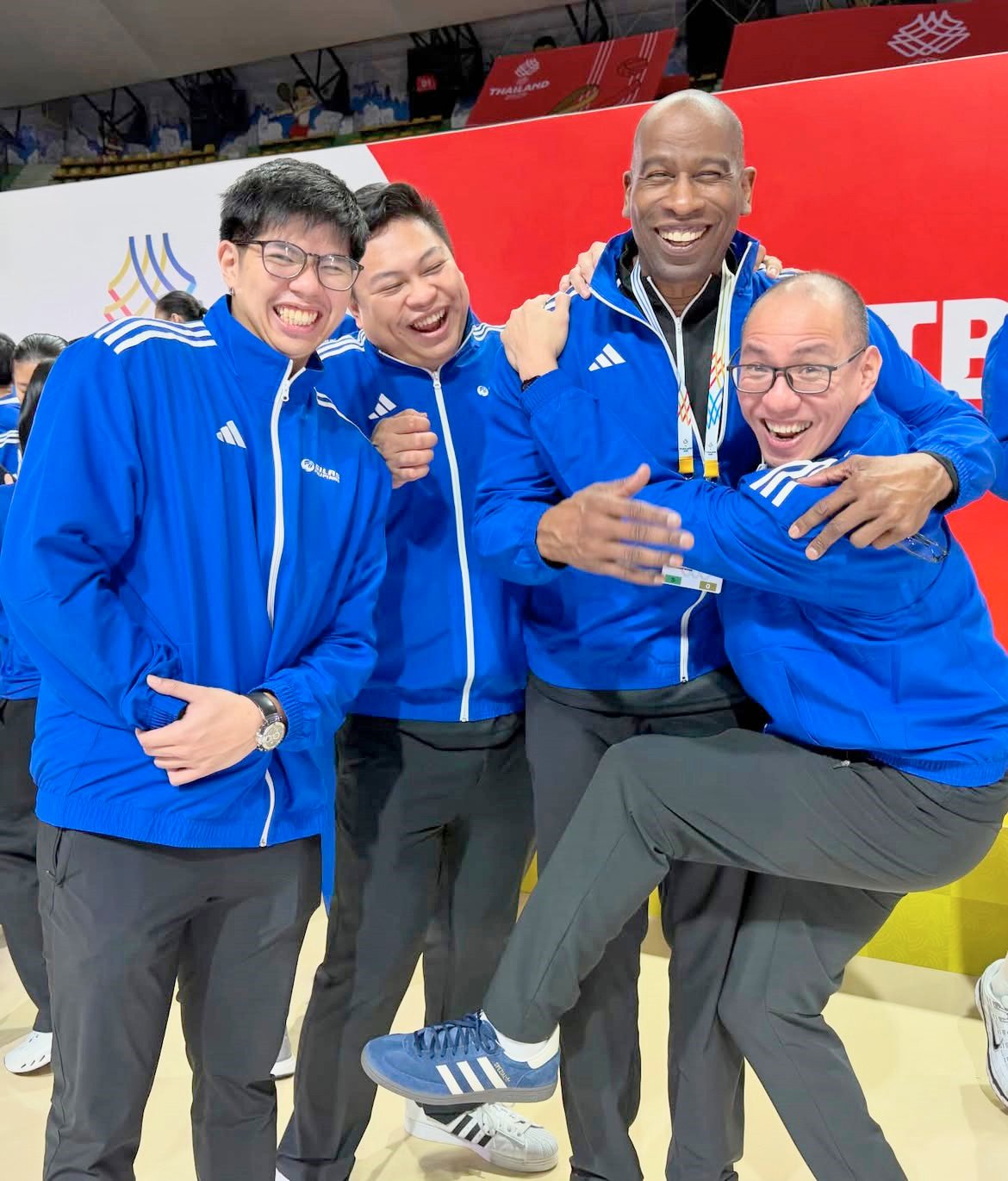
MULTI-TITLED coach Norman Black (second to the right) together with Bacon Austria (second to the left) and Sandy Arespacochaga (right) are among the mentors Andre Santos looks up to as he navigates his young and promising coaching career.
Photograph courtesy of SBP
Andre Santos didn’t have a hard time convincing himself to stay in basketball.
In fact, although the current Gilas Pilipinas Youth and San Beda University assistant coach knew early enough that a professional career was unlikely, he still stuck around, knowing that walking away from the game he loves was never an option.
Indeed, it was love at first shot.
“I knew in my heart that I wasn’t good enough to become a professional basketball player,” Santos said in an episode of Off the Court, the weekly online sports show of DAILY TRIBUNE.
“For me, the professional route was either to work a corporate job or — if I wanted to stay involved in basketball — to get into coaching. Any day, I would choose to stay in what I love, which is basketball.”
From playing for Ateneo de Manila University’s Team B, the 26-year-old tactician opted to try his hand at coaching after graduating with a BS Management degree in 2022. He joined the Red Lions coaching staff under mentor Yuri Escueta, which also included veterans Norman Black and Boyet Fernandez.
Santos admitted he was never among the most gifted players on the floor, but his curiosity about the game grew as he watched how his coaches prepared their teams.
“It was really under Coach Yuri that I learned what it meant to play good basketball — good team basketball, systematic basketball, rather,” Santos, who is at the forefront of the growing youth movement among local coaches, added.
“I wasn’t a highly skilled player, but I was really interested in how Coach Yuri taught us and how he prepared us for games.”
Humble beginnings
Before trying his hand at coaching, Santos began his basketball journey with De La Salle-Zobel at around 14 years old.
He recalled that former Junior Archers assistant coach Gian Nazario piqued his interest in coaching before he even considered it as a career.
“Coach Gian was the first coach who really taught me how to play systematic basketball,” said Santos, referring to Nazario, who now handles the 19U program of the Junior Archers.
“Even at an early age — when I was around 13 or 14 — Coach Gian showed me what it meant to prepare for games and become a leader on the court.”
At Ateneo, it was Escueta and former head coach Kiwi-American tactician Tab Baldwin who further shaped his understanding of the game. Baldwin handled the likes of Thirdy Ravena and brothers Mike and Matt Nieto, who led the school to a three-peat from 2017 to 2019.
“I think my interest in coaching really developed during my time in Ateneo. I was a Team B player under Coach Yuri Escueta,” Santos recalled.
“It was really under Coach Yuri that I learned what it meant to play good basketball — good team basketball, systematic basketball, rather.”
Under Gilas Youth head coach Juno Sauler, Santos learned about facilitating the squad and organizing practices.
“Coach Juno’s X’s and O’s are up there with the best. He understands what it means to play efficient basketball and to play the modern way, which includes understanding points per possession, both on offense and defense,” Santos said.
“These are really the guys who have helped me create my identity as a coach. As a young coach, all you really do is pick the brains of the people around you and use those ideas to form your own identity.”
The wisdom he gained eventually led him to call the shots on two separate occasions.
Hot seat
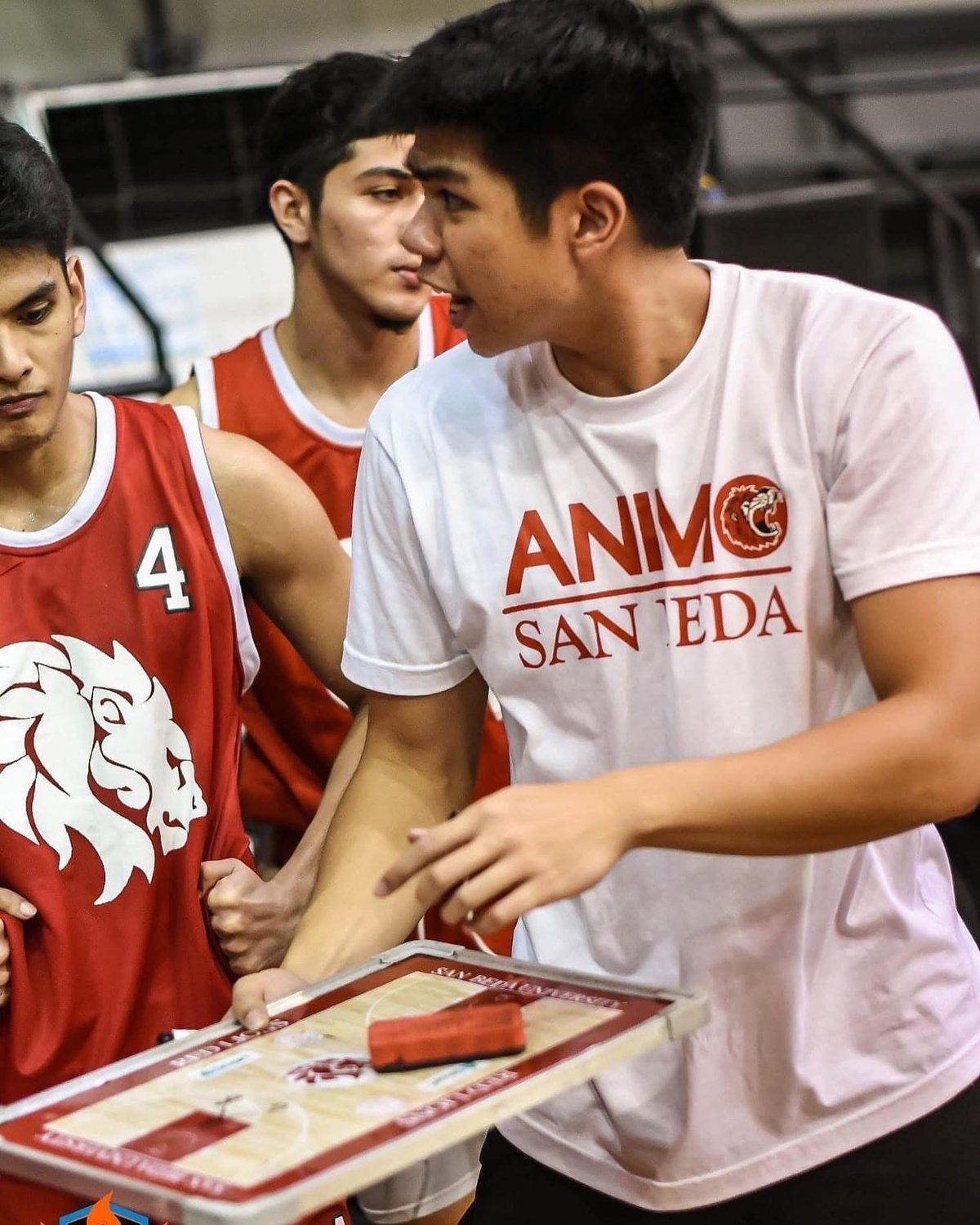
On 14 October 2023, Santos called the shots for San Beda as acting head coach against Jose Rizal University in Season 99 of the National Collegiate Athletic Association (NCAA) men’s basketball tournament, with Escueta serving a one-game suspension.
The Red Lions escaped the Heavy Bombers, 74-70, under Santos’ watch. The victory may be ugly, but it gave Santos a crash course on how to handle pressure when the game is on the line.
In fact, he broke down in tears after the match as it was his first time coaching an NCAA game, especially for a squad as storied as San Beda.
“That was the most memorable for me and, of course, it’s memorable for me and probably for everyone because I cried afterward,” Santos said.
“But more than that, it was my first NCAA victory as a head coach. That was something I’ll never forget — being able to taste that first victory in the NCAA as a head coach.”
Two years later, he got a big break when Black included him in the roster of coaches who will help him pull off a gold medal in the men’s basketball event of the 33rd Southeast Asian Games in Thailand.
There, his mettle was tested as they had to assemble a rag-tag roster at the very last-minute due to the strict eligibility rules of the organizers.
He donned the national colors anew when Sauler handed him the coaching reins for Gilas Youth in the Japan B.League U16 Challenge Cup in Tokyo.
With Sauler busy preparing the U18 squad for the FIBA Asia Cup in India, Santos took over as head coach and guided the team to a bronze medal with a 3-1 win-loss record.
He admitted that being in the hot seat for an entire tournament is no easy feat, but clear communication with the players was key to their success.
“I feel very grateful that I was given a head coaching opportunity like this,” said Santos, who savors the experience of handling some of the best young players in a high-level tournament.
“It does feel a bit more pressure when you’re already the head coach on paper, but being able to communicate with the players and relay information during games are things I’m already used to because of the freedom my head coaches have given me.”
Full circle
At San Beda, Santos also calls the shots as head coach of the Team B program, something that feels right up his alley.
Unlike some members of the coaching staff who were former Philippine Basketball Association and NCAA tacticians, Santos understands what it means
to be a player whose value was not always measured by individual skill.
“I understand Team B players maybe better than anyone else on our staff,” Santos said.
“I have a better understanding of what it means and how it feels not to be the most skilled or the greatest player, but still have a great understanding and appreciation for what we do as a team.”
For all the systems, scouting reports and defensive coverages that have shaped his basketball mind, Santos said his coaching personality can ultimately be summed up in one word.
“Passionate. I coach with a lot of passion,” Santos said.
“Maybe because I’m on the defensive side, where you really have to call things out and communicate coverages, it forces me to be vocal.”
But Santos believes passion goes beyond shouting instructions from the sidelines.
“Passion also shows care,” Santos said.
“I want my players to remember that I cared for them and that I cared for the team. I want them to know that I was passionate about everything I did because I always had our team’s goals in mind.”
For a coach who once realized he would not make it as a professional player, Santos has found another way to remain in the game — and perhaps leave an even bigger impact through the players and coaches who will come after him.
