
Adiong urges Duterte to provide evidence of alleged threats

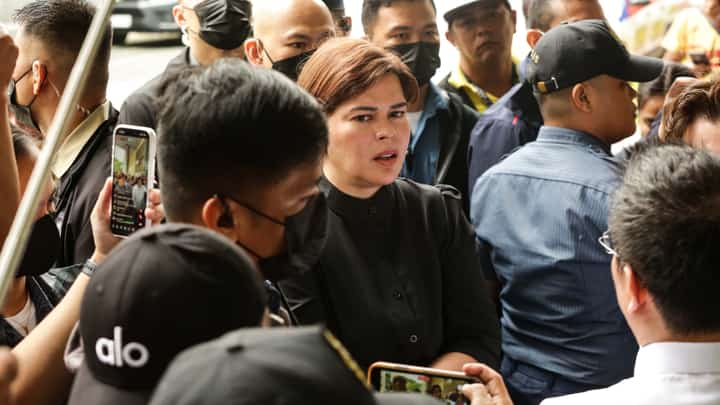
Vice President Sara Duterte arrived at the Quezon City Hall of Justice with her counsel following the issuance of a warrant of arrest against her on Saturday, 5 September 2026, over three counts of grave threats involving the First Family and former House Speaker Martin Romualdez.
Photo by Analy Labor for DAILY TRIBUNE
Vice President Sara Duterte must approach local authorities and provide evidence regarding the alleged threats she is facing so they can investigate and address the matter, a lawmaker said.
House trial spokesperson Rep. Zia Alonto Adiong urged Duterte to submit documents and evidence concerning the alleged dangers she and her family are facing to law enforcement agencies.
He noted that doing so was particularly important amid ongoing investigations and the issuance of an arrest warrant against Duterte over her alleged threatening statements, saying her claims could be substantiated through proper evidence.
“If she feels threatened, she could have at least reach out and tell and give the NBI or the police something to work on. Just to prove she feels threatened, so her side could be heard as well,” Adiong said in an interview with a radio program.
The threats referred to by Adiong stemmed from Duterte's own statements when she appeared before the Quezon City Regional Trial Court in connection with an arrest warrant issued against her in a case filed by the Department of Justice.
While speaking with her lawyers and members of the media, the Vice President repeatedly said she did not “feel safe” and feared she would be “killed” if she were imprisoned.
“I do not feel safe, I really do not feel safe. I don’t trust the court, I don’t trust the police,” Duterte said.
“Who will answer for it if I die later tonight? Who will be held accountable?” she added.
Despite her concerns, the court granted provisional liberty to Duterte after she posted bail. Courts remain open on Saturdays for urgent matters, including the posting of bail.
Her bail was set at P360,000, or P120,000 for each of the three counts of grave threats.
In a statement on her social media account following the court proceedings, Duterte said her decision to post bail was based on the advice of her lawyers, who told her she would be better protected by her security detail than in a detention facility.
She also said she had been experiencing threats to her life since 2023 and had distanced herself from her family to keep them safe.
“Since 2023 there has been continued pressure and harassment from the government. I do not feel that my mother and children are safe if I stay with them, and I am very worried for there safety and wellness,” her post read.
Adiong, for his part, said he was not taking Duterte's comments “lightly,” arguing that anyone who claims to be threatened has the right to seek help.
The only thing he was asking from the Vice President, however, was for her to provide evidence so that a proper investigation could begin.
Given the lack of evidence presented so far, Adiong said he found the situation “ironic,” particularly because Duterte was accusing the same institutions tasked with protecting her of being involved in the alleged threats against her.
“So it seems in all aspects, whatever ways you want to interpret that particular situation when she arrived at the Quezon City trial, Quezon City court, is all irony,” he said.
“She’s saying that she’s not safe when in fact and does not trust the police and the authorities when in fact…these are the very institutions that provide her security.”
Adiong further noted that the National Bureau of Investigation had reached out to Duterte in 2024, around the time she was investigated over her threats against the President, the First Lady and then-House Speaker Martin Romualdez, seeking details about the alleged threats against her.
Despite the agency's previous initiative, the Lanao del Sur representative said Duterte has yet to communicate with the NBI regarding the matter.