
Aetas draw line on Pax Silica

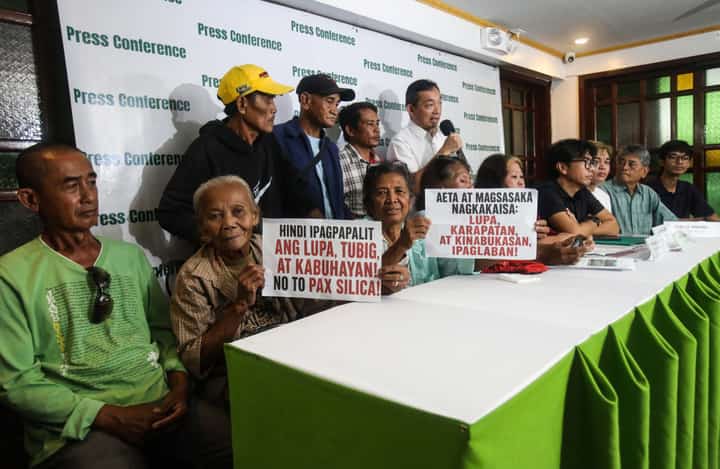
INDIGENOUS Aeta leaders and farmers from Capas, Tarlac speak during a press conference with petitioners and environmental advocates at Kamuning Bakery Cafe in Quezon City on Thursday, 6 August 2026. They are calling for the cancellation of the controversial Pax Silica project, citing its alleged impact on indigenous communities, farmlands and the environment.
ANALY LABOR
For Aeta chieftain Petronila Capiz-Muñoz, the fight over their ancestral land is not new.
It began years ago, when bulldozers moved up the mountains of Tarlac and into their community refused to leave. Now, with the planned establishment of the United States-led Pax Silica project in New Clark City, she fears the struggle may be starting all over again.
Progressive groups, civil society organizations, advocates and members of the Aeta community on Monday launched the “No to Pax Silica” campaign, forming a multi-sectoral network opposed to the project.
“We gather for an important purpose — to formally launch the broad alliance of a multi-sectoral people’s network to oppose Pax Silica,” Rev. Callum Tabada of the National Council of Churches in the Philippines said.
‘Our land is our life’
Muñoz, chieftain of the Sapang Kawayan community, recalled how Aeta families were given seven days in 2019 to leave their ancestral lands as development work linked to Green City and New Clark City proceeded.
The community resisted, putting up barricades that remained for months. Even during the Covid-19 pandemic, Muñoz said, they continued to oppose what they described as the destruction of their mountains.
She said, however, that eventually parts of their ancestral domain were transformed into a golf course, while natural caves were destroyed to make way for resorts and hotels.
Now, she said, the community has again been told to leave — this time by December — without being clearly informed about the project planned for their area.
“We only found out through social media that Pax Silica would be built in New Clark City,” Muñoz said.
For the Aeta leader, the issue goes beyond another development project.
“Our ancestral domain is our life,” she said, warning that losing the land would threaten the community’s livelihood and its future generations.
“We will all disappear. What will happen to our descendants?” she said.
Muñoz appealed for the project to be stopped, saying its impact would extend beyond indigenous communities to farmers and other local residents.
Beyond economics
The campaign launch also featured discussions on the broader implications of Pax Silica.
Dr. Giovanni Tapang, chair emeritus of AGHAM Advocates for Science and Technology for the People and former dean of the University of the Philippines College of Science, said the project should be viewed against the backdrop of the US-China competition over critical minerals and advanced technology.
He said the initiative could involve the extraction and processing of minerals needed for artificial intelligence chips, as well as data centers and other infrastructure.
Tapang also raised concerns over the project’s potential demand for water and electricity, citing a proposed water collection facility capable of supplying 60 million to 90 million liters per day. He also pointed to concerns over rare earth minerals, including thorium, and waste management.
Bagong Alyansang Makabayan chairperson Teddy Casiño said Pax Silica should not be viewed solely as an economic opportunity.
“The industrialization of the Philippines should be for the Philippines. The sovereignty of the Philippines should remain with Filipinos, and the future of the Philippines should be decided by us Filipinos,” Casiño said.
Miss Universe Philippines Bea Windorski also voiced opposition, citing reports that 92 farmers in Barangay O’Donnell, Capas, Tarlac, had been urged to leave land they had cultivated for generations. She also cited reports that around 500 families in Barangay Sta. Lucia could face displacement.
“We must resolutely reject Pax Silica and instead work hand-in-hand for a future where the Philippines is for the Filipinos,” Windorski said.
For Muñoz and the Aeta community, however, the message is simpler: development should not come at the cost of the land they call home.