
Can AI untangle decades of Phl law?
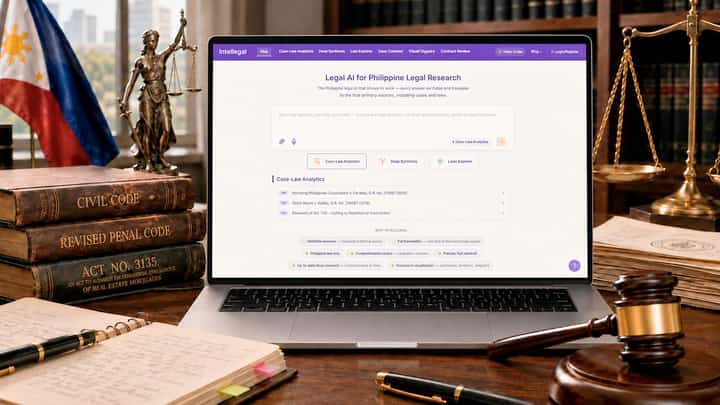
INTELLEGAL was tested against 82 years and 110 Supreme Court decisions to see whether Philippine legal AI can trace doctrine, exceptions and evidence back to verifiable sources.
Photograph courtesy of Intellegal
Fluent AI prose is no longer impressive. For lawyers, the real test is whether AI can find controlling cases, distinguish rules from exceptions and let counsel verify its work.
Philippine legal AI platform Intellegal was put to that test.
It was asked to determine the requirements for a writ of possession following an extrajudicial foreclosure under Act No. 3135 and when a third-party occupant could resist it.
The result drew from statutes, procedural authorities, court issuances and 110 Supreme Court decisions from 1941 to 2023, organizing them around the facts that could change the legal outcome.
The foreclosure test
The first issue was timing. During the redemption period, Section 7 of Act No. 3135 requires a sworn ex parte application before the proper court and a bond equivalent to 12 months’ use of the property.
Once the redemption period expires without redemption and ownership is consolidated, a bond is generally no longer required. Issuance of the writ becomes ministerial upon proper application and proof of title.
But another question complicates matters: Who occupies the property, and under what right?
A mortgagor, agent or successor whose claim derives from the mortgagor generally cannot defeat the summary process simply by challenging the foreclosure.
A genuine third party claiming an independent right stands differently. The court may need to receive evidence, and the purchaser could be required to pursue an ordinary action for possession.
For litigators, that distinction matters: rule, exception, burden and remedy, rather than an eloquent version of “it depends.”
AI that shows its work
Intellegal approaches the problem through three tools.
Visual Digest breaks lengthy decisions into timelines, arguments, legal concepts and relationships, helping lawyers quickly determine whether a case deserves closer reading.
Citation Map traces the cases, statutes and legal principles behind a decision, keeping propositions connected to their underlying authorities.
Deep Synthesis tackles broader questions by breaking them into research issues, searching Philippine legal sources and producing an IRAC-structured report with citations checked against retrieved sources.
In the foreclosure test, it also translated doctrine into an evidence plan.
A purchaser would need records of the sale, proof of notice and publication, title documents and evidence connecting the occupant to the mortgagor.
An occupant claiming an independent right would need evidence such as a separate chain of title, contracts, proof of possession, tax records, receipts or barangay certifications.
110 cases, not a crystal ball
Intellegal retrieved 110 Supreme Court decisions covering 82 years. Of these, 22 were tagged granted, four partly granted, 75 denied and nine as other or non-merits outcomes.
But those numbers are not predictive analytics.
A “denied” petition does not necessarily show who ultimately prevailed in the underlying property dispute, and a collection of cases cannot forecast the next ruling.
Instead, the data helps lawyers see the shape of jurisprudence, identify clusters and decide where deeper reading should begin.
The lawyer still decide
That is ultimately where legal AI meets its limit.
Philippine legal research requires navigating statutes, rules, circulars and decades of decisions that refine or qualify what came before.
AI can shorten that path. It cannot determine whether a witness is credible, authenticate a deed or discover a fact nobody supplied.
Those judgments remain with counsel. Fluent answers are cheap. A research trail that survives inspection is not.