
Ibay’s law: Show your face, Manila
The frustrations he carried as a law enforcer became the agenda he now pursues as a legislator.

All bases covered Manila City Councilor Rosalino Ibay Jr. authored the ‘Balaclava’ Law, which he said respects civil rights while restricting full-face covers following the spate of violence in the capital perpetrated by hooded and masked individuals.
Photographs by Justin Fabian for DAILY TRIBUNE
In Tondo, they still call him “Junyor,” the district where he was born, and the district he now represents in the Manila City Council. Rosalino Ibay Jr. joined the police service at 22. His baptism of fire came early: An armed encounter that earned him his first meritorious promotion and marked the start of a 28-year career that took him through some of Manila’s toughest assignments, including a stint as head of the mayor’s Special Mayor’s Reaction Team (SMART).
He retired from the Manila Police District with rank still ahead of him, choosing to close that chapter early. Public service, it turned out, was not finished with him. In 2025, Manila Mayor Isko Moreno picked him for his six-member council slate — “Yorme’s Choice” — and Ibay won a seat representing District 1.
The frustrations he carried as a law enforcer became the agenda he now pursues as a legislator.
“Our good mayor really has a program for the city of Manila, to make Manila great again, so we in the council support his programs,” Ibay said, explaining the philosophy behind his ordinances. He was named to chair the council’s peace and order committee — public safety — a portfolio that fits naturally with 28 years on the beat.
‘Balaclava’ Law
Ibay’s most talked-about measure is Manila City Ordinance 9134, the anti-face-concealment ordinance — what he and most residents call the “Balaclava law.” He is emphatic that it was never aimed at protesters or rallyists.
“The word balaclava is the ninja suit — where you really cover the face so people can’t recognize you,” Ibay said. “So what I did was to prevent crime. Face concealment isn’t for [ordinary people] — it’s for criminals who want to harm the city of Manila.”
The ordinance targets the everyday disguises of Manila street crime: riders committing hold-ups “in tandem,” jewelry-store robbers, and contract killers. It exempts motorcycle riders wearing helmets, Muslim residents wearing religious coverings, and anyone required to show their face when entering banks, malls, or hospitals. Enforcement, Ibay said, is not about instant arrest.
“You need to call the attention of an enforcer about the covering of the face,” he said. “If they don’t comply upon entering, they won’t be arrested outright. If someone says they’re sick or coughing, we won’t be harsh about it. The ordinance was just given the wrong interpretation.”
He traces the ordinance’s urgency to the unrest of 21 September, when face coverings hampered police efforts at crowd control, and, he said, some protesters were later found to have no link to the groups they claimed to represent. “We respect freedom of expression,” Ibay said. “Just don’t do things that are not morally acceptable. Sometimes the law is abused, sometimes rights are abused — that’s how the balaclava issue came about.”
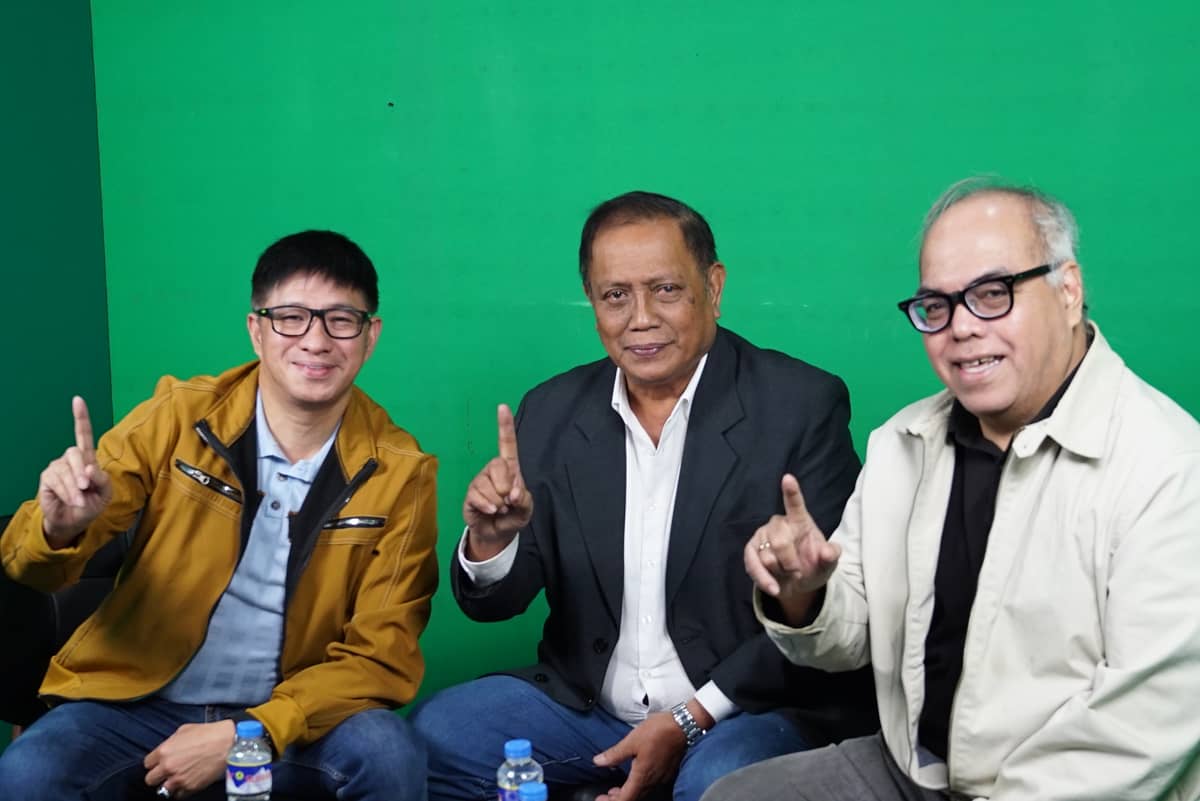
Public safety topnotcher Discouraging criminal intent and making Manila the number one in public safety in the region is one of the aims of the Barangay CCTV Ordinance of 2025, requiring each of Manila’s 896 barangays to install and maintain at least 10 working CCTV units, Councilor Jhun Ibay (left) indicated to hosts Pat Santos (center) and Chito Lozada.
Eyes on every barangay
Ibay followed the Balaclava Law with City Ordinance 9152, the Barangay CCTV Ordinance of 2025, requiring each of Manila’s 896 barangays to install and maintain at least 10 working CCTV units.
“It’s not just about installing cameras on the main streets,” Ibay said. “Those units must be operational, not just for display.” Under the ordinance, officers from the covering police station must periodically inspect the units and report their status to the city government; barangay chairpersons whose cameras are found defective face administrative sanctions — suspension of up to six months for repeat violations.
“While the children of Manila sleep, eyes are watching, so there is no place to commit crime in our city, and criminals will surely be caught — the mayor always says that in his broadcasts,” Ibay said, describing the surveillance program as the natural complement to the Balaclava Law: unmask the face, and the cameras do the rest.
He is now pushing a third phase, facial recognition for malls and banks, still on second reading, while barangay-level recognition remains held back by the data-privacy requirements of assigning a data protection officer to every barangay. Mall shoplifting and other petty theft, he noted, remain among the most common crimes recorded in the city.
Other measures
Ibay also authored City Ordinance 9204, giving emergency vehicles right of way — with penalties starting at P3,000 — for motorists and vendors who obstruct ambulances, fire trucks, and police vehicles, closing a gap he said national law under Republic Act 4136 does not adequately cover for non-moving obstructions like street vendors.
He is likewise revising Manila’s public drinking ordinance, raising the fine from P200 — “which people just laughed at” — to P2,000, alongside new curfew and permit requirements for street celebrations after 10 p.m.
Beyond law and order, Ibay lists a slate of welfare initiatives for District 1: wheelchair donations for sick and elderly constituents, free WiFi in barangays, free transportation for stranded commuters during the rainy season, the Tondo–Moriones one-way traffic loop, a siomai food-cart livelihood program, and a zero-cost solar project for qualified beneficiaries — all programs he intends to continue.
From the beat, now Council floor
Ibay was named one of Metrobank Foundation’s outstanding police officers in 2017, credited in part for pioneering a barangay-level identification and management system in Tondo that he says predated later proposals for a national ID system. “Whatever I’ve achieved also came from my own people,” he said. “You can’t do it alone.”
Asked about his political future — 2028 and beyond — Ibay was unambiguous: no higher ambitions, no shift to a national post. “I just want to remain a councilor, because there are still many ordinances to be made for the city of Manila, particularly for District 1,” he said. “As the population grows, we need laws that keep up with the times.”
His closing message to Tondo was brief. “Thank you for the trust you gave me to serve again,” he said. “Some people used to think I was too strict. Well — I’m still strict about making laws.”