
El Niño turning up the heat
WMO’s outlook shows that through October, nearly every land area on Earth is expected to be hotter than normal.

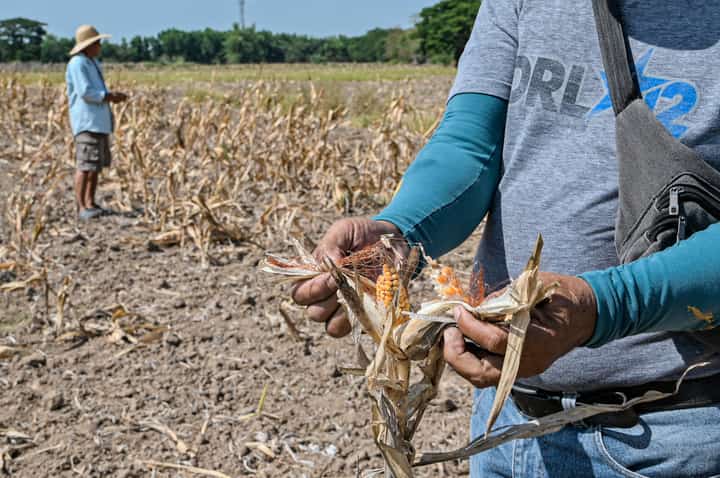
Crop losses The El Niño dry spell lays to waste an entire corn harvest recently in San Antonio, Nueva Ecija. Agricultural losses have amounted to billions of pesos, according to the Department of Agriculture.
JAM STA ROSA/AGENCE FRANCE-PRESSE
New forecasts released today by the World Meteorological Organization (WMO) provide a stark picture of the period from August through October. El Niño is strengthening — adding fuel to a planet already on fire. The Pacific waters driving it have never been this warm this early in an El Niño — and temperatures are still rising.
Today’s latest news indicates sea-surface temperatures in key monitoring regions to average nearly 3 degrees Celsius above normal. At the same time, WMO’s outlook shows that through October, nearly every land area on Earth is expected to be hotter than normal. Taken together, that risks shattering every seasonal record — and driving even more severe effects worldwide.
We are in uncharted territory. And El Niño does not bring heat alone — it profoundly affects the world’s rainfall. India’s monsoon is already running well below average. Forecasts point to worse ahead for a subcontinent where more than a billion people depend on the monsoon. Hotter and drier conditions are forecast from Central America and the Caribbean to parts of South America, South Asia, the Southwest Pacific, Europe and Africa.
The verdict is clear: the climate crisis is in overdrive. Extreme heat has long been called the silent killer. Yet even that description may understate the crisis, because heat deaths are vastly undercounted around the world. Many fatalities linked to extreme heat are never recorded as such, even when heat plays a decisive role. What we do know is deeply alarming: heat is claiming lives on a growing scale, day after day, in every region of the world. It is also putting an enormous share of the global workforce at risk, exposing billions of people to dangers and often life-threatening conditions.
Two years ago this month, I launched a Call to Action on Extreme Heat. Since then, we have helped more governments improve forecasts and early warnings. More cities have adopted Heat Action Plans — and over 250 have joined the Beat the Heat initiative. These measures are saving lives. But the planet is heating faster than our response. We need far more action on four fronts.
First, protecting people before heat becomes deadlier.
Every city and country should have heat-health action plans, early warning systems and public health measures that reach every community in time. And access to sustainable cooling must expand — urgently and equitably. Extreme heat is a society-wide threat — and demands a government-wide response.
Second, make work safer.
Take the garment industry: more than 90 million workers, most of them women. In 17 of its 23 biggest production hubs, dangerously hot days have jumped by more than 10 percent in two decades. Yet most global brands set no heat standard for the factories that supply them. Governments and employers must set heat standards, adjust working hours, and protect incomes when work must stop. No one should have to risk their life to earn a living.
Third, build and retrofit for the heat that is coming.
Protection from extreme heat must be designed into our cities, homes, schools and hospitals, and factored into every plan and public budget.
Fourth, and fundamentally, the world must stop fueling the crisis.
We hear much about record heat, drought, and wildfires — but not enough about the real change that is driving these events — the accelerating climate crisis powered by fossil fuels. Every new fossil fuel project approved today makes tomorrow’s heatwaves more dangerous, and our world less secure. Yet some governments still plan to produce more than twice as much fossil fuel in 2030 as the 1.5-degree limit allows. And fossil fuels still enjoy trillions of dollars a year in subsidies and underpricing.
We are spending too much public money fueling the crisis — and too little protecting the people from it. More coal, oil and gas will lead to a more combustible future.
Today’s findings show that extreme heat is not a future threat. It is here. It is becoming more dangerous. And unless we act — to protect people and tackle the root cause of the crisis — it will become deadlier still.
The warm-up act is over. We cannot afford to wait for the main event.
(Excerpts of UN Secretary-General Antonio Guterres’ press encounter on his recent travels, the Middle East and Climate Change Press events in New York on 31 July 2026.)