
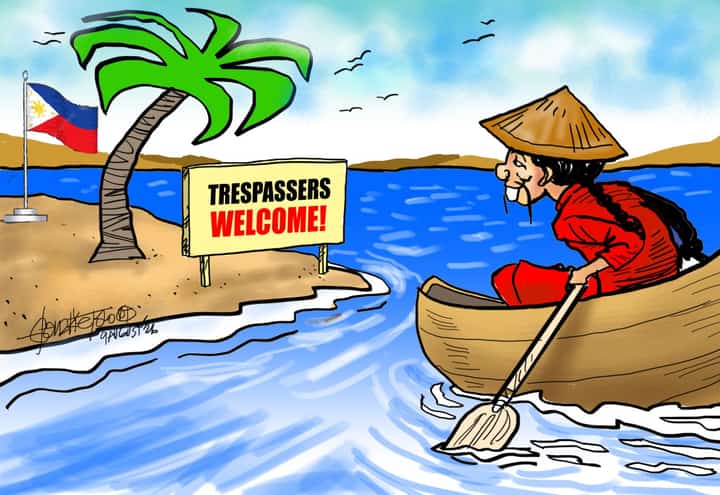
Seeking trespasser’s okay to enter our own house
It makes no sense for the Philippines to negotiate with China over terms that would allow the Philippines to enter its own waters.

Eight years ago, the Permanent Court of Arbitration handed the Philippines the cleanest legal victory any small state has ever won against a great power.
The tribunal shredded China’s nine-dash line, declared that it had no basis in international law, and placed Ayungin Shoal within the Philippines’ exclusive economic zone.
Ayungin Shoal was where the Philippines had intentionally grounded the World War II-era ship, BRP Sierra Madre, to serve as a military outpost and assert the nation’s sovereignty.
The arbitral award to the Philippines was supported by 44 nations, which affirmed that the award did not need China’s blessing to be final.
And yet, two years after a Chinese ship rammed a Philippine boat and cost a sailor his finger, the Philippines’ Department of Foreign Affairs quietly struck a “provisional understanding” with the very power that lost the arbitral case — and that country is now watching the DFA and the National Maritime Council scramble to explain what the arrangement actually means, because China tells a story different from the Philippine government’s.
That right there is the tell. An agreement so supposedly harmless that it doesn’t infringe on our sovereignty should not require the DFA to hold press conferences to insist that it did not issue a permission slip.
It should not need a National Maritime Council statement rejecting the Chinese ambassador’s version of events, or a Senate resolution demanding an inquiry into whether the deal squares with the 2016 award.
When both sides walk away from the same handshake with irreconcilable accounts of what was agreed on, the ambiguity is not an accident. It is the arrangement working exactly as Beijing designed it: vague enough to be reinterpreted at the exact moment China wants leverage over a resupply mission to the BRP Sierra Madre.
The DFA’s defense is that Ayungin generates no maritime entitlement for anyone else, that Philippine vessels never needed anyone’s go-ahead to sail there, and that nothing in the understanding cedes our sovereignty. All true, as a matter of law.
But law and leverage are different things. Under the 2016 award the Philippines does not have to explain itself to Beijing whenever its own navy sails within its own economic zone.
China’s monitoring of Philippine boats “from a distance,” checking their waterline to gauge if the resupply boats are carrying construction materials, tallying the number of missions Manila is “allowed” without incident — all of this reintroduces exactly the asymmetry the tribunal erased.
Former Supreme Court Associate Justice Antonio Carpio, a primary authority on the 2016 PCA ruling and a vigorous defender of Philippine sovereign rights who helped shape the legal framework that challenged China’s maritime claims over Philippine waters, has called the provisional understanding “dumber than dumb.”
He said it makes no sense for the Philippines to negotiate with China over terms that would allow the Philippines to enter its own waters — as if China was the one with the legitimate claim to police them.
Simply put, one doesn’t ask a trespasser for permission to walk through one’s own front door.
What should the DFA do now? First, stop treating “provisional” as a synonym for indefinite. The understanding was born of a 2024 crisis; it has outlived that crisis by two years and thirteen resupply runs.
Manila should set an established expiration date, tied to the next serious incident-free milestone, and use it to force a renegotiation on paper — not another verbal nod in Xiamen.
Second, the DFA needs to publish the actual terms, not paraphrase them in statements to media after China contradicts us. An unpublished understanding cannot be defended; it can only be re-explained, badly, forever.
Third, Malacañang should have the Senate open a full inquiry and use its findings to formalize, in writing, that no Chinese monitoring, inspection, or notification requirement of any kind attaches to rotate and resupply missions to the BRP Sierra Madre — full stop — not “no requirement to seek permission” hedged around a monitoring presence China insists is real.
The Philippines did not win its hard-earned victory over a superpower at the PCA so that eight years later its foreign policy establishment would treat “we don’t need China’s permission” as a talking point rather than a settled fact.
Every minute this understanding stays unwritten and undefined is time that Beijing gets to keep testing how much of that 2016 victory it can quietly claw back down the waterline.