
Defense stands by objections
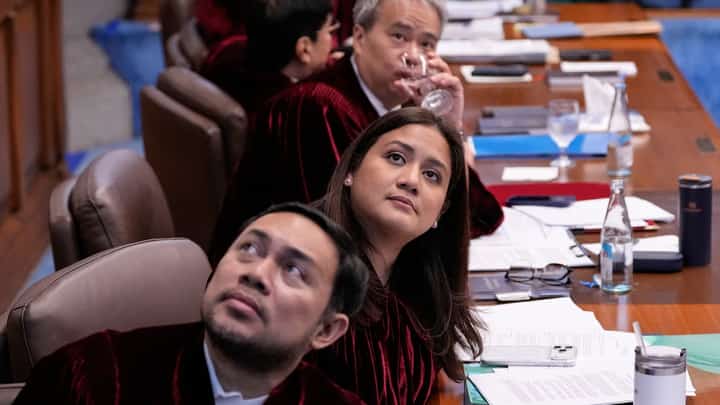
SENATORS Mark Villar, Camille Villar and Joel Villanueva closely examine documentary evidence presented during the impeachment trial of Vice President Sara Duterte at the Senate in Pasay City on Tuesday as the historic proceedings entered another crucial day with prosecutors laying out key evidence before the impeachment court.
AGENCE FRANCE-PRESSE
The defense team of Vice President Sara Duterte on Tuesday defended its string of courtroom objections during the second day of her impeachment trial, saying the interruptions were part of a deliberate legal strategy to protect the Vice President’s rights and preserve issues for the record.
The explanation came after defense counsel Carlo Joaquin Narvasa repeatedly objected to questions from House prosecutors as they presented testimony from National Bureau of Investigation (NBI) senior agent John Mark Calilung, the government’s digital forensics expert tasked with authenticating electronic evidence, including records obtained from Meta Platforms Inc.
Narvasa’s repeated “Objection, Your Honor” became one of the day’s most talked-about moments, with clips of the proceedings quickly circulating on social media and spawning memes comparing the hearing to a courtroom television drama.
Defense spokesperson Michael Poa said many of the reactions stemmed from a misunderstanding of courtroom procedure.
“For example, during direct examination, a lawyer generally cannot ask leading questions — those that can be answered with a simple ‘yes’ or ‘no’ and already suggest the answer,” Poa told reporters after the hearing.
“It’s as if the lawyer is answering the question, giving the testimony, and then merely asking the witness to confirm it,” he explained.
Under the Rules of Court, leading questions are generally prohibited during direct examination because the witness — not the lawyer — is expected to provide the testimony.
Poa stressed that the defense was not objecting merely to disrupt the proceedings but to ensure that any legal issues were properly raised.
“Even if our objections are overruled, that’s fine. What’s important is that our position is placed on the record,” he said.
He added that the defense also sought to challenge the admissibility and authenticity of documentary and electronic evidence presented by the prosecution.
Earlier in the day, the defense unsuccessfully moved to bar Calilung from testifying, arguing that he had not been identified in the original impeachment complaints. Presiding Officer Francis “Chiz” Escudero denied the motion, ruling that witnesses identified during pretrial may testify.
Poa also rejected suggestions that the day’s proceedings should be viewed as victories or defeats for either side.
“When it comes to the defense, we don’t really count wins or losses,” he said.
“We’re only on our first witness and the second day of trial. It’s far too early to look at it that way.”
Instead, he said, the defense’s focus remains on building a complete legal record that could become relevant later in the impeachment proceedings or in any subsequent judicial review.
Asked about possible future motions from the prosecution, Poa declined to speculate.
“There’s room to argue on different issues,” he said. “Once the prosecution files its motion, we will definitely present our position.”
The Senate impeachment court is set to resume hearings as House prosecutors continue presenting evidence in support of the Articles of Impeachment against Duterte, while the defense is expected to maintain its procedural challenges throughout the trial.