
NATION, WOVEN
From malong to inaul, Filipinos showed Cairo a country that still knows how to weave itself together.

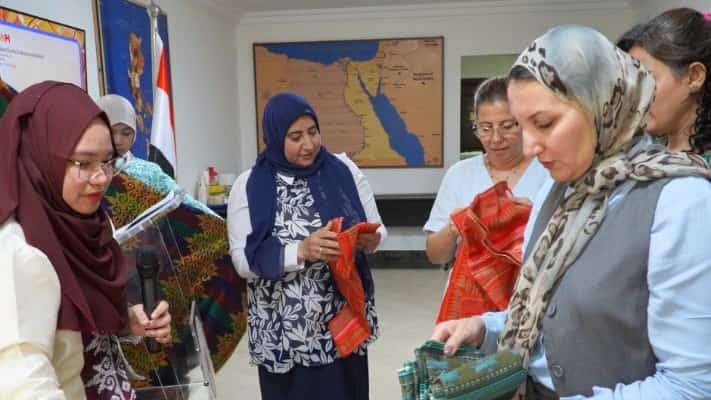
The Philippine Embassy hosted "Philippine Textile: A Representation of Woven Diverse Filipino Stories, Traditions, and Identities" on 16 June in celebration of the recently concluded National Heritage Month.
Following this year's theme, "Roots and Horizons: Our Shared Heritage, Our Collective Future," the event showcased the artistry, resilience and cultural significance of Philippine textiles as living testaments of history, traditions, and collective identity.
Guests were welcomed at the Sentro Rizal Library with an exhibit walk-through featuring woven textiles from Luzon, Visayas and Mindanao, complemented by a video presentation courtesy of the Lanao Tourism and Information Office, entitled "Kapmalongmalong."
-The program opened with remarks from Ambassador Charmaine Rowena Aviquivil who highlighted Philippine textiles as powerful symbols of the nation’s diverse traditions and identities.
She emphasized that each weave reflects the history, struggles, and resilience of Filipino communities, underscoring the importance of honoring cultural heritage while carrying it forward for future generations.
Ambassador Aviquivil also expressed gratitude to local partner institutions and encouraged collaboration to promote Philippine culture and heritage in Egypt.
Bryan Fernandez, third secretary and vice consul, followed with his lecture, "Law and Legacy: Strengthening Preservation of Philippine Heritage," stressing the need to safeguard cultural sites, traditions, arts and monuments.
He underscored the role of laws such as the National Cultural Heritage Act, the Indigenous Peoples' Rights Act, and the National Museum Act in protecting heritage, while addressing challenges like urbanization, illegal trafficking, and limited awareness.
His message called for stronger education, community participation, enforcement, and restoration efforts to ensure that cultural treasures are preserved for generations to come.
A highlight of the event was the presentation and hands-on demonstration of traditional costumes from Luzon, Visayas and Mindanao.
Crystal Ann Dunuan, second secretary and consul, gave a brief overview of Philippine textiles including how they are made and the popular materials used.
She let the guests experience and touch sample textiles. She also asked members of the audience to try on traditional skirts from Northern Luzon (Ifugao and Kalinga).
Meanwhile, Sohaila Amerol-Alonto, cultural officer, assisted by Ms. Ahlam Abdulkadir, showcased Mindanao textiles, particularly, the Maranao Landap, Maguindanao Inaul, and Tausug Habul Tiyahian.
Guests also experienced the practical uses of the malong, from everyday clothing and storage to ceremonial attire and dance.
The event was attended by representatives from Cairo museums such as the National Museum of Egyptian Civilization and the Coptic Museum, representatives from British and Al-Azhar Universities, student representatives from the Philippine Students Association, and members of the Filipino community.
The program concluded with Filipino delicacies, including halo-halo, Spanish bread, pandesal, and pansit bihon, provided by Tinapay Restaurant, a well-known Filipino establishment in Cairo.
The celebration not only honored Philippine textiles as vibrant cultural emblems but also strengthened international collaboration in heritage promotion.