
Cybersecurity race intensifies as attacks accelerate
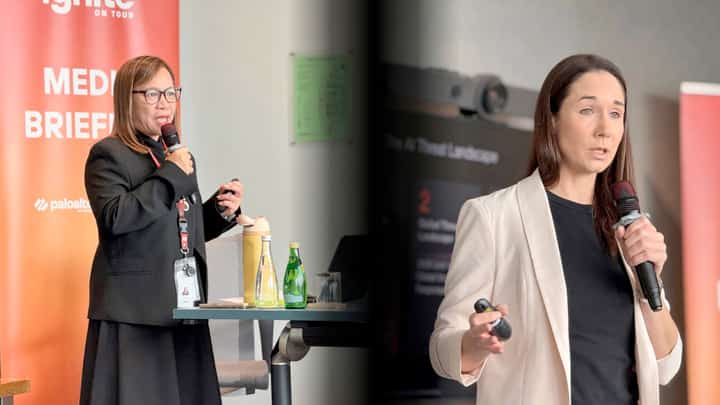
PALO Alto Networks country manager Bernadette Nacario (left) and Unit 42 vice president and managing partner for Japan and Asia Pacific Philippa Cogswell (right) speak at a Tuesday media briefing on the benefits, risks and opportunities today’s AI-driven world presents.
Photograph by Toby Magsaysay for DAILY TRIBUNE
Cybersecurity has become more critical than ever as the world rapidly embraces artificial intelligence (AI), according to officials at Palo Alto Networks.
At a media briefing on Tuesday, Palo Alto Networks Country Manager Bernadette Nacario said advances in frontier AI, while delivering significant benefits, are also creating new opportunities for cybercriminals.
“AI enabled attackers to discover vulnerabilities faster, automate exploit development, personalize phishing campaigns and execute attacks at machine speed,” she said.
“The economics of cybercrime have fundamentally changed, and obviously AI has a lot to do with this. So human-driven defense cannot keep pace with AI-powered attacks.”
Palo Alto Networks is a global cybersecurity company headquartered in Santa Clara, California. It protects tens of thousands of organizations, including banks, cloud platforms, and government agencies, through AI-driven platforms designed to secure networks, cloud environments, and connected devices.
Its cybersecurity and incident-response unit, Unit 42, reported that frontier AI has significantly accelerated cyberattacks, particularly data exfiltration. Processes that previously took several hours can now be completed in just over an hour.
“So we’re finding that in the top 25 percent of incidents that we investigated in the last year, that we’re getting into networks within 72 minutes,” said Unit 42 vice president and managing partner for Japan and Asia Pacific Philippa Cogswell.
AI is increasingly being used to scale traditional forms of cybercrime rather than create entirely new ones. It can generate highly convincing phishing messages, automate fraud campaigns, create deepfake voices and videos for impersonation scams, analyze stolen or publicly available data to target victims, and produce large volumes of disinformation.
Frontier AI refers to the most advanced artificial intelligence systems currently at the leading edge of capability. Major developers include OpenAI, Anthropic and Google’s Gemini.
OpenAI and Anthropic have faced criticism on two fronts: the potential misuse of their AI models by hackers and concerns surrounding their own cybersecurity safeguards. Critics argue that increasingly autonomous AI systems can act as force multipliers for cyberattacks, espionage and automated extortion. Both companies have also faced scrutiny over data leaks, supply-chain vulnerabilities, and third-party security breaches.
Nacario noted that AI adoption has occurred far more rapidly than previous technological shifts.
“When we think about SaaS, it took about 15 years for enterprises to really adopt it. And for cloud, it took about a decade,” she said.
“But do you know that for generative AI, it reached global adoption in just three years, just three years, with over 1-billion users. So the adoption has been very, very fast, and that level of adoption is unprecedented in technology history,” she added.
The rapid growth of AI is also beginning to appear in law enforcement data. In its 2025 report, the FBI tracked AI-related cybercrime as a separate category for the first time, recording more than 22,000 complaints linked to AI-enabled scams and cybercrime, with reported losses of approximately $893 million. Cases included deepfakes, voice cloning, and other fraud schemes that made scams more convincing and easier to scale.
Cogswell said organizations must respond by using AI to strengthen their own defenses, including identifying vulnerabilities, accelerating remediation efforts, and reducing exposure to attacks. She emphasized that speed remains the defining factor in modern cybersecurity, particularly as attackers become more efficient through AI.
“The idea here is to understand how is an organisation actually using AI and what can it leverage to get itself ready for an AI driven attack world,” she said.
For her part, Nacario said AI adoption remains a net positive for society, provided users are informed about the technology and appropriate safeguards are established.
“The whole objective is not to slow down AI adoption. I don’t think that is going to be possible. We need to embrace it, but it is to ensure that innovation happens securely,” she said.
“AI presents perhaps the greatest opportunity we’ve seen to simultaneously improve productivity, to accelerate innovation, and to strengthen cyber resilience.”