
EU kicks off membership negotiations with Ukraine
‘This is a long process. Ukraine is at war. It has organized crime issues to solve. It would be the third biggest country in the EU.’
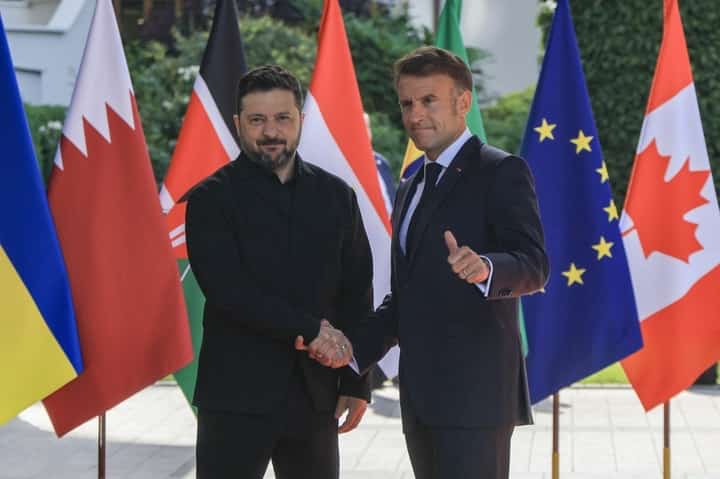
FRANCE'S President Emmanuel Macron greets Ukraine’s President Volodymyr Zelensky ahead of the working session with G7 leaders and Ukraine during the G7 summit, in Evian, eastern France.
LUDOVIC MARIN/AGENCE FRANCE-PRESSE
Brussels (AFP) — The European Union (EU) on Monday moved Ukraine’s bid to join onto the next stage after a long delay — but Kyiv still has a long and tricky path ahead to becoming a full member.
Foreign ministers from the 27-nation bloc formally kicked off negotiations with Ukraine and neighboring Moldova on aligning with a first “cluster” of EU laws.
Ukraine was stuck for some two years as Hungary’s nationalist leader Viktor Orban vetoed all progress, but his election defeat by rival Peter Magyar in April opened up the way.
“We have all waited for this day a long time and today is a day to celebrate,” said EU enlargement commissioner Marta Kos at a gathering in Luxembourg.
“While Ukraine is gaining momentum on the battlefield, it is also building its path towards a prosperous and secure Ukraine inside the European Union.”
Ukrainian deputy prime minister for European integration Taras Kachka called the moment a “rubicon, a milestone” for his country.
But despite the fanfare — and Kyiv’s pleas for quick progress four years after it applied for membership in the wake of Russia’s invasion — that doesn’t mean the war-torn country is going to join the bloc any time soon.
In purely practical terms, a mammoth workload still lies ahead to align Ukraine’s laws, institutions, and standards with the EU’s — despite major strides already made by Kyiv, even as it battles Russia.
That involves negotiating through 35 “chapters” covering everything from the environment and agriculture to justice and security — grouped into six “clusters.”
Kyiv and EU officials say they want to start talks on all the remaining areas in the coming months.
But, as ever in the EU, the question is also deeply political and there are myriad points at which any member state that wants can slam the brakes on Kyiv.
“This is a long process. Ukraine is at war. It has organized crime issues to solve. It would be the third biggest country in the EU,” a European diplomat told AFP on condition of anonymity.
“The prospect of Ukraine enlargement happening soon never was realistic.”
Hungary’s Magyar, for one, has pledged a referendum on Kyiv joining if Ukraine completes all the negotiations “within the next 10 to 15 years.”
Beyond that, there seems to be a broader willingness to temper Kyiv’s ambitions — and growing talk of possible alternatives.
Estonian foreign minister Margus Tsahkna said that other countries reluctant on enlargement had been hiding behind Orban.
“Now Orban is gone, so quite many have come out from Orban’s shadow, and let’s see whether we have this unity about enlargement,” he said.
German Chancellor Friedrich Merz said in April that it was clear to everyone that the “immediate accession of Ukraine to the EU is, of course, not possible.”
Merz has proposed making Ukraine an “associate member” of the EU without voting rights, while Kyiv goes through the lengthy process of joining fully.
That plan has drawn skepticism from Ukraine, which fears that any suggested interim solutions will see it stranded permanently in a halfway house.
President Volodymyr Zelensky has insisted Ukraine’s accession should be “complete — with full rights.”
But there is a broader push to shake up the EU’s accession process as Ukraine, Moldova and other hopefuls knock on the door.