
The trees are infrastructure, too
The US Environmental Protection Agency notes that shaded surfaces, such as asphalt and concrete, can be 11 to 25 degrees Celsius cooler than those directly exposed to the sun.


As one walks along Metro Manila does the true value of shade reveal itself. It is felt under the canopies of UP Diliman’s Academic Oval, Quezon Memorial Circle, Ayala Triangle Gardens or Arroceros Forest Park. These places feel alive and special as these are the few remaining places where people can enjoy the outdoors comfortably. Unlike in other places in Metro Manila, the trees here provide a particular luxury that concrete alone cannot give. This is why the recent cutting of roadside trees along Quirino Avenue in Manila has struck a public nerve.
The issue should not be reduced to trees versus development. It is undeniable that Metro Manila needs better roads, airport access, logistics routes and transit systems. NAIA recorded 52.02 million passengers in 2025, its highest-ever passenger volume, which makes the need for better mobility infrastructure clear. The NAIA Expressway, for example, establishes a direct route that connects passengers to the airport and avoids the congested thoroughfares in our cities.

TREE-LINED pedestrian corridor in Iloilo City shows how shade, greenery, and walkable infrastructure can make urban streets more comfortable and humane
Photograph by Berniemac Arellano for DAILY TRIBUNE
However, trees clearly bring both economic and environmental value to our cities. The US Environmental Protection Agency notes that shaded surfaces, such as asphalt and concrete, can be 11 to 25 degrees Celsius cooler than those directly exposed to the sun. Trees also release moisture into the air, which helps lower peak temperatures by 1 to 5 degrees Celsius. The abundance of trees and other green infrastructure has been observed to reduce energy demand of nearby buildings by 10 percent.
Locally, the Climate Change Commission has noted that Arroceros Forest Park was reported to be 5 degrees Celsius cooler than the city average.
Trees also help manage flooding, too, as they intercept rainfall before it hits pavement, reduce the force of raindrops, slow runoff and help water return to the ground. A US Geological Survey study on the loss of mature street-tree canopy found that removed canopy had provided a runoff reduction capacity of 66 liters per square meter.
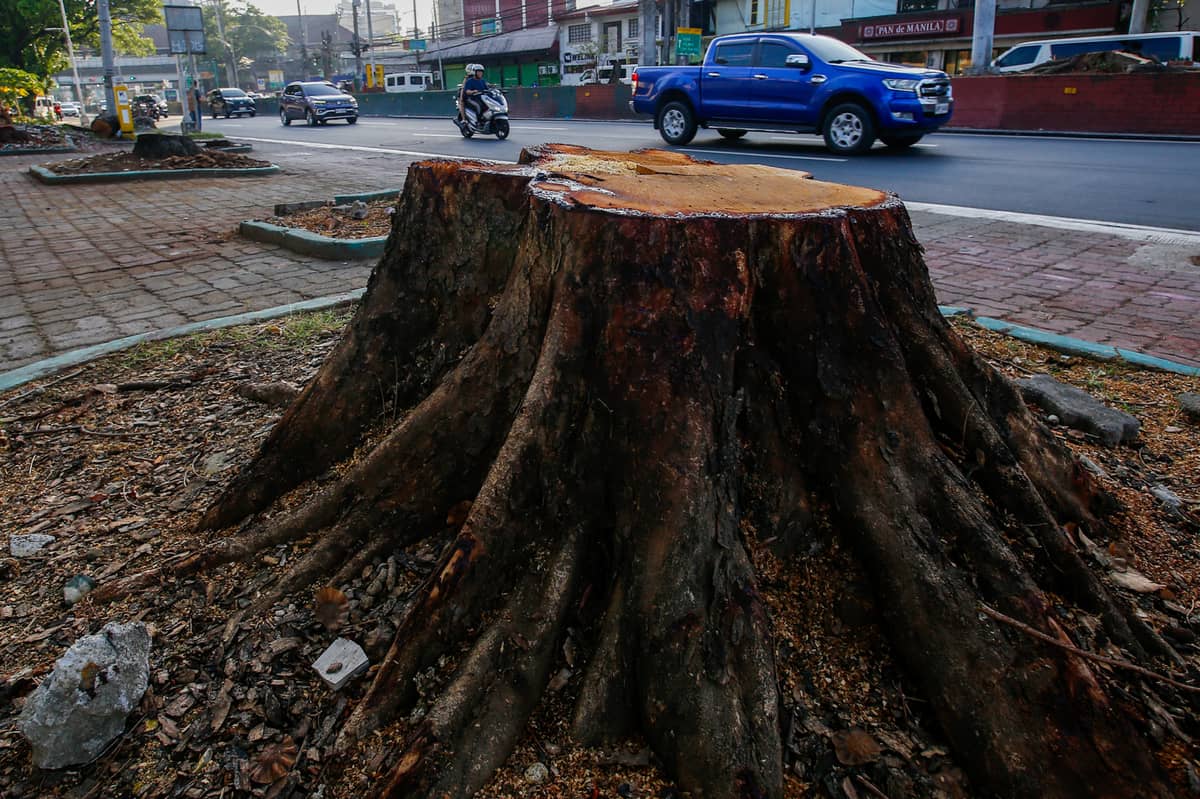
A freshly cut tree stump along Quirino Avenue captures the immediate loss of mature shade amid the push for new transport infrastructure.
Photograph by Toto Lozano for DAILY TRIBUNE
This is where the trade-off for developers and government agencies becomes more precise. Cutting a tree can simplify construction as it clears a right-of-way, allows a cleaner alignment, reduces design constraints and may lower immediate construction complexity. Designing around a mature tree can require additional surveying, root-zone protection, adjusted road sections, special drainage detailing, or changes in staging. Those measures cost time and money upfront, and it would be dishonest to pretend otherwise.
Yet cutting also carries costs as the city loses cooling, stormwater interception, shade, pedestrian comfort, ecological function and sometimes property value.
Replacement planting is important, but it is not instant equivalence. DENR Administrative Order 2018-16 already recognizes this logic by requiring infrastructure projects to consider the least number of trees to be affected, while DENR replacement standards (DMO-2012-02) requires 50 seedlings for every planted tree and 100 seedlings for every naturally growing tree removed.
Metro Manila needs roads, rail, airports, bridges and logistics corridors. It also needs shade, permeable ground, urban forests and streets that enrich the quality of our city environments. These are not opposing ambitions. The best cities will be those that learn to build mobility without stripping away livability. In Metro Manila, the trees are infrastructure, too — not instead of roads, but alongside them.