
DND shoots down sovereignty yarn
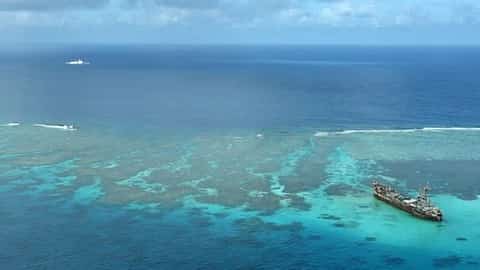
The Department of National Defense (DND) on Wednesday rejected the Chinese Ministry of National Defense’s statement that claimed “indisputable” sovereignty over Pag-asa and Lawak islands.
“Pag-asa Island and Lawak Island form part of the Kalayaan Island Group, which has long been administered by the Philippines as the Municipality of Kalayaan under the Province of Palawan,” a DND statement read.
“The legitimate exercise of Philippine authority in these areas, including the conduct of improvement and development activities, is intended to support the welfare, safety, and livelihood of Filipinos residing and working therein,” the defense department added.
The DND explained that China’s claim of “indisputable sovereignty” over nearly the entire South China Sea, including areas within the West Philippine Sea, as reflected in its so-called “nine-dash line,” has no legal basis under international law.
Award ‘final’
“The 2016 Arbitral Award, rendered under the framework of the United Nations Convention on the Law of the Sea, to which both the Philippines and China are States Parties, found no legal basis for China’s claims to historic rights within the nine-dash line. The Award remains final and legally binding on the parties,” the DND stressed.
The Department pointed out that the Tribunal likewise found that China’s large-scale land reclamation and construction activities on several features at the South China Sea caused severe harm to the marine environment and that certain Chinese actions unlawfully interfered with the Philippines’ exercise of sovereign rights within its Exclusive Economic Zone.
Continued interference with lawful Philippine activities, including in the vicinity of Bajo de Masinloc, undermines regional stability and the rules-based international order.
“The Department of National Defense remains steadfast in safeguarding Philippine territory, sovereign rights, and jurisdiction in the West Philippine Sea, in accordance with international law and in pursuit of a peaceful, stable, and rules-based maritime domain,” the DND emphasized.