
Henri Lamy: On Philippine faces, life and capoeira
He has often cited the honesty of children as one of his greatest inspirations — a kind of instinctive truthfulness which adults gradually lose over time. That same sincerity flowed through ‘Sovereign Faces,’ where each portrait revealed some inner, unabashed truths.


French figurative painter Henri Lamy has long been utterly fascinated by faces — not merely their appearances, but through the narratives, tensions, and emotions within them.
In Sovereign Faces, his latest and recently concluded exhibition at the Hulot Gallery of the Iloilo Museum of Contemporary Art, Henri explored portraiture as a deeply human and profoundly personal experience. The showcase gathered obras which treated the face almost like a living landscape — they told a story, not just a snapshot in time.

ARTIST Henri Lamy.
Photographs courtesy of Henri Lamy
Born in Lyon, France, in 1985, Henri grew up in a creative household where art was part of daily life. His father encouraged that abandoned spaces could become preserves for creativity, an adhered philosophy which shaped the artist-run projects Henri assisted to build in France and the Philippines. “My father, an artist himself, gifted me the belief that an abandoned building could become a sanctuary for hundreds of artists,” he recounted.
As a child, he found early inspiration in Franco-Belgian comic books such as Tintin and Lucky Luke. Years later, after leaving a thriving career in product design for the unpredictability of the famed 59 Rivoli Art Squat in Paris, he eventually developed the visual language which now defined his distinctive work: expressive portraits with explosive color and sculptural palette-knife textures.
Part of this physicality emerged from an unusual source: Capoeira.
In 2014, Henri began merging painting with the Afro-Brazilian art form, which combined movement, rhythm, and dance into a dialogue between performers. Together with his wife, Maïa d’Aboville, he developed a technique described as Capoeira Painting, where the body itself is part of the creative act.
We definitely sensed traces of this viewpoint throughout Sovereign Faces. The knife strokes had momentum, paint swung around, slashed through, and even paused for reprieve.

HENRI Lamy and wife Maïa d’Aboville with their two children.
“I wanted to share a deeper, more philosophical look at the “why” behind my work — specifically the link among Capoeira, my residency work at Taverne Gutenberg, and my life in Puerto Galera,” he divulged.
The exposition itself was an intimate return to Henri’s practice following the huge public scale of the Ugnayan sa Poblacion project with Taverne Gutenberg, which transformed a burned-down house in Makati into a haven for artists.
Some faces belonged to Philippine historical figures, such as the revolutionary heroine Gabriela Silang and former president Corazon Aquino. Others remained anonymous, including a young T’boli girl rendered with the same reverence as other famed figures.

‘GABRIELA Silang,’ 104 x 104 cm, acrylic on canvas, 2025.
Using thick acrylic applied with a palette knife, he masterfully transformed skin into a sculptural and performative medium. This tactile element was backed by his Capoeira practice, where motion and rhythm remained inseparable from expression.
Meanwhile, Henri drew inspiration from the intensity of natural local light — raw canvas and bold contrasts, which allowed the images to breathe. While most backgrounds were abstract enough to avoid alienation, several works developed in Calapan and other parts of Mindoro were definite stars.
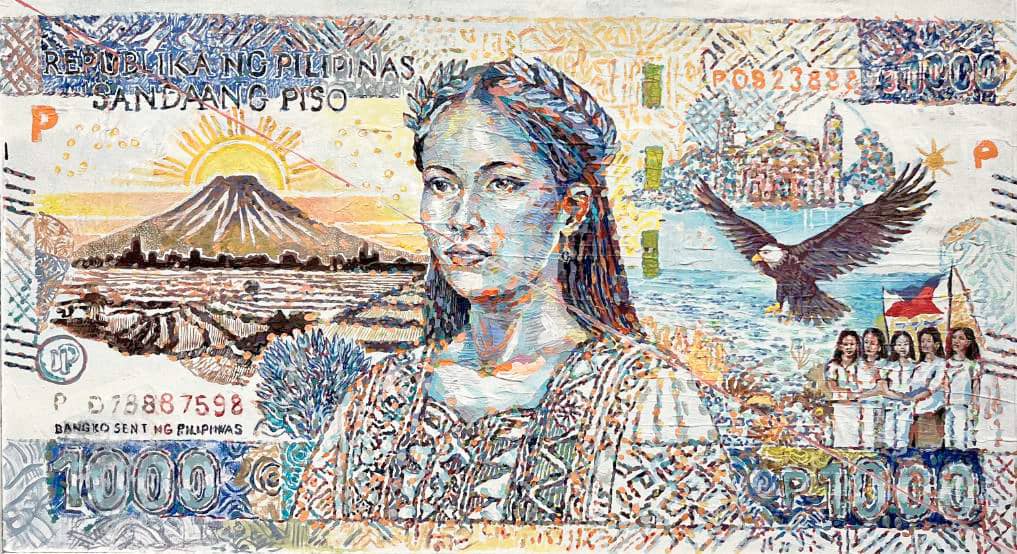
‘FILIPINO Peso,’ 126 x 72 cm, acrylic on canvas, 2025.
Over the years, Henri has gradually yet fully moved his life to the country. Together with his wife, he collaborated with organizations such as Stairway Foundation in Puerto Galera in Mindoro, Project PEARLS in Tondo, Museo Pambata in Manila, and the E. Zobel Foundation in Calatagan, Batangas.
His favorite tool remains the palette knife, which allows him to sculpt paint into thick surfaces. “It brings a sense of ‘action’ even to a still portrait,” he confesses. Among all his paintings, the portrait of his wife is still dearest to him — largely because he considered it unfinished and constantly evolving, much like their shared journey together.
He has spoken with admiration of Spanish artist Sebas Velasco and his atmospheric treatment of light and shadow. The Whitney Museum of American Art is among his favorite for its openness to diverse voices. More recently, however, he found himself genuinely moved by the National Museum of the Philippines, particularly the works of Fernando Amorsolo and his mastery of Philippine light.

‘AGNES Arellano,’ 89 x 100 cm, acrylic on canvas, 2025.
In addition to his love affair with the studio, the gentleman copes with stress through movement and immersion in nature. He trains Capoeira, treks through forests with his family, and explores hidden coves around Puerto Galera, where he and Maïa eventually settled with their children.
He has often cited the honesty of children as one of his greatest inspirations — a kind of instinctive truthfulness which adults gradually lose over time. That same sincerity flowed through Sovereign Faces, where each portrait revealed some inner, unabashed truths.
Let’s sit down with the Frenchman and listen to his thoughts:
On transfer to Puerto Galera
“Twelve years ago, I felt the pulse of the Mangyan culture and the magnetism of Mindoro. It felt like a ‘cultural homecoming.’ After the birth of our second son, Dakila, Maïa and I realized we wanted our children to grow up where the jungle meets the sea — where life is dictated by the elements rather than the clock.”
On the Sovereign Faces exhibit
“The exhibition, Sovereign Faces at ILOMOCA, is a study in power and decolonization. I’ve reimagined global currency by replacing traditional icons with the ‘Sovereign’ faces of women — a tribute to matriarchal strength, featuring figures like Gabriela Silang and Corazon Aquino.”
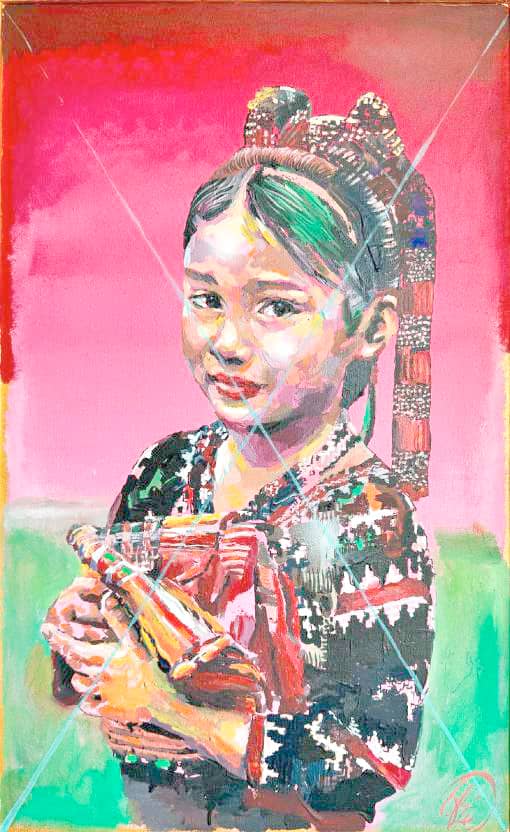
‘MANGYAN Girl,’ 69 x 100 cm, acrylic on canvas, 2025.
On how life experiences impacted the creative process
“The loss of my grandfather when I was four led me to start walking on my hands — literally inverting my world to cope with a reality that no longer made sense. This led me to Capoeira. It saved my painting; it taught me that the whole body, not just the hand, must be involved in the creative act.”
On preferred medium
“I work in the tension between acrylic and oil. Recently, through Fitz Contemporary in the USA, I’ve rediscovered the intimacy of drawing. My sketches are about the ‘skeleton’ of a moment — a fragile, raw texture which American collectors have truly gravitated toward.”
On painting style
“I am a painter of ‘atmospheres.’ Whether it is an urban landscape in Marseille — such as my recent series at Fondation Jouenne — or the lush jungles of Mindoro, I paint while wandering. I want the viewer to feel the humidity of the air or the grit of the pavement.”
On future projects
“I am currently preparing for the Mandala Art Festival in Pulilan, Bulacan. It is a beautiful opportunity to bring the Ugnayan spirit of community exchange to a new audience. I will also hold an upcoming exhibit entitled Maharlika x Dakila at the Alliance Française de Manille. It is a collaborative and multi-disciplinary show which explores the intersection of traditional painting and the Brazilian martial art of capoeira.”