
A space for art in Antipolo

Art simply needs space — mysterious, beautiful, and open to anyone willing to engage with it. This belief sits at the core of Thumbnail Art Gallery, a growing art space founded by artist Miles Villanueva, 33, and his partner and gallery manager, Gab Baez, 32, in Antipolo, Rizal.
Raised in a family of artists, Villanueva grew up seeing art as something meant to be shared. Teaching, in particular, became his way of honoring the practice. Before Thumbnail was formally established as a gallery, the space functioned as a workshop venue where Villanueva taught art classes to children.
Over time, however, he realized the limitations of teaching alone. “We realized that teaching was seasonal because our workshops were focused on kids. There were periods when there were simply no enrollees, and that’s when we decided to turn the space into an art gallery,” he said in Filipino.
Initially, Thumbnail opened its doors to friends who wanted to support Villanueva’s first exhibit. The response eventually encouraged him and Baez to make the space accessible to the public, particularly to artists who wanted to experiment, and to those who had works they labored over but felt had no platform.
What continues to give Villanueva the most fulfillment are the people who pass through the gallery, including former students who have since chosen to pursue art themselves.
Villanueva began teaching art in 2011 while studying Fine Arts at the University of the Philippines Diliman. Nearly a decade later, he discovered that some of his former students were now enrolled in the same program.
Art, he said, has always felt inevitable in his life. “I also taught in high school, and from then on, I realized I couldn’t really stop myself from teaching art.”
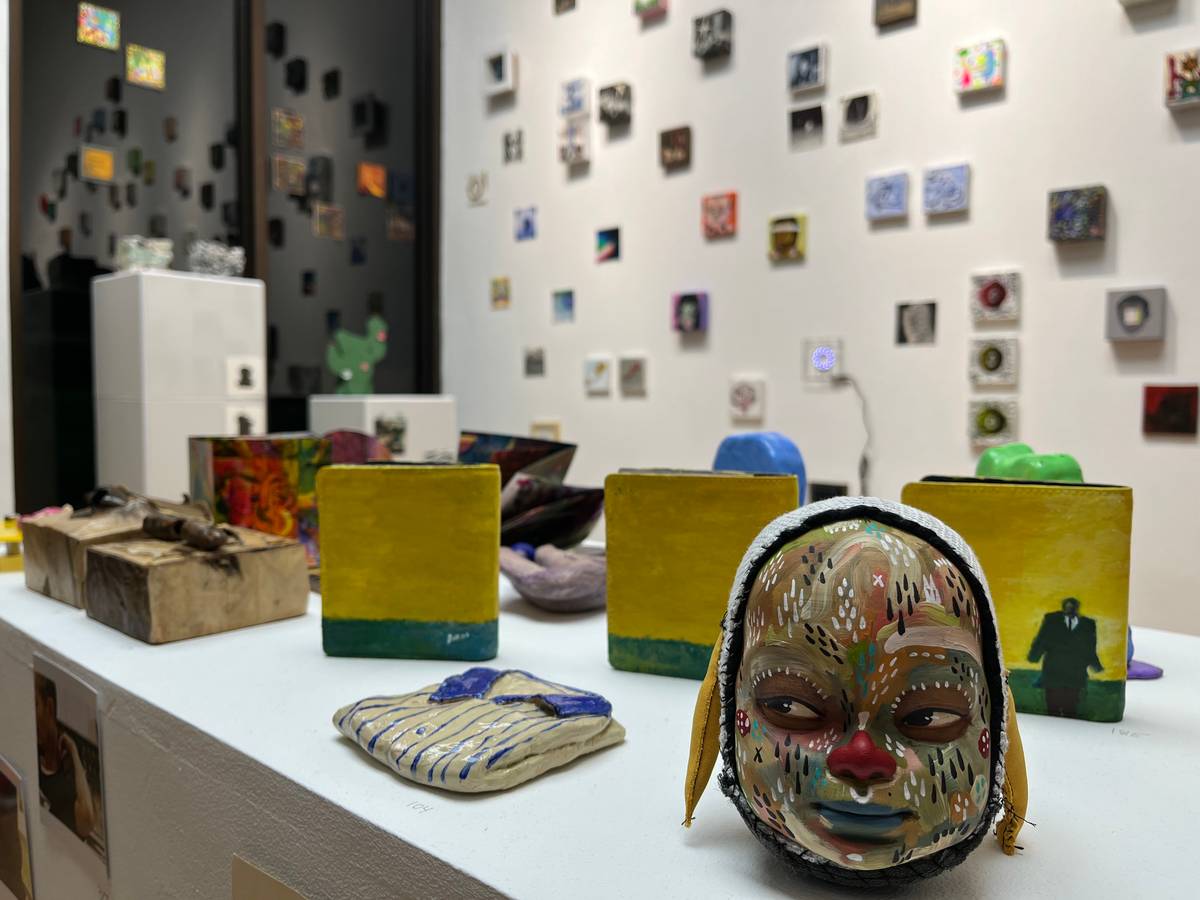
WORKS crafted in various mediums, including ceramics, wood and leather wallets.
Photographs by Louisse Kalingag for DAILY TRIBUNE
Despite studying and working within a largely Manila-centric art scene, Villanueva felt compelled to strengthen the artistic community in his hometown.
“I’m not against art being Manila-centric because I’m part of that system too. But since I’m from Antipolo, even if it’s just a 45-minute drive, it often feels difficult to bring my work there or have it shown. So I decided to start in my own backyard,” he emphasized.
The community he has built around Thumbnail is informal and deeply personal — one he likens to a “big birthday house party.” Today, the challenge they face is sustaining the space financially without compromising their identities as practicing artists.
While Villanueva acknowledges the prestige of larger institutions such as museums, he believes a different path suits him better.
“They say that when a road becomes too slippery or too familiar, you should look for a patch of grass and step there instead,” he said, referring to his decision to create a more accessible, education-centered art space.
“It’s educational, and at the same time it reflects that we’re also learning. I’m really a fan of learning, and of sharing what I’ve learned with others.”
Teaching has never been a struggle for Villanueva, even among those with no background in art. He believes beginners often learn more easily than peers with established habits. “Regardless of age or socio-economic background, everyone seems hungry for that feeling of ‘How do I express myself?’”
“It’s actually harder to teach peers because they already have their own experiences, and those can’t be unlearned,” Villanueva noted.
He has taught everyone from senior citizens to as young as four-year-olds, including individuals on the autism spectrum. These experiences reinforced his belief that artistic expression is universal and that appreciating art does not require knowing the artist behind the work.
“What Gab and I never forget is that we are practicing artists,” he emphasized.
His measure of success remains deeply internal. As long as he finds satisfaction in his work, he will continue creating regardless of visibility. “I had works during the pandemic — pieces that stayed at home, wrapped up, unseen by anyone. That’s why my measure has always been personal satisfaction.”
Much of Villanueva’s work explores dark themes, particularly death, which he views as a beautiful and necessary subject. “It’s something worth talking about. It completes the cycle of life — death, not killings.”
Among his most memorable works is What’s Left of It, a mockumentary-style installation featuring broken glass displayed in a museum enclosure.
“People wonder why their broken belongings are thrown away, while mine are priced, given value, and even glorified as art,” he said, challenging audiences to question how value is assigned to objects and artworks alike.
“I’m at a point in my life where I mix humor into my practice as I continue my craft. I’m more interested in questions than in answers.”