
AFP spots 35 Chinese vessels in WPS during Balikatan

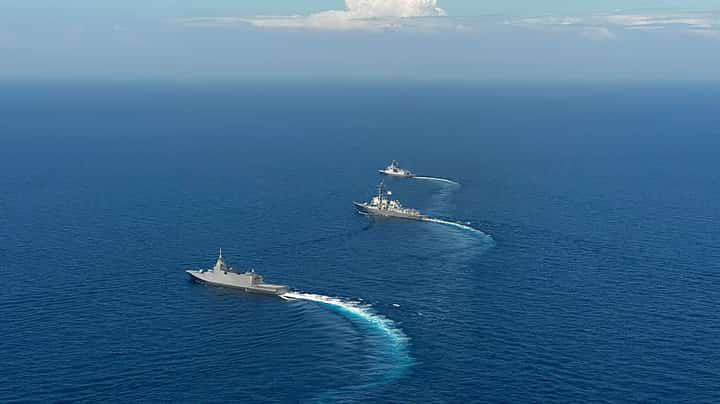
The Armed Forces of the Philippines (AFP) reported Tuesday that 35 Chinese vessels were monitored in several features of the West Philippine Sea (WPS) over the past week.
AFP spokesperson for the WPS Rear Adm. Roy Vincent Trinidad said in a press briefing at Camp Aguinaldo that vessels from the People’s Liberation Army Navy (PLAN) and the China Coast Guard (CCG) were monitored in WPS features from 4 to 11 May.
Seven vessels — one PLAN ship and six CCG vessels — were spotted near Ayungin Shoal. In Bajo de Masinloc, authorities monitored 17 vessels composed of eight PLAN and nine CCG ships.
Meanwhile, five vessels — three PLAN and two CCG ships — were monitored near Escoda Shoal, while six vessels — three PLAN and three CCG ships — were spotted around the Pag-asa Islands.
Trinidad said 62 Chinese vessels were monitored in the same areas in April.
He added that authorities did not observe any aggressive or coercive actions from the Chinese vessels during the Balikatan 2026 exercises in the WPS.
“There were no recorded coercive and aggressive actions,” Trinidad said during the press briefing.
“What we have noticed was the same narrative given out that they performed combat exercises in the vicinity of Bajo de Masinloc. But upon checking, what we noted was the presence of PLA Navy ships and Chinese Coast Guard and the occasional presence of a PLA Air Force. There was no noted synchronized activity,” he added.
This year’s Balikatan, the annual joint military exercises between the Philippines and the United States, started on 20 April and concluded on 8 May. Allied nations including Japan, Australia and Canada also participated in this year’s drills.
Tensions in the region, however, continue as Beijing claims almost the entire South China Sea, including areas claimed by the Philippines, Vietnam, Indonesia, Malaysia and Brunei.
The WPS refers to maritime areas on the western side of the Philippine archipelago, including the Luzon Sea and waters within and adjacent to the Kalayaan Island Group and Bajo de Masinloc.
In 2016, the Permanent Court of Arbitration in The Hague ruled in favor of the Philippines in its case against China’s claims in the South China Sea, saying Beijing’s expansive claims had “no legal basis.”