
Economy avoids stagflation — for now: DEPDev
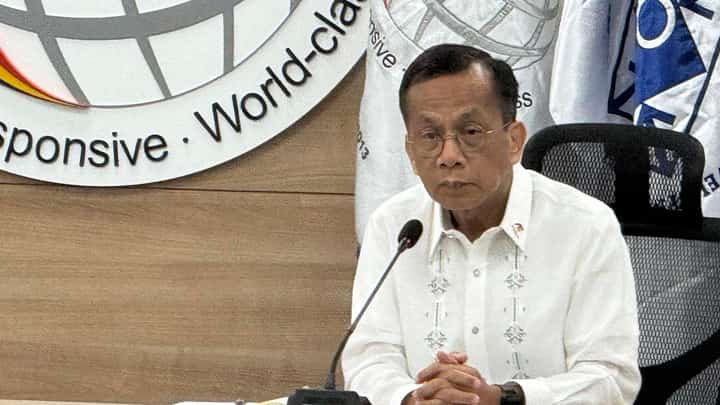
DEPARTMENT of Planning and Economic Development Arsenio Balisacan says while momentum has slowed, he maintains that ‘we are also doing many structural reforms intended to address issues like infrastructure, connectivity, ease of doing business, public-private partnership. All these many new laws passed and being implemented are aimed at raising productivity growth.’
Photograph by Toby Magsaysay for DAILY TRIBUNE.
The Philippine economy has yet to enter “stagflation” territory despite a whirlwind of domestic and external headwinds, according to Department of Economy, Planning, and Development (DEPDev) Secretary Arsenio Balisacan.
Speaking at a Thursday press conference on the country’s first-quarter growth results, the DEPDev chief said the Middle East conflict has not yet pushed the economy into stagflation—a condition marked by low growth, high inflation, and high unemployment occurring simultaneously.
Moving away from slow economic growth
“I don’t see it that way,” he said. “[A]lthough we saw slow economic growth [over the past three quarters,] I think we are moving away from that. And we have learned our lessons.”
The Philippine Statistics Authority (PSA) reported updated figures for all three indicators of stagflation over the past three days.
On Tuesday, the PSA said headline inflation surged to 7.2 percent, the highest in three years, as price pressures from the global oil shortage intensified.
On Thursday, it reported gross domestic product (GDP) growth slowed to 2.8 percent in the first quarter — the weakest in five years, or since the height of the Covid-19 pandemic — both reflecting the impact of the ongoing energy crisis.
However, unemployment eased from 5.1 percent in February to 5.0 percent in March. While still higher than the 3.9 percent posted a year earlier, Balisacan noted the figure remains far below pandemic-era peaks.
Unemployment hasn’t yet reached past high levels
“Unemployment still hasn’t reached the highs of the past, and we are seeing improvements in job quality over the last three years,” he said.
Both inflation and GDP growth have been adversely affected by the Middle East crisis. Domestic fuel prices climbed into the triple-digit-per-liter range, raising costs across goods and services, slowing production as businesses face higher operating expenses, and eroding consumer purchasing power.