




48TH ASEAN SUMMIT STARTS TOMORROW: Energy security high on the agenda


Text size
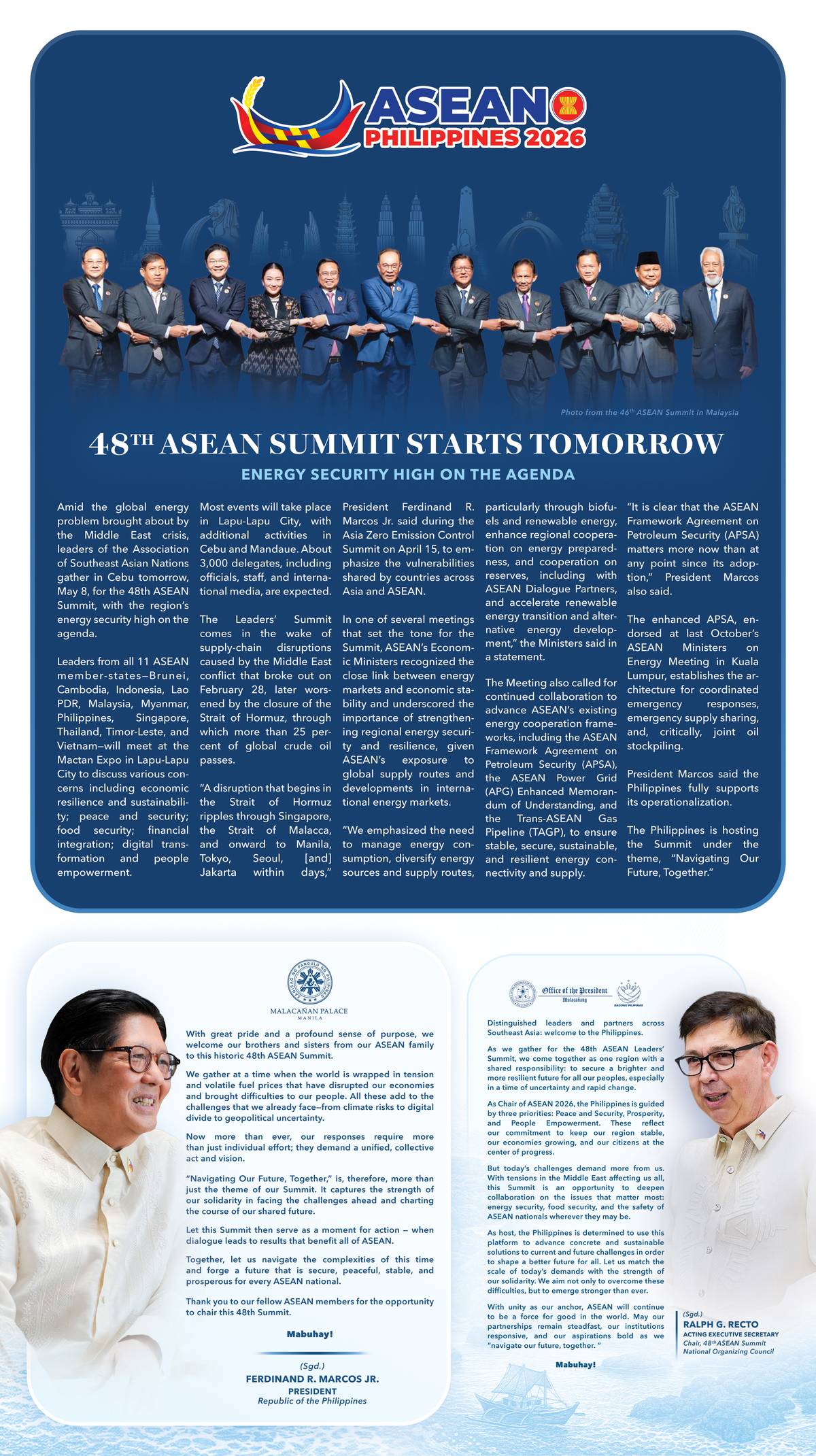
PHOTO from the 46th ASEAN Summit in Malaysia
Amid the global energy problem brought about by the Middle East crisis, leaders of the Association of Southeast Asian Nations gather in Cebu tomorrow, May 8, for the 48th ASEAN Summit, with the region’s energy security high on the agenda.
Leaders from all 11 ASEAN member-states—Brunei, Cambodia, Indonesia, Lao PDR, Malaysia, Myanmar, Philippines, Singapore, Thailand, Timor-Leste, and Vietnam—will meet at the Mactan Expo in Lapu-Lapu City to discuss various concerns including economic resilience and sustainability; peace and security; food security; financial integration; digital transformation and people empowerment.
Most events will take place in Lapu-Lapu City, with additional activities in Cebu and Mandaue. About 3,000 delegates, including officials, staff, and international media, are expected.
The Leaders’ Summit comes in the wake of supply-chain disruptions caused by the Middle East conflict that broke out on February 28, later worsened by the closure of the Strait of Hormuz, through which more than 25 percent of global crude oil passes.
“A disruption that begins in the Strait of Hormuz ripples through Singapore, the Strait of Malacca, and onward to Manila, Tokyo, Seoul, [and] Jakarta within days,”
President Ferdinand R. Marcos Jr. said during the Asia Zero Emission Control Summit on April 15, to emphasize the vulnerabilities shared by countries across Asia and ASEAN.
In one of several meetings that set the tone for the Summit, ASEAN’s Economic Ministers recognized the close link between energy markets and economic stability and underscored the importance of strengthening regional energy security and resilience, given ASEAN’s exposure to global supply routes and developments in international energy markets.
“We emphasized the need to manage energy consumption, diversify energy sources and supply routes, particularly through biofuels and renewable energy, enhance regional cooperation on energy preparedness, and cooperation on reserves, including with ASEAN Dialogue Partners, and accelerate renewable energy transition and alternative energy development,” the Ministers said in a statement.
The Meeting also called for continued collaboration to advance ASEAN’s existing energy cooperation frameworks, including the ASEAN Framework Agreement on Petroleum Security (APSA), the ASEAN Power Grid (APG) Enhanced Memorandum of Understanding, and the Trans-ASEAN Gas Pipeline (TAGP), to ensure stable, secure, sustainable, and resilient energy connectivity and supply.
“It is clear that the ASEAN Framework Agreement on Petroleum Security (APSA) matters more now than at any point since its adoption,” President Marcos also said.
The enhanced APSA, endorsed at last October’s ASEAN Ministers on Energy Meeting in Kuala Lumpur, establishes the architecture for coordinated emergency responses, emergency supply sharing, and, critically, joint oil stockpiling.
President Marcos said the Philippines fully supports its operationalization.
The Philippines is hosting the Summit under the theme, “Navigating Our Future, Together.”
Before politics, the pressures of public life, and the Presidential Palace, Ferdinand “Bongbong” Marcos Jr. remembers a…
When a Tennessee woman was sentenced to death in 1996 for murdering a 19-year-old student the year before, she remained…
Records from the Anti-Money Laundering Council (AMLC) showed that Cale88 Foods Corp., a firm linked to Vice President…
