
Switching from post-disaster funding to anticipatory finance
Billions in climate finance technically exist.

FREQUENT flooding in Masantol, Pampanga is caused by a combination of altered waterways, fishponds that impede water flow, and land subsidence exacerbated by volcanic lahars from Mount Pinatubo.
PHOTOGRAPH BY YUMMIE DINGDING FOR DAILY TRIBUNE
The Asian Institute of Management (AIM) has set the stage for the shifting of climate financing norm from post-disaster funding to pre-crisis response.
At its Asian Conference on Climate Change and Disaster Resilience (ACCCDR) 2026 last 30 April, policymakers, finance ministers, private sector innovators and local government executives were gathered to spearhead the setting of anticipatory financing as a primary disaster response model.
Guest speaker Senator Loren Legarda started the ball rolling, revealing her plan to amend the budget law to allow the Department of Budget and Management (DBM) to disperse disaster funds based on a forecast instead of from a declaration of a state of calamity.
“We must simplify the trigger mechanisms for local aid. If PAGASA predicts a storm surge of a certain height or magnitude, the cash transfer should be automatic,” said Legarda, referring to the state weather agency.
AIM president Jikyeong Kang said that billions in climate finance technically exist but, ironically, “when a disaster breaks, the local responders — the people standing in the mud — still lack the resources to act.”
Kang said AIM chose to strengthen anticipatory financing as it is aligned with its values that saving lives are worth the investment.
AIM professor and director of the institute’s executive master in Disaster Risk and Crisis Management program, Dr. Chad Briggs, said anticipatory finance treats the forecast or scenario itself as the actionable event and moves capital before the typhoon makes landfall, before the drought breaks the harvest.
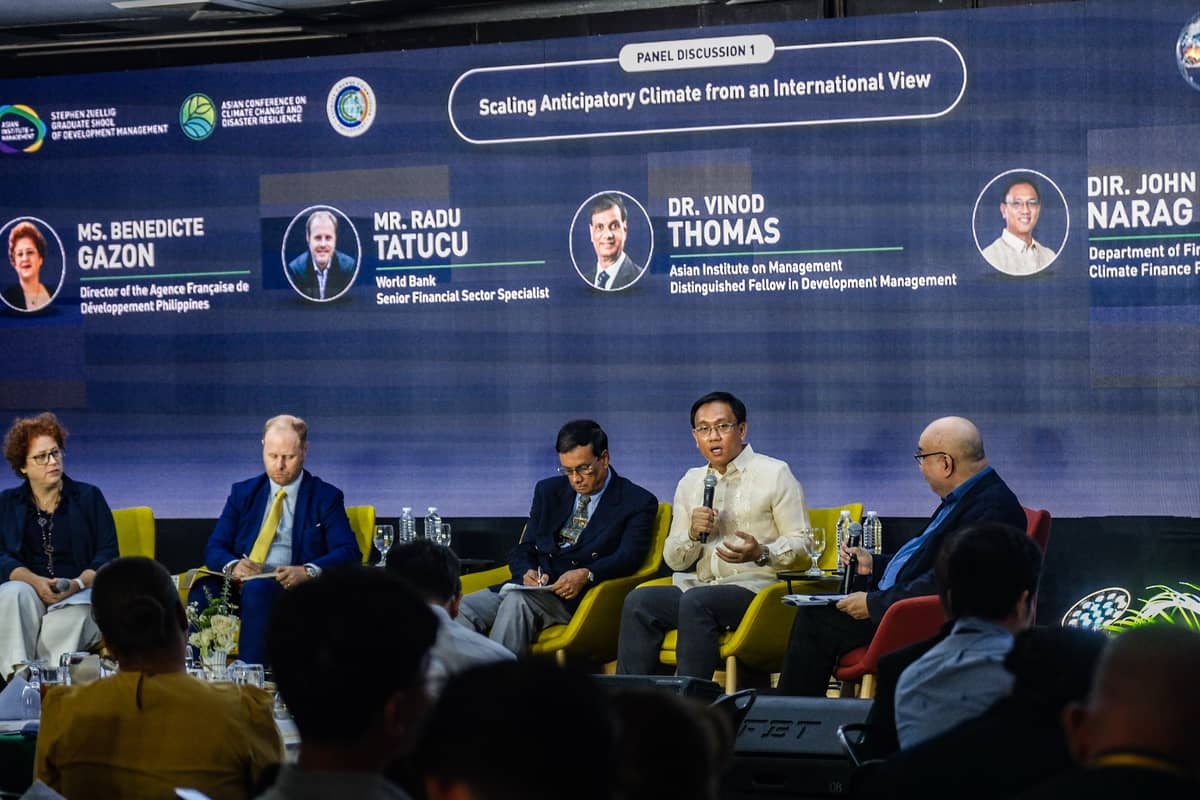
A PANEL discussion sees (from left) Benedicte Gazon, director of the Agence Française de Développement Philippines; Radu Tatucu, senior financial sector specialist at the World Bank; Vinod Thomas, distinguished fellow in development management at the Asian Institute of Management; John Narag, director of the Department of Finance’s Climate Finance Group; and Jose Luis Santillan, faculty member at AIM, discussing available disaster readiness funding at the Asian Conference on Climate Change and Disaster Resilience at AIM in Makati City on 30 April 2026.
PHOTOGRAPH BY YUMMIE DINGDING FOR DAILY TRIBUNE
Funding access
Department of Finance director John Adrian M. Narag shared in the event’s panel discussion on scaling anticipatory climate financing that a number of funds are readily available for the local government units. Among these are the annual local government support fund from the DBM and the People’s Survival Fund (PSF), a law authored by Legarda intended for adaptation projects for vulnerable communities.
Narag also said there are international funds committed by developed nations such as the Adaptation Fund and Loss and Damage Fund.
Radu Tatucu, senior financial sector specialist and financial sector lead at the World Bank, said the WB is working with the Department of Agriculture, Philippine Crop Insurance Corp., private insurance companies and Land Bank of the Philippines in setting up a co-insurance pool to scale up insurance coverage to non-subsistence farmers.
Tatucu said the intention of the project is to increase the number of local farmers being covered by insurance in one crop season from 5,000 to half a million.
Former Hagonoy mayor and president of the Alyansa ng mga Baybaying Bayan ng Bulacan at Pampanga, Angel Cruz Jr., shared during the panel discussion on anticipatory financing that the local governments of Calumpit and Hagonoy are undertaking a flood defense system for 1,500 hectares of waterlogged rice land, with the Witteveen + BOS, an international engineering and consultancy firm headquartered in the Netherlands, funding the preparatory study.
Cruz asked if there is funding for the feasibility study of the Calumpit-Hagonoy Basin Project and Narag said they can get a project development grant from PSF or from the Green Climate Fund’s (GCF) Readiness and Preparatory Support Program.
GCF is a funding mechanism designed to help developing countries enhance their institutional capacities, governance mechanisms, and planning frameworks to effectively access and utilize climate finance.
International funding can also be accessed from the World Bank, Asian Development Bank, Agence Française de Développement, Deutsche Gesellschaft für Internationale Zusammenarbeit, and United Nations Development Program.
Dr. Vinod Thomas, AIM distinguished fellow in development management, added that Cruz can tap funds from the Multilateral Cooperation Center for Development Finance based in Beijing, China.