
DOTr flags ‘ghost riders’ in TNCs amid aid irregularities
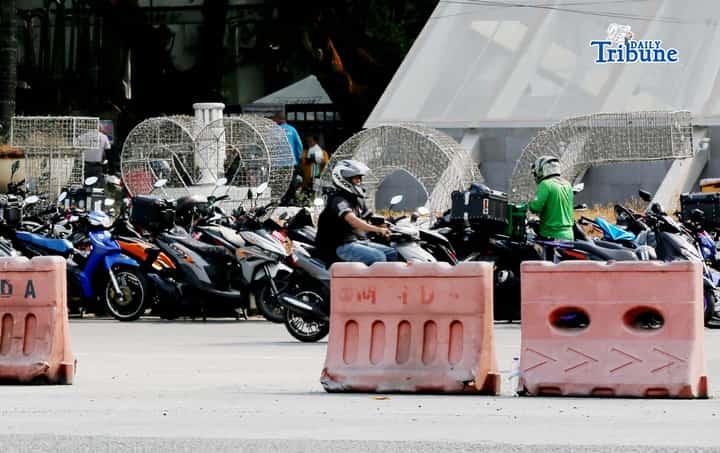
(April 17 2026) Motorcycles are parked at the entrance of the Quezon Memorial Circle in Quezon City as motorcycle taxi and delivery riders claim their P5,000 from Department of Social Welfare and Development (DSWD) personnel during a special payout schedule for unclaimed cash relief assistance on Friday April 17 2026. Photo/Analy Labor
The Department of Transportation (DOTr) has confirmed the existence of so-called “ghost riders” in transport network services, highlighting irregularities linked to financial aid distribution and driver onboarding practices.
Transportation Secretary Giovanni Lopez said Thursday the issue surfaced during the government’s rollout of assistance to drivers affected by fuel price spikes tied to tensions in the Middle East.
As payouts were issued, discrepancies began to emerge.
“There are indeed ghost riders,” Lopez said in an interview with DZRH, explaining that the submitted lists included individuals who were not legitimately registered or authorized to operate. The discovery also pointed to the presence of “colorum,” or unregistered, drivers within official databases.
Lopez attributed the problem to earlier onboarding practices. Transport network companies (TNCs) were allocated a specific number of slots by the Land Transportation Franchising and Regulatory Board (LTFRB), intended solely for drivers with valid franchises or provisional authority. However, some platforms allegedly exceeded these allocations.
“Drivers should first be granted a franchise by the LTFRB before being onboarded,” he said. “What happened was that even after the slots were filled, additional drivers were still allowed to join without proper authorization.”
The scale of the issue is considerable. Authorities estimate around 30,000 questionable entries for four-wheel vehicles, and over 200,000 for motorcycle taxis. Lopez emphasized that TNCs could not claim ignorance, as the master lists originated from the companies themselves.
Despite the irregularities, the DOTr opted to proceed with payouts to ensure legitimate drivers received assistance, with accountability measures to follow.
Fees, accountability concerns
Beyond unauthorized onboarding, Lopez raised alarms about excessive fees imposed on drivers, exposing further vulnerabilities.
Drivers reportedly paid onboarding fees ranging from P25,000 to P90,000 in addition to standard commission charges. These payments, he said, were often required even when applicants lacked the necessary provisional authority.
“Some drivers were told they would not be onboarded unless they paid,” Lopez noted. “That raises serious questions about where the money is going.”
He described a layered system involving companies, operators, and platform intermediaries, making it difficult to trace responsibility. Some accounts suggested that payments may have extended beyond private entities, hinting at potential complicity within government ranks.
The DOTr chief stressed that both TNCs and regulators, including current or former LTFRB officials, would be investigated.
“It’s impossible that they did not know,” he said, pointing to potential negligence or deliberate inaction. “There are too many irregularities for this to have gone unnoticed.”
Lopez identified major players in the sector, including InDrive and Grab for four-wheel services, and JoyRide, Angkas, and MoveIt for motorcycle taxis, as among those with the largest reported numbers. Each company, he noted, often argues that others have higher figures.
To prevent further abuse, the DOTr is transitioning to a fully digital onboarding and monitoring process, aiming to tighten verification and eliminate manual loopholes.
A formal investigation is scheduled to begin after another payout cycle, overseen by a different transport official. Authorities expect the probe to determine liabilities across both private companies and government agencies.
For Lopez, the episode underscores a systemic failure that allowed irregular practices to persist unchecked.
“This would not have escalated if it had been controlled early on,” he said, stressing the need for stricter oversight moving forward.