
Allied forces repel simulated amphibious attack in Palawan drills


CAPTIONS: CLLFX_Photo 5: A light armored vehicle (LAV) deployed by the Philippine Marine Corps’ 3rd Marine Brigade engages simulated maritime threats during the Counter-Landing Live Fire Exercise - West in Apurawan Beach, Aborlan, Palawan on April 27, 2026. (Photo by 3rd Marine Brigade, Philippine Marine Corps)
The Philippines and allied troops showcased a coordinated, multi-domain coastal defense during a live-fire exercise that simulated an amphibious landing along Palawan’s western shoreline
The Counter-Landing Live Fire Exercise (CLLFX-West), held at Apurawan Beach Landing Site on 27 April, brought together the Armed Forces of the Philippines (AFP), United States Armed Forces, Australian Defence Force, and New Zealand Defence Force in a complex littoral battle scenario as part of Exercise Balikatan 41–2026.
The Philippine Marine Corps’ 3rd Marine Brigade conducted drills showcasing how joint forces would detect, disrupt, and deny enemy troops attempting to establish a beachhead.
The scenario highlighted close coordination across air, land, and sea units in countering a maritime threat.
Air assets from the Philippine Air Force, including FA-50 fighter jets, conducted interdiction strikes, while U.S. forces deployed High Mobility Artillery Rocket System (HIMARS) for long-range precision fires.
Ground troops engaged targets using artillery, mortars, armored vehicles, anti-armor systems, and heavy machine guns, supported by reconnaissance and precision strike capabilities.
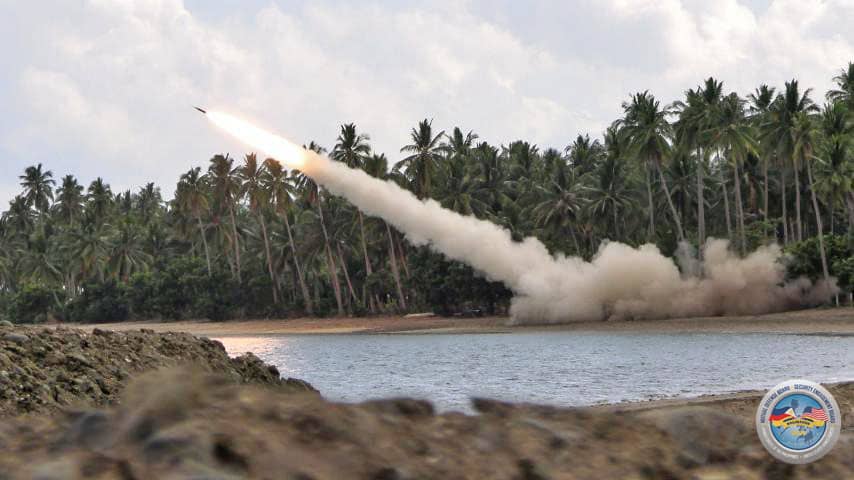
CLLFX_Photo 8: A rocket launch from the U.S. High Mobility Artillery Rocket Systems (HIMARS) illuminates the shoreline during the Counter-Landing Live Fire Exercise at Apurawan Beach, Palawan on April 27, 2026. (Photo by Staff Sgt. Brandon Rickert, 7th Infantry Division, US Army)
The exercise also featured a simulated Non-Combatant Evacuation Operation (NEO) in nearby communities, alongside a civil-military outreach activity with local officials, underscoring the military’s dual role in defense and humanitarian missions.
Among those who observed the drills were AFP Chief of Staff General Romeo Brawner Jr. and AFP Western Command chief Vice Admiral Alan Javier, along with senior U.S. military officials.
Marine Colonel Dennis Hernandez, Balikatan spokesperson for the Philippines, said the exercise demonstrated the allies’ ability to deliver a “swift and unified response” to threats approaching from the sea.
“Beach defense requires seamless integration across services and with our allies,” Hernandez said, emphasizing that joint drills like Balikatan ensure readiness to protect coastal communities and uphold territorial integrity.