
Multinational forces simulate beach assault to boost regional defense readiness


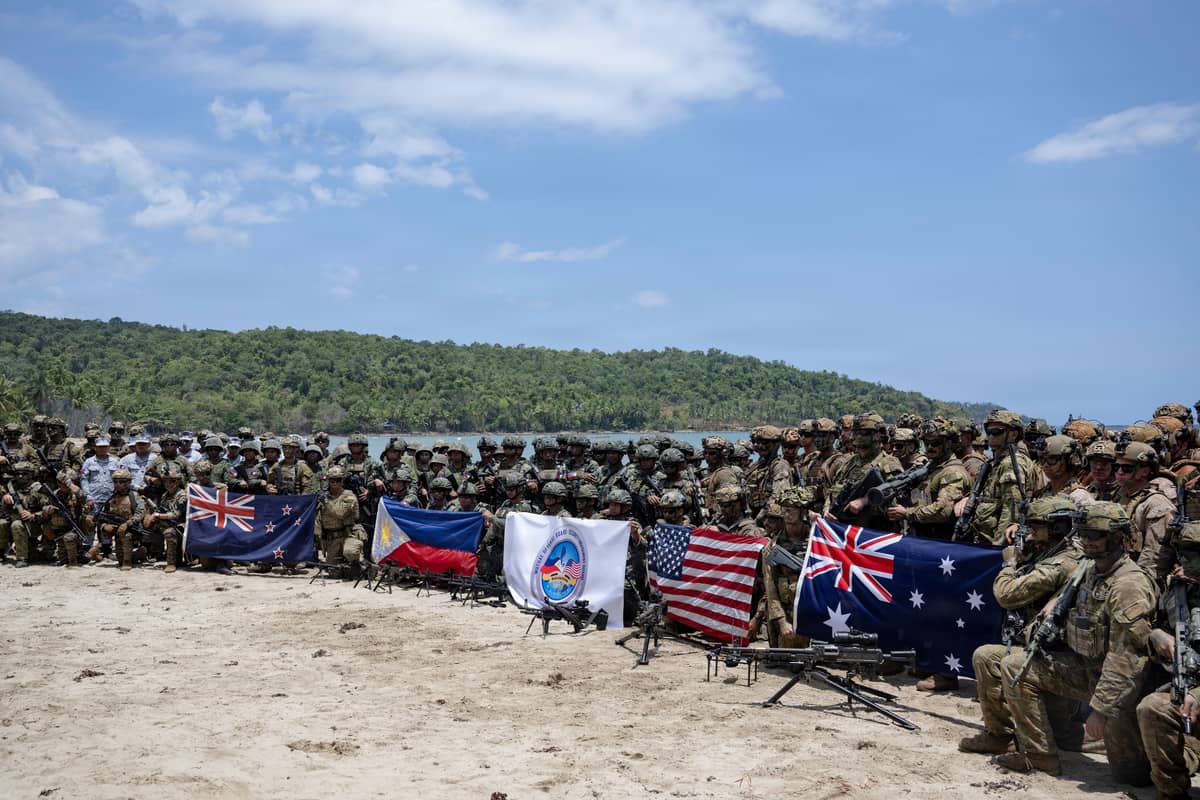
More than 500 service members from the United States, the Philippines, Australia, and New Zealand successfully repelled a simulated amphibious assault during a high-intensity live-fire exercise under Exercise Balikatan 2026, demonstrating a new level of coordination and interoperability among allied forces.
The counter-landing drill, held as part of the annual Balikatan war games, marked the first time the four nations jointly executed a live-fire beach defense scenario—an evolution seen by military leaders as a significant step toward strengthening collective security in the Indo-Pacific.
Forces operated across land and air domains, combining missile systems, fighter aircraft, mortars, and machine guns to neutralize a simulated enemy force attempting to breach a defended coastline.
The exercise relied heavily on real-time intelligence, surveillance, and reconnaissance (ISR), enabling troops to detect threats early and coordinate rapid responses through a unified command-and-control system.
U.S. Marine Corps Col. G. J. Flynn III emphasized that while advanced weaponry played a critical role, true success came from integration.
“The integration of those capabilities is the cornerstone of how this is done right,” Flynn said, adding that shared experiences in field conditions helped build trust among troops.
Philippine Marine Corps Col. Dennis Hernandez underscored the broader implications of the exercise, particularly for national defense. He noted that coastal protection requires seamless coordination across multiple branches and allied forces.
“Exercises like this ensure that we are prepared to protect our coastal communities and territorial integrity with precision, speed, and overwhelming coordination,” he said.
The simulated operation began with ISR assets detecting an approaching hostile vessel. High Mobility Artillery Rocket Systems (HIMARS) engaged from shore, followed by coordinated fire from anti-armor systems, mortars, and air defense platforms as mock enemy amphibious vehicles advanced.
The exercise concluded with a final defensive stand, where combined ground forces eliminated remaining threats and secured the beachhead.
The exercise likewise highlighted growing defense ties among participating nations.
New Zealand Army Capt. Will Hutchinson said the training strengthened interoperability and laid the groundwork for future joint operations, while Australian Army Lt. Col. Benjamin Woolmer pointed to the importance of “shoulder-to-shoulder” cooperation—a phrase that reflects the meaning of “Balikatan” in Filipino.
Impact on regional security
The successful execution of the counter-landing live-fire drill carries significant implications for regional stability. As maritime tensions persist in the Indo-Pacific, the ability of allied forces to operate as a unified, multi-domain team enhances deterrence against potential aggressors.
For the Philippines, the exercise reinforces its coastal defense capabilities, particularly in safeguarding vulnerable shorelines and communities.
It also signals a deepening of military partnerships with key allies, improving readiness to respond to both conventional threats and humanitarian crises.
Further, the drill demonstrated how allied nations are moving beyond basic cooperation toward full operational integration, including sharing intelligence, synchronizing firepower, and making joint decisions in real time.
This level of coordination not only increases battlefield effectiveness but also sends a strong message of unity and preparedness.
As Balikatan continues to evolve, this year’s milestone underscores a shift toward more complex, realistic scenarios.
This aims to ensure that allied forces are not just equipped, but fully prepared to act together in defense of shared interests.