
Environmental group seeks probe of Navotas fire, other landfill incidents
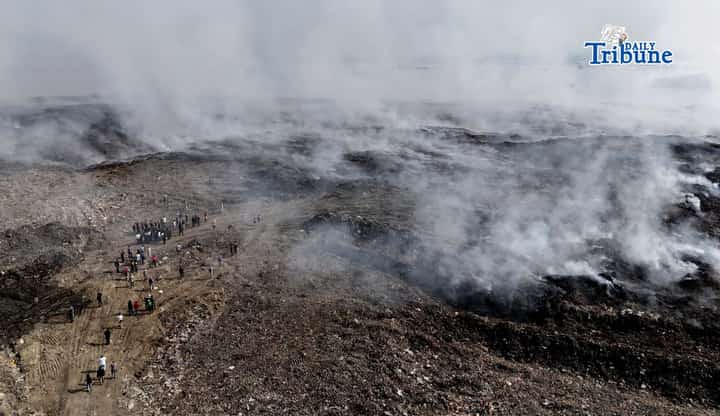
An aerial view of the #Navotas Sanitary Landfill on 16 April 2026 shows a fire that has been burning for days, affecting nearby communities in Navotas, Malabon, and Obando, Bulacan. | Analy Labor
Photo by Analy Labor for DAILY TRIBUNE
An environmental group is calling for an independent investigation into the multiple landfill-related incidents in recent months, following the Navotas Sanitary Landfill that started on 10 April.
The advocacy group BAN Toxics said there are critical gaps in waste management practices and policies, and the ‘business-as-usual’ mindset, citing that the Navotas Sanitary Landfill is a product “when businesses take precedence over the protection of public welfare and the environment.”
BAN Toxics said the Navotas Sanitary Landfill is the third major landfill incident in the Philippines in less than four months. The two others were the deadly trash slide at the Binaliw Landfill in Cebu City last 8 January, which killed 36 workers, and the similar collapse at the Rizal Provincial Sanitary Landfill in Rodriguez, Rizal last 20 February, which left one dead and two others missing.
Jam Lorenzo, BAN Toxics Deputy Executive Director and head of Policy Development and Research Unit, said the fire could have been prevented if all parties involved exercised the precautionary principle, and ensured the landfill’s safe closure and rehabilitation.
"Instead, by prioritizing court orders and schedules over environmental safeguards, we are now in this situation that has impacted the environment and endangered the lives of millions of Filipinos,” Lorenzo said.
Lorenzo was referring to the court-ordered expropriation and writ of possession to transfer the site to San Miguel Aerocity Inc. (SMAI), effectively removing Phil Ecology Systems Corp. (PhilEco), the former operator of the landfill. SMAI is set to construct a cloverleaf interchange linked to the New Manila International Airport project in Bulacan.
Lorenzo said there should be an independent fact-finding mission to determine accountability and ensure that the full chain of decisions that led to this disaster is examined.
"The public deserves answers that go beyond legal maneuvmanering and corporate disclaimers. An independent investigation, involving not only the government but also civil society, is the only way to cut through the bias and get to the truth," Lorenzo said.
The group has also called on the government for a thorough assessment of the status of all landfills and dump sites in the country, stressing that these recurring disasters point to a systemic failure in waste management oversight that can no longer be addressed on a case-by-case basis.
BAN Toxics also pointed out that, ultimately, the recent landfill tragedies are a symptom of a deeper waste crisis that can no longer be addressed downstream or at the point of disposal, where waste has already been generated, collected, and dumped.
According to the group, lasting solutions require embracing genuine zero waste principles — reducing the production and consumption of single-use plastics and other products designed for disposal — and holding producers accountable for the waste they generate, rather than leaving communities and the environment to bear the consequences.