
ICC confirms 3 murder raps vs Duterte; sends him to full trial
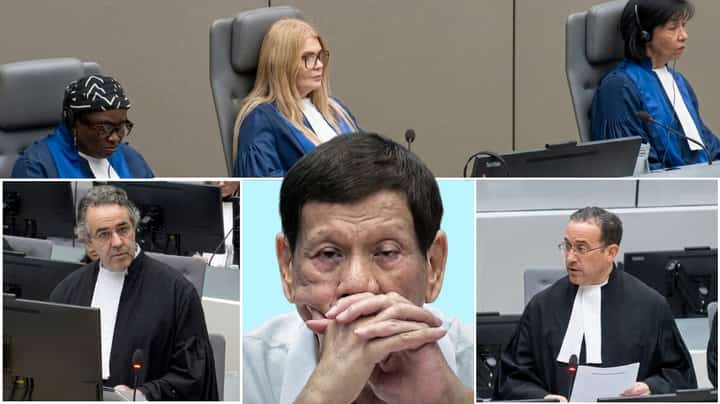
ON the fourth and final day of the confirmation of charges hearing on the case against former President Rodrigo Duterte (center), the defense team led by counsel Nicholas Kaufman (right) made their final presentation, and the prosecution led by senior trial lawyer Julian Nicholls (left), the common legal representatives of the victims and the defense team delivered their closing statements. The pre-trial chamber (top photo) made up of Presiding Judge Iulia Antoanella Motoc and Judges Reine Adélaïde Sophie Alapini-Gansou and María del Socorro Flores Liera also discussed the review of Duterte’s detention at the International Criminal Court.
Photographs courtesy of ICC/DAILY TRIBUNE images
It was a back-to-back setback for former president Rodrigo Duterte after the International Criminal Court Pre-Trial Chamber I unanimously confirmed the three murder charges against him on Thursday, just a day after he lost anew the petition contesting the tribunal’s jurisdiction over his crimes against humanity case.
The ruling effectively sent Duterte’s case to a full trial, to be presided over by a new, separate chamber, the Trial Chamber, composed of three new judges. This also suggest that Duterte, 81, will remain in detention while awaiting the trial.
In a 50-page decision, the three-member PTC-I concluded that there are “substantial grounds” to believe that Duterte was responsible for the crimes against humanity of murder and attempted murder under Article 7(1)(a) of the Rome Statute, the ICC’s founding treaty.
“In light of the above, the Chamber finds that there are substantial grounds to believe that Mr Duterte is criminally responsible for the crimes charged in Counts 1-3 as an indirect co-perpetrator, and/or for ordering and/or inducing, and/or for aiding and abetting the commission of the crimes, pursuant to Articles 25(3)(a), (b) and (c) of the Statute,” the verdict reads.
The prosecution team welcomed the ruling as a “significant milestone”, saying that it only validated their work in establishing that Duterte bears responsibility for the crimes charged.
The ruling was anchored on the evidence presented to the court by the ICC prosecutors, the drug war victims camp, as well as the defense team of the former president during the critical four-day confirmation of charges hearing in late February.
Duterte has been detained in the ICC custody since 11 March last year over his role as an “indirect co-perpetrator” in the alleged extrajudicial killings tied to his notorious bloody drug war.
The prosecution charged him with three counts of murder for the killings of 78 individuals, including six children, allegedly suspected of drug dealings from 2013 to 2018, spanning his tenure as Davao mayor and as president.
The count one recorded 19 murders, including three children. It was carried out between 2013 and 2016 by members of the so-called Davao Death Squad (DDS)—a notorious group allegedly comprised of Davao-based police and hitmen—while Duterte was sitting as the city mayor.
Meanwhile, 14 murders were logged under count two, covering July 2016 and 2017, during Duterte’s presidential period. These individuals were classified as “high-value targets” who are allegedly involved in drug manufacturing or drug syndicates.
Although it was not explicitly named in the decision, among the murdered high-value targets named by the prosecution during the presentation of the evidence in February was the late Albuera mayor Rolando Espinosa.
Espinosa, who was in the so-called “PRRD list (Duterte’s initials)” comprised of other high-value targets, was shot dead inside his jail cell, allegedly after firing at police officers, in November 2016.
“Police who killed a target on the list could access a covert reward system (which existed outside of the regular formal rewards system) and receive a payment ranging from P50,000 to P1 million, depending on the level of the target,” the ruling states.
As for the third count, the prosecutors said Duterte was responsible for 43 murders and two attempted murders of alleged drug suspects, including three children.
These cases were also recorded during Duterte’s tenure as president, and were carried out by members of the “national network” during barangay clearance operations between July 2016 and September 2018.
The decision states that Duterte and his co-perpetrators executed a “common plan” to “neutralize” criminals in the Philippines, including those perceived or alleged to be associated with drug use, sale, or production. The scheme involves systematic killings, torture, murder, and other crimes.
ICC prosecutors have argued that while he might not have personally killed the said victims, Duterte, as an indirect co-perpetrator, held top responsibility for ordering, encouraging, or facilitating the killings through his subordinates, like the police and DDS.
The PTC-I ruled in their favor.
“Duterte and his co-perpetrators used the DDS, including its low-level members, as tools to commit the crimes encompassed by the common plan…
Duterte recruited individuals he could trust and control for the DDS, with Duterte personally inducting some DDS hitmen,” the chamber said in the ruling.
“They also maintained control by recruiting some physical perpetrators in circumstances in which they owed a debt to Duterte and/or the police. DDS physical perpetrators were fungible within the apparatus,” it added.
The ruling also mentioned the key roles of Senators Bato de la Rosa and Bong Go in implementing the common plan. They were named as co-perpetrators alongside former Justice secretary Vitaliano Aguirre II, and De la Rosa’s successor, former PNP chief Oscar Albayalde.
Others are Vicente Danao and Isidro Lapeña, former Davao City Police chiefs; Camilo Cascolan, finance chief of the Davao Region Police Office; Dante Gierran, Davao regional director of the National Bureau of Investigation; and other unnamed law-enforcement high-ranking officers.
In 2018, Duterte ordered that the Philippines cease to be a party to the Statute, shortly after ICC prosecutors launched a preliminary examination into his bloody drug war that has drawn global condemnation.
However, the withdrawal only became official one year later. Under the ICC’s rules, a one-year window is required to prevent a state party from immediately departing the treaty once it learns that it is under investigation for committing possible grave crimes, including crimes against humanity.
The ICC asserted it still maintains jurisdiction over the killings committed prior to the withdrawal.