
Garin pushes shift to EV, review of Oil Deregulation Law
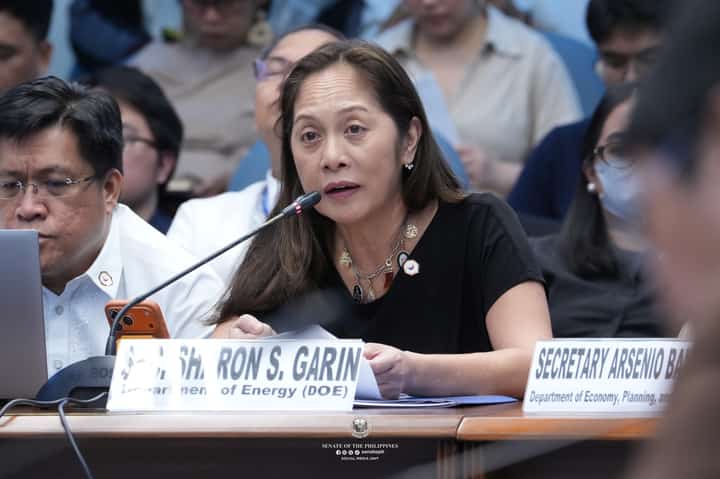
The Department of Energy on Monday urged government agencies to begin shifting to electric vehicles (e-vehicles) as the ongoing oil crisis stemming from the conflict in the Middle East highlighted the ramifications of the Philippines’ heavy reliance on fuel imports.
Energy Secretary Sharon Garin made the call during the third hearing of the Senate PROTECT Committee, saying the dire effects of the country’s reliance on imports are aggravated by the government's inability to swiftly intervene when oil supplies destabilize and prices rise due to the deregulated nature of the local oil industry.
“We are pushing for all government agencies [that] procurement should be electric vehicles already, Mr. Chair. Combustible makes us dependent on diesel; we have realized that. And I think electric vehicles will wean us out of dependence on diesel, especially [in] transportation,” she told the panel.
Unlike the Philippines, China is “less affected” by the current global oil supply disruption because [its] fleet [its] already electric.”
The Philippines has been greatly affected by the United States-Israel war on Iran, as it imports about 95 to 98 percent of its oil from the Middle East.
“With electric, we can use coal and even renewable, Mr. Chair. We're not only dependent on diesel,” the DOE chief added.
Panel chair Win Gatchalian agreed with the need for a transition to e-vehicles, calling it the only solution to cut the Philippines’ dependence on fuel imports.
In a year, the government procures “almost half a million new vehicles” with internal combustion engines, according to the chair.
“If we replace this with electric vehicles, we will no longer need to import oil from anywhere,” Gatchalian, who also co-heads the Senate energy committee, averred.
Recently, Gatchalian called on the administration to fast-track the transition of traditional jeepneys to EVs through the PUV modernization program to safeguard drivers and operators from abrupt oil price shocks.
He claimed that EVs are essentially insulated from oil price volatilities and enjoy an excise tax exemption, significantly lowering purchase costs compared with internal combustion vehicles.
Gov’t lack of regulatoty powers a ‘main problem’
Garin, meanwhile, admitted that the “main problem” the government faces in addressing the crisis is its limited powers to regulate the oil industry, such as setting a cap during times of soaring prices, due to the Oil Deregulation Act (RA 8479), which she said must be revisited.
“We are dependent on an industry that the government doesn't have any regulatory powers [over],” Garin told senators.
The law liberalized the downstream industry and removed government control over the pricing, importation, and export of petroleum products, to promote free competition for private firms.
Prior to its enactment in 1998, petrol prices were set by the Energy Regulatory Board based on global oil costs and exchange rates, with the Oil Price Stabilization Fund absorbing fluctuations to prevent changes in pump costs.
As a result, she lamented that the government could only step in to ensure that fuel prices are fairly set by private oil firms when a state of national energy emergency is declared, but only to some degree.
In times of crisis or supply disruption, like in the current situation in the Middle East, Garin asserted that the government should be granted powers to regulate the industry, but “not to the extent that the oil companies cannot purchase more or operate properly.”
“So I think there should be a revisiting of the Oil Deregulation Law, whether it's in times of crisis, what pricing do we want, and what is the role of government in the whole oil industry,’” she stressed.
According to the DOE chief, the oil crisis has pushed liquefied natural gas prices to triple, while coal costs have risen by about 30 percent.
Based on the DOE’s latest average fuel inventory, Garin said the total inventory stands at 50.31 days.
The breakdown showed that gasoline stocks could last up to 54.38 days, while diesel for up to 48.90 days.
Kerosene buffer led the pack with 104.73 days, jet fuel supplies with 67.65 days, while fuel oil could last up to 45.96 days.
LPG, the main cooking fuel for households and restaurants, still has the shortest supply at 36.27 days.
Garin said several petrol firms are about to receive their upcoming supplies, though she added that the DOE is also working with the Philippine National Oil Company to secure cheaper fuel stocks.