
Excise the excise tax for Pinoys’ relief
Balbieran is not sounding a doomsday alarm. He points to an ongoing infrastructure push as a potential buffer.


INFRA drive as shock absorber Professor Ronilo Balbieran, a senior economist at the University of Asia and the Pacific School of Economics, cites an ongoing infrastructure push as a potential buffer to the impact of the Middle East conflict.
Photograph courtesy of Professor Ronilo Balbieran/FB
Amid the surging global oil prices triggered by renewed fighting in the Middle East, a prominent Filipino economist is calling on the government to take bold, immediate action by temporarily slashing fuel excise taxes to keep money circulating and prevent the economy from grinding to a halt.
Professor Ronilo Balbieran, a senior economist at the University of Asia and the Pacific (UA&P) School of Economics and vice president of the Research, Education and Institutional Development (REID) Foundation, warns that the Philippines faces a dual threat of skyrocketing transport and logistics costs combined with delays in infrastructure spending that could stall growth and push lower-income Filipinos toward economic distress.
“Our problem of excessive use of diesel that leads to pollution is now the least of our concerns,” Balbieran told the DAILY TRIBUNE.
“Our most important concern is that the price and cost of transport and logistics have gone so high that our economy might suddenly halt due to the lack of movement of people and goods, which creates spending and businesses across the country.”
A licensed environmental planner and infrastructure specialist with nearly two decades of experience in high-impact policy reforms, Balbieran brings a rare blend of academic rigor and practical expertise to the debate.
He holds a Master of Science in Industrial Economics and a Bachelor of Arts in Humanities from UA&P, where he serves as a faculty member.
At REID Foundation, he oversees research, education, and institutional development initiatives, often focusing on finance, public-private partnerships, and infrastructure policy. His background includes leadership roles in major projects such as the US Agency for International Development (USAID) DELIVER program and tourism road infrastructure under the Department of Tourism and the Department of Public Works and Highways.
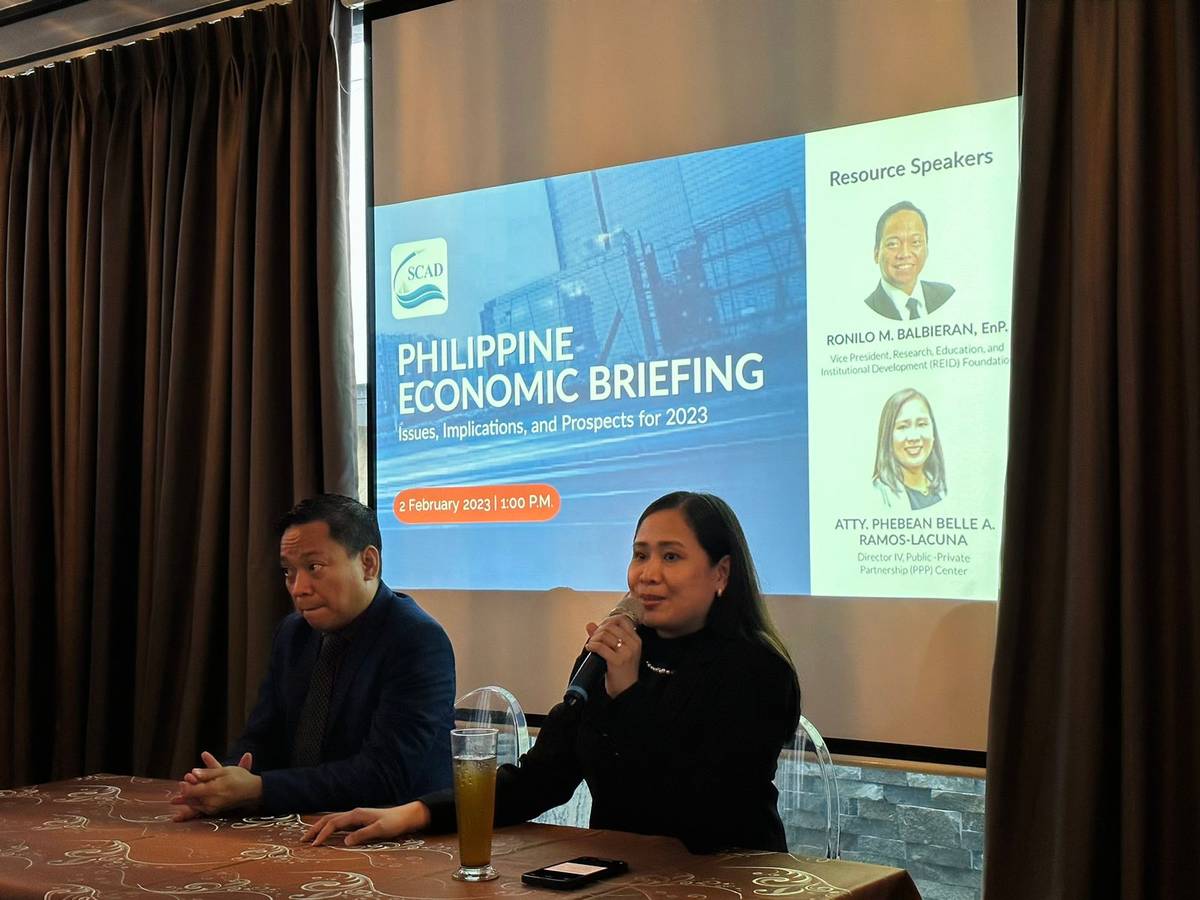
GROUNDWORK for progress Ronilo Balbieran, vice president of the Research, Education and Institutional Development Foundation (left) and Phebean Belle Ramos-Lacuna, Public-Private Partnership Center director, break down the infrastructure buildup push of the administration of President Ferdinand Marcos Jr.Groundwork for progress Ronilo Balbieran, vice president of the Research, Education and Institutional Development Foundation (left) and Phebean Belle Ramos-Lacuna, Public-Private Partnership Center director, break down the infrastructure buildup push of the administration of President Ferdinand Marcos Jr.
Photograph courtesy of REID Foundation
Oil prices have spiked due to geopolitical uncertainty, “the keyword is uncertainty,” Balbieran stresses.
A brief ceasefire talk quickly gave way to renewed conflict, making prices “sticky downward.”
He invoked the classic “rocket and feather” phenomenon under the country’s oil deregulation law, in which prices shoot up like a rocket when global costs rise, as oil firms protect profits and inventory strategies, but descend slowly like a feather when they fall.
The Philippines, a net oil importer with a peso weakened against the dollar, feels this acutely. So far, the pain has been concentrated in the transport sector, but if the crisis drags on another one to two months, pushing the total to 2 to 3 months, in which food prices will catch up, and gross domestic product (GDP) growth could approach zero.
Yet Balbieran is not sounding a doomsday alarm but points to an ongoing infrastructure push as a potential buffer.
“What we want is for infrastructure spending — payments and procurement—to offset rising prices,” he explained.
Construction workers and related sectors stand to benefit most, provided government and private projects accelerate. The real danger, he says, lies in a double crisis: oil shock plus stalled infrastructure, which could drag year-end GDP significantly lower.
He also flags risks beyond domestic borders. A potential escalation in the Middle East could trigger an overseas Filipino workers (OFW) repatriation crisis.
With 60 to 70 percent of overseas Filipino workers possibly returning if power infrastructure is targeted, remittances, the lifeblood of dollar reserves, could plummet.
Balbieran does not discount the risk of broader regional fallout. Under President Ferdinand Marcos Jr.’s emergency powers, the government should immediately reduce excise taxes on fuel to encourage spending.
This, he argues, must come on top of, rather than in place of, cash subsidies for low-income families and targeted oil discounts for transport operators, such as jeepney and bus drivers.
“Why do we have to choose? This is already an emergency — especially for lower-income groups,” he said.
“We don’t need to choose anymore. Decisions have already been delayed. We should implement all of them.”
Balbieran acknowledged the orthodox view that higher excise taxes during price spikes help fund subsidies.
But he counters that with oil consumption already declining, continued heavy taxation risks a “silent journey to depression” for lower-income Filipinos.
Instead, the government should redirect unused infrastructure funds (notably from the 2025 and 2026 budgets) and treat the situation like a pandemic response, distributing cash widely to households, which make up about 76 percent of the economy.
“There’s no point in over-calculating who gets aid and who doesn’t,” he insisted. “We should rescue Filipino families.”
He is equally blunt on fiscal optics. While some worry about revenue loss from tax cuts, Balbieran noted that VAT on oil automatically rises with prices, and other revenue streams (income tax and VAT from non-oil sectors remain robust.
The middle class, a major taxpayer group, must be protected to keep the economy humming. “You want them to survive.”
Balbieran’s message is that the economy remains resilient for now, but hesitation could turn a manageable fuel shock into something far worse.
As he put it in one recent broadcast: the government must act fast to keep the engines running — literally and figuratively — until global uncertainty subsides and oil prices eventually ease, potentially three to six months after any lasting resolution in the Middle East.
In a nation where every peso counts for millions of families, Balbieran’s call is both a technical economic brief and a human one by keeping spending flowing, protecting the vulnerable, and letting infrastructure carry the load.
For now, the choice, he believes, is not between revenue and relief; it is between action and paralysis.