
DFA urged to act against China’s WPS expansion attempt
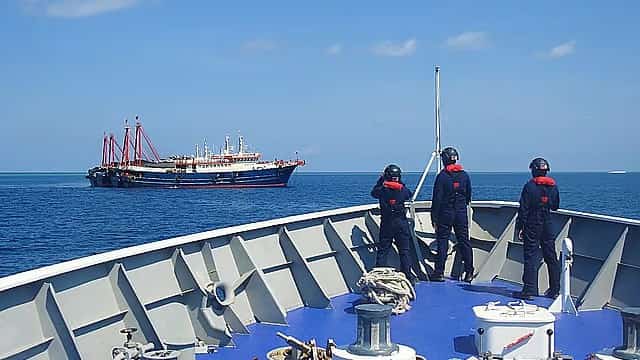
(FILES) Philippine Coast Guard crew members aboard the BRP Cabra monitor a Chinese vessel anchored at Sabina Shoal, a West Philippine Sea outcrop located about 135 kilometers west of Palawan. China’s ‘aggressive’ actions in the WPS have earned condemnation from the Philippines and such countries as the United States, Japan, and Australia.
Handout/Philippine Coastguard/AGENCE FRANCE-PRESSE
The Department of Foreign Affairs was urged Wednesday to immediately file a diplomatic protest against China for allegedly exploiting the ongoing oil crisis to expand its footprint in the West Philippines Sea under the guise of oil and gas exploration.
Senator Jinggoy Estrada issued the call as well for the Armed Forces of the Philippines, urging the troops to intensify routine patrols in the disputed waters amid the reported progress in talks between Manila and Beijing for the joint energy exploration.
The move aims to ensure a steady fuel supply amid global disruption brought about by the Middle East crisis, but Estrada derided it as “deliberate” and “illegal,” citing studies indicating substantial untapped oil and natural gas resources in the WPS being unlawfully claimed by China.
“Any attempt to exploit the situation—at a time when global attention is focused on the ongoing conflict in the Middle East—not only undermines our sovereignty, but also threatens regional security and the rules-based international order,” he argued.
China signaled an openness to a truce with the Philippines to resume the stalled talks on joint energy development, notwithstanding the dispute over the sea to be explored.
This came after President Marcos Jr. bared in late March that the United States-Israel war on Iran may provide as “impetus” for the Philippines and China to revive stalled negotiations for a joint energy exploration in the contested waters of the South China Sea despite their longstanding maritime dispute.
This was subsequently supported by DFA Secretary Maria Theresa Lazaro, who confirmed the arrangement had long been on the table, but past negotiations had been hampered by a “little misunderstanding on the finer points of the discussion.
The ongoing maritime tensions in the WPS between the two nations are also a contributing factor, according to President Marcos.
Despite strained relations, the President expressed openness to revisiting oil talks with China, notwithstanding a 2023 Supreme Court ruling that declared the gas exploration “unconstitutional.”
The tripartite agreement, signed by former president Gloria Macapagal-Arroyo, allows the Philippines, China, and Vietnam—or the primary claimants in the SCS—to explore oil resources in the highly disputed region.
The agreement, called Joint Marine Seismic Undertaking (JMSU), covered some 142,886 square kilometers, much of which lies within the Philippines’ 200-nautical-mile exclusive economic zone.
The SC ruling states the JMSU was unconstitutional for allowing wholly foreign-owned corporations to participate in the exploration of the country’s natural resources, in violation of Section 2, Article XII of the Constitution, which mandates that such resources remain under full state control and supervision.
The high court ruled in favor of the petitioners, led by former progressive lawmakers, finding that the arrangement effectively allowed foreign entities to undertake large-scale exploration of Philippine petroleum resources.
According to Estrada, the revived pact is “unacceptable and deeply concerning,” given the series of past aggressive maritime incidents maneuvered by Beijing against Filipino troops.
He argued that while efforts were made to address the tightening fuel supply in the country, which is heavily dependent on imports from the Middle East, asserting jurisdiction in the WPS in the face of China’s “provocative actions” is equally important.
“We have fought and won our rights in the arbitral tribunal, in accordance with the United Nations Convention on the Law of the Sea. Therefore, it is clear: the West Philippine Sea is ours, including the resources within it,” he stressed in Filipino.
Retired SC associate justice Antonio Carpio also expressed alarm about the revived joint energy talks, warning that it could be a “trap” for the Philippines to concede ownership of its oil, gas, and natural resources to China.
China brazenly continues to asserts juridisction in the entire SCS, which overlaps WPS, notwithstanding the 2016 arbitral ruling that favored Manila and invalidated Beijing’s maritime assertion as baseless.