
Oil crisis exposes need to shift from fossil fuels to solar powers, renewable energy: expert
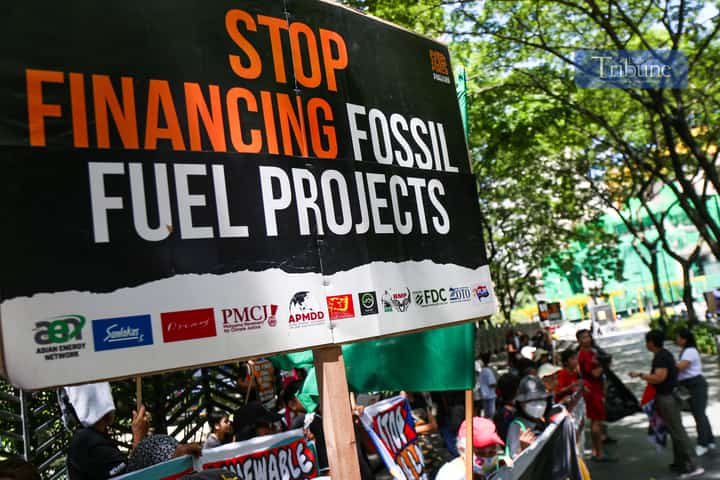
Climate advocates rally at the Ninoy Aquino Monument in Makati City on 24 June 2025, urging the Japanese government and its financiers to end support for coal and other fossil fuel projects in the Philippines and across Asia. They call instead for stronger investments in renewable energy like solar and wind.
Photo by Toto Lozano for DAILY TRIBUNE
The ongoing oil crisis brought about by the conflict in the Middle East has exposed the need for the Philippines anew to shift dependence from fossil fuels to clean energy like solar power and other renewables, an energy expert said Tuesday.
Gerry Arances, director of clean energy think tank Center for Energy, Ecology, and Development (CEED), argued that the Philippines’ “over-reliance” on fossil fuels like coal, oil, and gas being imported from other countries is “very vulnerable to international attacks,” which trigger supply disruption, leading to elevated electricity costs and higher bills for consumers.
He lamented that the Philippines still has not learned from the past energy crises, with the most recent being in 2022, triggered by the Russia-Ukraine war, before the latest crisis in the Middle East caused by the United States-Israel conflict with Iran.
“CEED and the Power for People Coalition have been saying this and advocating for a long time that we transition away from being dependent on fossil fuel, coal, or gas because there are renewables,” Arances said in Filipino in a radio interview.
The Philippines is heavily reliant on fossil fuels to sustain power supply, with coal accounting for over 60 percent and natural gas around 15 percent as of 2024, data from the Southeast Asia Information Platform for Energy Transition showed.
As the threat of global oil shortage looms large, which could strain energy supply, Arances argued that it’s high time that the Philippines shift away from questionable imported and expensive fossil fuels to renewable energy.
This is through investing in solar power to enhance energy security and lower electricity costs, especially for the vulnerable sectors—farmers and fisherfolk—who are backbones of food security.
Solar panels, installed on rooftops to convert sunlight into electricity, will help produce “clean and inexpensive electricity,” according to Arrances, though the government will shell out around P30 to P50 billion to deploy at least 1 million solar panels nationwide.
“The government can easily deploy that amount of money,” he said.
The government, he added, should not be complacent this time because the oil crisis is projected to last even if the US-Israel war on Iran stops earlier than expected.
The Department of Energy on Monday announced that the government is fast-tracking the completion of about 1,471 megawatts of renewable energy and energy storage projects. The objective is to have them operational as early as April to ensure power stability in the face of the looming uncertainty in oil supply.