
Stars share life during the war

To mark the liberation of the Philippines from Japanese forces 81 years ago, The Butcher wrote a column last month condemning wars and how humanity is affected by nations fighting each other. And now, it’s the US and Israel vs. Iran.
While the Philippine government is trying its best to repatriate our poor overseas Filipino workers (OFWs), a lot of them are still trapped in the Middle East, fearing for their safety. Tragically, a Pinay caregiver named Mary Ann Velasquez de Vera died during a missile strike in Israel while trying to save her patient during the attack.
Apart from deaths and massive destruction, war also brings rationing. That is the fear of every Filipino now. Gas prices did not only shoot up, but until when would supply last? And what about the price — and availability — of basic commodities? We should also worry about that.
During the Japanese Occupation, Filipinos did not only fear for their lives. They also went through food rationing and lack of fuel for transport. Below are real-life accounts of how our local movie stars suffered from deprivation during the Second World War.
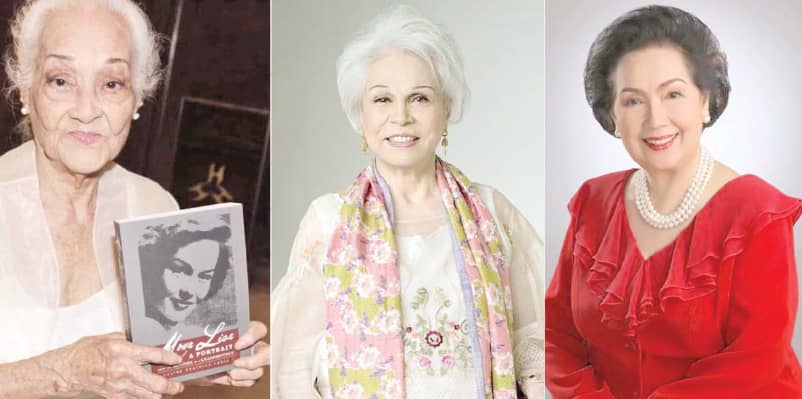
MONA Lisa, Armida Siguion-Reyna and Susan Roces.
Photographs courtesy of IMDB/ Facebook
Armida Siguion-Reyna
Armida didn’t suffer like most other Filipinos during the early phase of the war. Her maternal grandparents (the Liwanags), after all, still had a thriving business making hats (worn by every gentleman in the past) even during the Japanese Occupation. Her father, the lawyer Alfonso Ponce-Enrile, was also lucky to have found a job as treasurer of the Manila Jai-alai almost immediately after his law firm was shut down.
Getting to work became a problem for Atty. Siguion-Reyna, though. Automobiles were confiscated by the Japanese. And even if one still had a car, there was no gasoline to run it since the Japanese controlled fuel supply. That was when the “dokar” (from dogcart) was introduced here in the Philippines and even in Indonesia.
The “dokar” was very much like the calesa. It was a carriage that was also pulled by a horse. In time, however, even the “dokar” disappeared from the streets of Manila. Some of the horses that were used to run the “dokar” — horrors! — were slaughtered and consumed by a starving population. Even dogs, cats and — ugh — rats vanished from city streets and turned into food. Hunger numbs even the most discriminating palate.
To solve his transportation woes, Atty. Ponce-Enrile got himself a bicycle and pedaled away from his in-laws’ house in Pinaglabanan in San Juan to the Jai-Alai office along Taft Avenue. That was no mean feat, especially since he had to bike under the scorching afternoon sun every day and race back home at night to beat the 8 p.m. curfew.
During the early part of World War II, Armida’s mother, the opera singer Purita Liwanag, was still able to make native cakes for her mahjong sessions with friends (there was nothing much to do around that period). But as the war deepened, they had to make do with “castanog.” “Castanog” was a marriage of two words: castañas (chestnut) and niyog (mature coconut).
Coconut trees were still abundant in the city even during the war. To ease their hunger, Filipinos roasted the thick flesh of the niyog and to their delight, a lot of them swore that it tasted like castanas, the holiday treat that makes its presence during Christmas.
Toward the end of the Japanese interlude, Armida, then already 14, experienced beyond imagination the tragedy of war. She and her family were evacuating from place to place to get away from the cruelties of Japanese soldiers. One time, she was bathing — with her body covered in soap suds — when somebody shouted: “Mga Hapon!” She only had time to put on her underwear before she rushed out of the bathroom to run for safety. Armida was wrapped in a sarong while bathing and did not bother to rinse herself anymore. She was that scared of the Japanese.
Mona Lisa
Mona Lisa, who played Hilda Koronel’s mother in the film version of Insiang, suffered a lot more during the war. According to the book, Mona Lisa: A Portrait, which was written by the actress’ granddaughter, Celine Beatrice Fabie, Mona Lisa was pregnant with the son of Fernando Poe, Sr. (FPJ’s dad) when a severe food shortage hit Manila during the Japanese Occupation.
A woman on the family way needs all the nutrients her body requires during pregnancy. But the only food source that was within reach was the swamp of kangkong (water spinach) across their house in the neighborhood of San Andres in Manila. Mona Lisa and her family ate boiled kangkong three times a day that it almost came out of her ears. Due to malnutrition, Mona Lisa had fainting spells. Her body craved for protein, but there was no meat available.
Susan Roces
In the case of Susan, the late movie queen was just four months old when war erupted in December 1941. She was almost four years old by the time the war ended. Susan recalled always being teased for being skinny. How could she have gained weight given the food shortage during the wartime years?
Food deprivation during the Japanese Occupation had a lasting effect on her. While having snacks with this writer years back, she said that there is one word in the Filipino vocabulary that prevents most mothers from losing weight: “Sayang (What a waste).”
Unknown to many, Susan wasn’t only mother to Grace Poe. She also raised the brothers Jeffrey and Joseph Sonora, who are her nephews and FPJ’s grandchildren. How did that happen? The two boys’ father, Joey, is the brother of Susan. He married FPJ’s niece, Penny, who is the daughter of Poe’s sister, Elizabeth. When Joey and Penny separated, Susan and FPJ decided to raise Jeffrey and Joseph.
During meals with the kids, Susan recounted to me, she would cringe every time the children didn’t finish all the food on their plates. She always ended up eating all the leftovers. “Sayang” — she would say to herself, recalling the war years when she and her family often just slept off hunger pangs.
In 1973, it was also tension in the Middle East that gave birth to what eventually was called “the first oil shock.” The Philippines was also affected by the fuel shortage that then President Ferdinand Marcos, Sr. suspended classes in the primary and secondary levels for a whole month. Gasoline was rationed.
The government also worried about the shortage of rice that was already being imported even then from Southeast Asian neighbors. Filipinos, therefore, were encouraged to eat rice mixed with corn grits. That wasn’t a problem in Cebu and in other provinces in the Visayas and Mindanao. The Cebuanos, in particular, were no stranger to bigas mais, especially for those who live in areas — usually the islands — where it was difficult to transport rice.
But that didn’t fly for people in imperial Manila. For Manilenos, it had to be white rice (if only they knew then that white rice easily converts to sugar). Maybe it was due to the fact that Manila was closer to Central Luzon, which was the rice granary of the Philippines.
Fortunately, the oil crisis didn’t last long. By Christmas season of 1973, Jamon Excelente was back as part of the Noche Buena spread among middle class Pinoys. And it was the whole leg – not per kilo. Today, ham lovers with limited budget make do with scrap, which Excelente sells for P900 per 500g.
It was easier to deal with the oil crisis in the old days. There were fewer automobiles. It was also more convenient to carpool since the only urbanized areas were Manila, Cubao, Caloocan and Makati. Las Pinas was practically still considered to be quite rural and was famous for its salt mines — and, of course, the bamboo organ. Alabang and even BGC (Bonifacio Global City) were rice fields.
After more than half a century, the metro had expanded. There are even megacities in the Visayas and Mindanao. The population is so much bigger now. How are we going to cope with rationing?
Filipinos are resilient. That used to be considered a positive trait among Pinoys. But in the face of the corruption scandals, resiliency is now a bad word among the more enlightened Filipinos. Why do we have to be content with crumbs the government gives us? We contribute so much in taxes, after all. And yet, Filipinos are expected to still be pliant at all times, while some senators, congressmen and people in government help themselves to public funds.
But if the Middle East war continues, there may be no choice for us but to be resilient, as usual. That should be no problem though. No thanks to corrupt government officials, we had a lot of practice when it comes to being resilient.