
Somebody forgot he’s President
In the Office of the President alone, more than P4 billion to P4.5 billion can be realigned to provide assistance to overseas Filipino workers.

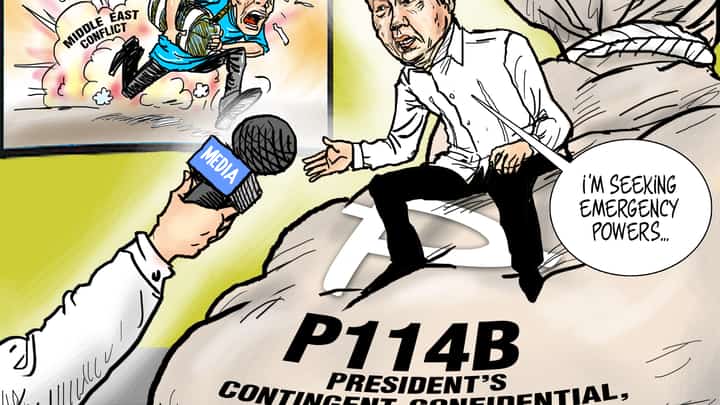
Seeking emergency powers will require a process in Congress that, even if granted, may be too late for the economy and the 10 million Filipinos working overseas.
The critical situation, if not addressed immediately, may push many of our countrymen here and overseas into a desperate situation that cannot be addressed by a speech at the United Nations General Assembly on sharing best practices on gender equality.
If there is a crisis that will test President Ferdinand Marcos Jr.’s capabilities, this is it.
Several budget years have shown that the administration has the resourcefulness to sweep the budget for doles to command patronage, a skill that can be applied in the current crisis situation.
An emergency power will need a law, and the power will be applied on revising the tariff or the excise tax once certain conditions are met.
Former Senate President Frank Drilon, however, said the 2026 budget has many items available for use. There are around P112 billion to P114 billion in contingent, confidential, and intelligence funds which can be pulled from the spending plan to cushion the impact of the Middle East crisis.
“There is sufficient authority because the turmoil in the Middle East could not have been predicted at the time the budget was being crafted. That is why they are called contingent funds,” Drilon pointed out.
In the Office of the President alone, more than P4 billion to P4.5 billion can be realigned to provide assistance to overseas Filipino workers (OFWs) “immediately.”
All that is needed, Drilon said, is the President’s authority to realign some items in the confidential and intelligence funds for assistance to OFWs.
There is sufficient authority in the present budget, making it superfluous for the Emergency Powers Act that President Ferdinand Marcos Jr. is talking about.
The powers already exist under current law to address the problems spawned by the war between the United States–Israel alliance against Iran.
Reviewing the excise tax system, particularly regarding the importation of oil, can come later. Drilon said it is about time the tax schedule is reviewed, as it has become too burdensome and a hindrance to attracting investments.
“However, if we are talking about the need for funds right away to respond to the needs of our countrymen in the Middle East, there is sufficient authority under the General Appropriations Act to address this,” Drilon held.
Under the Constitution, the President has the authority to realign budget items, to move funds from one item to another.
The resources under Mr. Marcos’ discretion can be used to assist OFWs while waiting for the authority to revise the excise tax on oil and prevent increases in the prices of basic goods.
The funds can also be used to repatriate Filipinos if the war worsens.
The cost of basic commodities is, in effect, affected by the tariff on imported oil, which should be reduced immediately to prevent a spiraling increase in their prices.
“So a short-term solution, and a longer-term approach, which involves reviewing the law,” must be in place.
Leadership is urgently needed at this juncture, as the impact of high prices threatens the nation.
It cannot wait until Mr. Marcos completes his semi-junket to New York.