SUBSCRIBE NOW SUPPORT US

DMW asks Congress for supplemental budget to repatriate 2.4M OFWs in Middle East

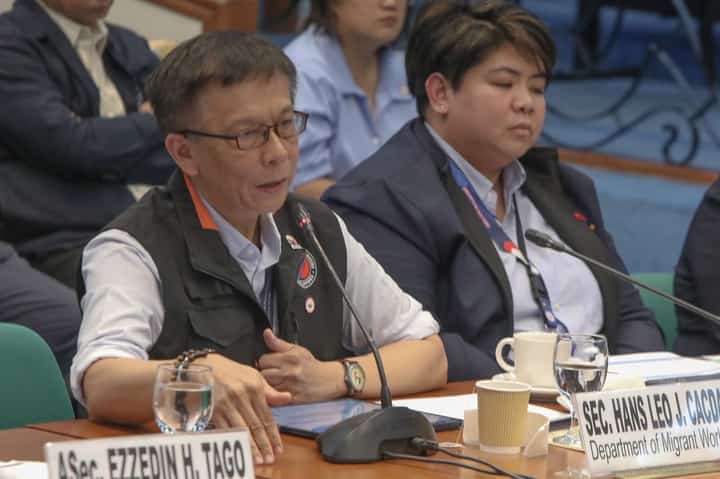
DMW Secretary Hans Leo Cacdac over a joint hearing of the Senate Committee on Foreign Relations and the Committee on Migrant Workers on Friday, 6 March 2026
DMW Secretary Hans Leo Cacdac over a joint hearing of the Senate Committee on Foreign Relations and the Committee on Migrant Workers on Friday, 6 March 2026Aram Lascano for the DAILY TRIBUNE
Published on

The Department of Migrant Workers (DMW) would need supplemental funding from Congress to bankroll the repatriation expenses for over 2.4 million overseas Filipino workers in the Middle East if the ongoing conflict there hits “worst-case scenario.”

DMW Secretary Hans Cacdac did not explicitly provide an estimated additional repatriation fund, but said that the agency already tapped the Department of Budget and Management for sourcing. 

However, Senator Sherwin Gatchalian, head of the Committee on Finance, estimated that the supplemental budget may reach as high as P13 billion, which Cacdac agreed. However, the amount would only cover 93,000 Filipinos, regardless of whether they are OFWs or pilgrims.

“We need the funding in a worst-case scenario. We can live with the current budget, with the current level of repatriation requests. However, the question of whether we can handle the worst-case scenario also depends on increasing repatriation requests,” Cacdac said during the hearing of the Senate Committee on Foreign Relations on the government’s response to the Israeli-United States war on Iran.

Earlier, Gatchalian said securing Congress’ approval for a supplemental budget would require lengthy deliberations.

As of Friday, there were around 2,000 active repatriation requests from overseas Filipino workers (OFWs).

According to Overseas Workers Welfare Administration (OWWA) Administrator Patricia Yvonne Caunan, the Emergency Repatriation Fund (ERF) under the 2025 budget stands at P1.286 billion. OWWA also has a continuing appropriation of P474 million from the previous year, bringing the total available funds to P1.76 billion.

“But Mr. Chair, it’s already March. It is already being used. We already have around 15 percent utilization, so it is only around P1.5 billion,” Caunan told the committee.

DMW Secretary Hans Leo Cacdac over a joint hearing of the Senate Committee on Foreign Relations and the Committee on Migrant Workers on Friday, 6 March 2026
DMW may seek more funds if Middle East crisis worsens

With the conflict in several Middle Eastern countries driving up transportation and accommodation costs, Caunan said OWWA would need additional funds to cover repatriation-related expenses.

She said the estimated repatriation cost per OFW was initially pegged at around P135,000 to P140,000 during the early days of the conflict last week. However, the figure is expected to increase by about P10,000 per person in the coming days due to rising service costs, bringing the estimated cost to around P150,000 per head.

At that rate, the current ERF allocation could only cover the repatriation of around 10,000 OFWs.

Caunan said OWWA could face a funding gap of about P338 million if only 0.5 percent — or roughly 12,000 — of the estimated 2.4 million OFWs in the Middle East request repatriation.

“So let’s say 1 percent requests repatriation, that would be around 24,000, Mr. Chair. Our funding gap will stand at P2.2 billion. So the total estimated cost will be around P3.67 billion at P150,000,” she added.

Department of Finance Undersecretary Maria Edita Tan told senators that the government is considering tapping the contingency fund, subject to the President’s approval, aside from using available government savings.

The contingency fund may be used exclusively for urgent projects and activities that need to be implemented within the year.

“So what happens is that DBM would tell us whether there is sufficient funds, or we could tap the contingency fund. Otherwise, we could look into the possibility of providing a supplemental budget for them,” Tan said.

Some senators have also proposed using the President’s contingency fund to provide immediate fuel subsidies to public utility vehicle drivers without waiting for Dubai crude oil prices to exceed $80 per barrel.

Latest Stories

No stories found.
logo
Daily Tribune
tribune.net.ph