
PH, Japan, U.S. stage fresh WPS maritime drills
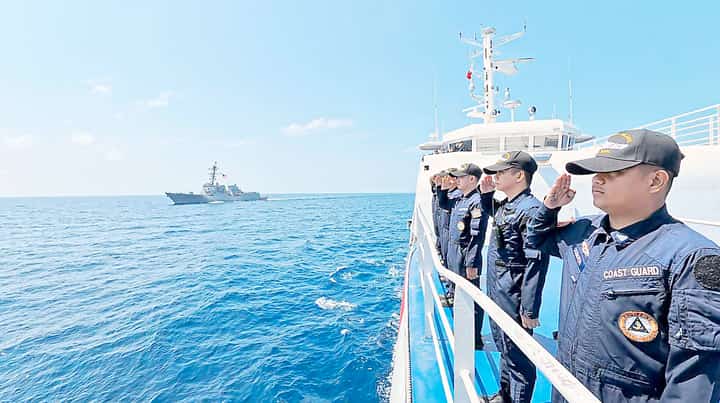
JOINT patrol The BRP Gabriela Silang takes part in the 15th Multilateral Maritime Cooperative Activity with the Armed Forces of the Philippines, the United States Indo-Pacific Command and the Japan Maritime Self-Defense Force in the West Philippine Sea.
Photo courtesy of PCG
The Armed Forces of the Philippines (AFP), together with the Japan Maritime Self-Defense Force and the United States Indo-Pacific Command, conducted the 15th Multilateral Maritime Cooperative Activity recently in the West Philippine Sea (WPS), continuing a series of joint maritime engagements this month.
Philippine assets included the Navy’s BRP Antonio Luna with an embarked AW159 helicopter, Philippine Air Force FA-50 fighter jets, C-208B aircraft, A-29 Super Tucano aircraft and a Sokol search-and-rescue helicopter.
The Philippine Coast Guard deployed BRP Gabriela Silang, reflecting what officials described as a whole-of-nation approach to protecting the country’s maritime domain.
Japan contributed a P-3 Orion maritime patrol aircraft, while the United States deployed the guided-missile destroyer USS Dewey and a P-8A Poseidon maritime patrol aircraft.
Exercise components included communications checks, maritime domain awareness drills, replenishment at sea, joint air patrols, fly-bys, ship maneuvering exercises, a photo exercise and anti-submarine warfare drills.
The BRP Antonio Luna conducted a live-fire gunnery exercise to validate targeting accuracy and combat readiness. The activity concluded with post-exercise evaluations.
Encounters
The drills come as the Philippines continues to report encounters with Chinese vessels in the West Philippine Sea, including incidents involving water cannoning, blocking maneuvers and close-quarter actions against PCG and civilian resupply ships.
In 2016, an arbitral tribunal cited the United Nations Convention on the Law of the Sea as it ruled in favor of the Philippines, declaring China’s expansive “nine-dash line” claim to most of the South China Sea to have no legal basis.
The ruling also found that several maritime features claimed by China were either rocks or low-tide elevations and did not amount to exclusive economic zones.
China rejected the ruling and has continued to assert sovereignty over vast portions of the sea, including areas within the Philippines’ 200-nautical-mile exclusive economic zone.
Chinese forces have since maintained a sustained presence around contested features, including Scarborough Shoal and areas near Second Thomas Shoal, where Philippine forces maintain a grounded naval vessel as an outpost.
China has also carried out large-scale land reclamation and construction activities on several features in the Spratly Islands, including Fiery Cross Reef, Subi Reef and Mischief Reef.
Regional stability
Satellite imagery and defense assessments have shown the construction of airstrips, hangars, radar installations, missile platforms and port facilities, developments that regional security analysts say have altered the strategic balance in the area.
Philippine officials have said recent maritime cooperation activities are part of broader efforts to enhance deterrence, surveillance and interoperability with partners while asserting rights under international law.
Manila has expanded security partnerships amid tensions in the West Philippine Sea through defense agreements, joint patrols and capacity-building initiatives.
The Philippines has defense arrangements with the United States under the Enhanced Defense Cooperation Agreement and conducts regular joint exercises with Australia.
In 2024, Manila and Tokyo signed a Reciprocal Access Agreement allowing each country’s forces to train and operate in the other’s territory. Officials have said the partnerships aim to reinforce freedom of navigation, maritime domain awareness and adherence to international law, while improving disaster response and regional stability.