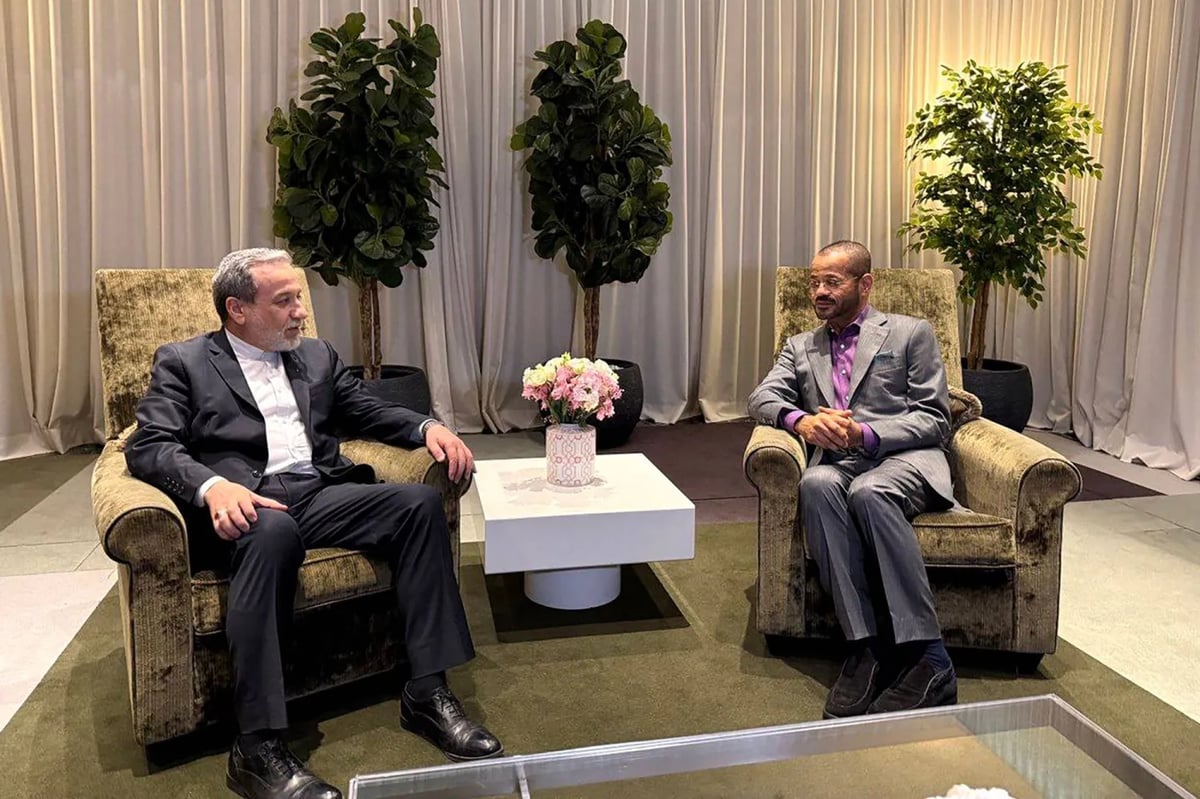
TEHRAN (AFP) — Iran’s Foreign Minister Abbas Araghchi said on Friday that in order to reach a deal, the United States will have to drop its “excessive demands,” after the two sides held talks in Geneva.
In a phone call with Egypt’s top diplomat Badr Abdelatty, Araghchi said “success in this path requires seriousness and realism from the other side and avoidance of any miscalculation and excessive demands.”
Araghchi did not clarify what demands he was referring to, but Washington has pointed to Iran’s ballistic missile program and has repeatedly described Tehran’s uranium enrichment capability as a red line.
US President Donald Trump said on Wednesday that Tehran had “already developed missiles that can threaten Europe and our bases overseas, and they’re working to build missiles that will soon reach the United States of America.”
Also on Wednesday, US Secretary of State Marco Rubio said Iran is “not enriching right now, but they’re trying to get to the point where they ultimately can,” adding that Tehran “refuses” to discuss its ballistic missile program and “that’s a big problem.”
Iran has repeatedly said its missile program is part of its defensive capabilities and has ruled out abandoning uranium enrichment, insisting its nuclear program is solely for peaceful purposes.
Longtime adversaries Iran and the US held their third round of Omani-mediated nuclear talks on Thursday in Geneva, seeking to avert military escalation as Washington expands its military build-up in the region.
Both Iran and Oman cited progress after the talks, with technical discussions scheduled for Monday in Vienna ahead of a fourth round expected next week.
Meanwhile, a powerful Iran-backed Iraqi armed group told its fighters to prepare for the scenario of a long war in neighboring Iran should the US launch strikes.
Kataeb Hezbollah warned the US on Thursday of “immense losses” were it to start a war in the region, while a commander in an armed faction told Agence France-Presse his group was “highly likely” to intervene in case of strikes.
“Amid American threats and military build-up indicating a dangerous escalation in the region, it is necessary” for all fighters “to prepare for a potentially long war of attrition,” Kataeb Hezbollah said in a statement.
The commander told AFP that his group sees Iran as strategic to its own interests, and therefore any attack on the Islamic republic “directly threatens us.”
US-sanctioned Iraqi armed groups did not intervene during the 12-day war between Israel and Iran last year.
This time, the commander said they would be “less restrained”, especially in the event of strikes seeking to overthrow the regime