
DENR cites EPR partners as plastic waste recovery hits 56%
‘The EPR Law is alive, operational and reshaping how we manage waste in this country.’


Text size
‘The EPR Law is alive, operational and reshaping how we manage waste in this country.’
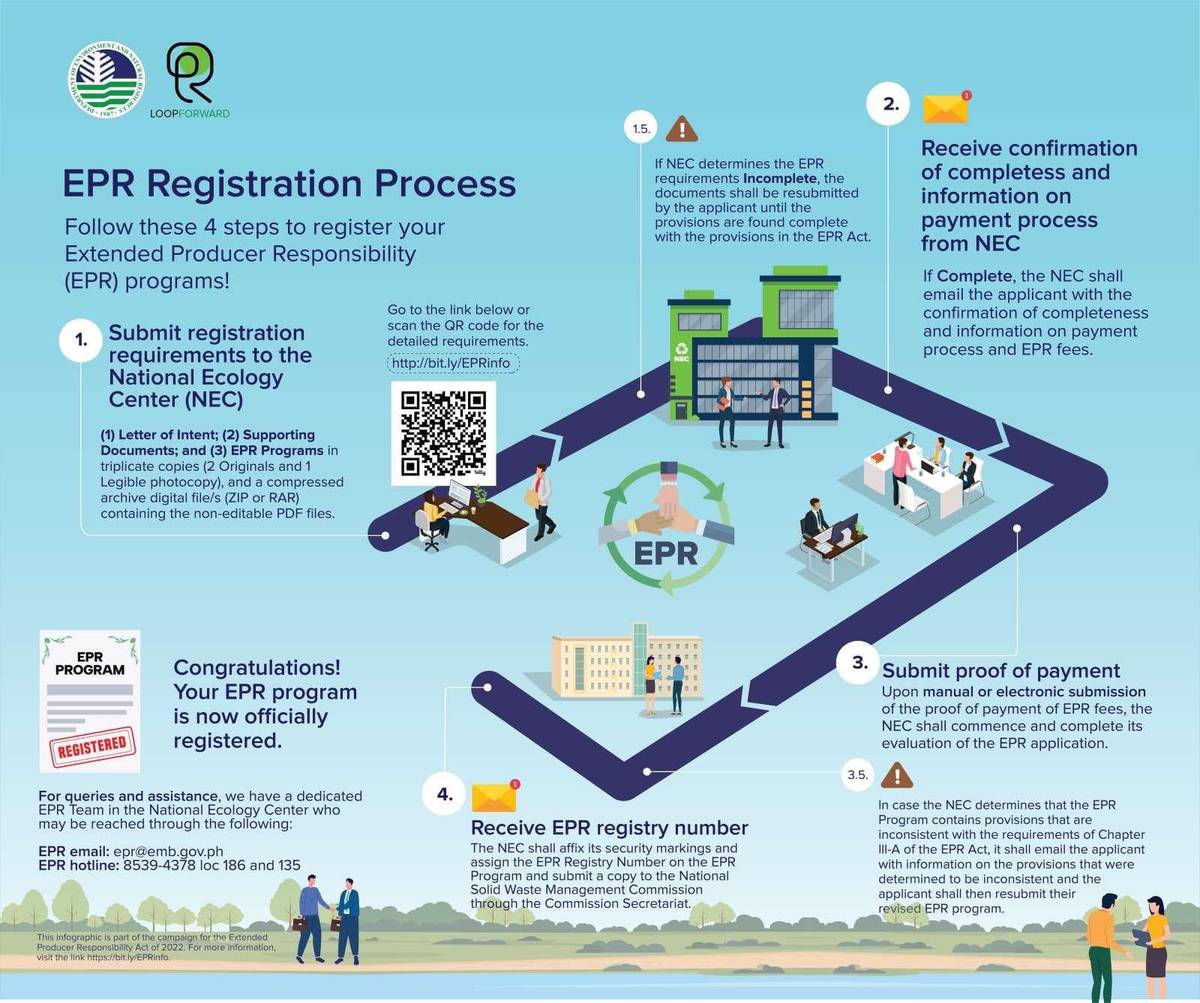
STEPS in registering as obliged enterprise under the EPR law. Registration must be maintained, yearly compliance documentation must be submitted and escalating recovery targets must be met.
Image courtesy of DENR
The Department of Environment and Natural Resources (DENR) has reported exceeding its 40 percent target of recovering plastic waste in 2025 by registering a national diversion rate of 56 percent last year.
Over 246 million kilograms of plastic waste had been diverted in 2025 as a result of 1,017 entities registering their Extended Producers Responsibility (EPR) programs as of January 2026, according to the DENR’s Environmental Management Bureau (EMB).
The EPR Act of 2022 requires companies producing plastic packaging to be responsible for related waste that consumers generate and they have to register with the EMB as obliged enterprises (OEs) under the law to implement it.
DENR Secretary Raphael P.M. Lotilla attributed the success of the EPR law to the increased private sector participation and broader engagement with compliance requirements.
“These efforts show that the Philippines is not simply complying with global standards; we are helping shape the transition toward a circular economy,” Lotilla said.
“What we celebrate today are not just milestones; they are proof that when government, industry, and communities move together, policy translates into impact and commitment becomes measurable change. The EPR Law is no longer an aspiration. It is alive, operational, and reshaping how we manage waste in this country,” he added.
Of the plastic waste recycled, upcycled and co-processed in 2025, more than 56 percent were flexible plastics and over 55 percent were rigid plastics, the DENR revealed during its 2026 EPR Recognition Program on 30 January.
Held alongside the National Zero Waste Month and the 25th anniversary of the Ecological Solid Waste Management Act (RA 9003), the event co-organized by the EMB and the Philippine Alliance for Recycling and Material Sustainability complimented OEs. Coca-Cola Europacific Aboitiz Philippines (CEAP) was among OEs that received a Special Citation.
“This recognition reflects our unwavering support for the EPR Law and the power of strong partnerships, as we continue to work together in building a circular economy and advancing collection and recycling in our communities,” read CEAP’s Facebook post.
The CEAP provided the Coca-Cola Sprite Contour Bin in November 2025 to encourage the active participation of EMB-National Capital Region personnel in the proper recovery, segregation, and disposal of PET plastic bottles.
On 26 January, EMB-NCR officials collected a total of 12.18 kilograms of recyclable materials from the bins in the agency’s ground. The waste earned 12.42 environmental points or cashback.
The activity supports the Bureau’s solid waste management initiatives and aligns with the EPR law and RA 9003.
Meanwhile, the EMB celebrated the 25th signing anniversary of RA 9003 at the Novotel Hotel on 27 January 2026 with the theme “Honoring our Legacy, Renewing our Commitment, Innovating for a Cleaner Tomorrow.
Lotilla said, “RA 9003 has been the cornerstone of our environmental mission for 25 years, turning waste management from a logistical problem into a shared national duty.”
“We take pride in the significant strides made in waste segregation and sustainable infrastructure, yet we recognize that the true success of this law lies in the behavioral change and shared responsibility of every Filipino,” assistant secretary for environment and concurrent EMB director Jacqueline A. Caancan.
Since the passage of RA 9003, the Philippines has transformed a culture of uncontrolled dumping to a regulated, decentralized system. The creation of materials recovery facilities across the country and the incorporation of solid waste management into local government planning are two significant accomplishments that were highlighted during the anniversary.
Looking ahead to 2026, the DENR identified priority areas for strengthening implementation, including improvements in digital monitoring systems, capacity-building within institutions, and public information efforts. Planned measures also include the standardization of audit frameworks to enhance transparency and the development of systems to incentivize more sustainable packaging design.
The Commission on Audit (CoA) has “affirmed with finality” its P73.28-million disallowance of confidential funds spent…
Car company Tesla has rolled out its autonomous taxi in Austin, Texas, USA.
First Lady Liza Araneta-Marcos joined members of the Philippine Constitution Association (PhilConsa) in celebrating its…