
Anti-aging injection shows promise against arthritis pain
Stanford researchers say a new treatment could regrow knee cartilage.


CARTILAGE is a soft tissue that cushions joints. Once it tears or breaks down, it rarely repairs itself, often leading to joint pain and stiffness.
Stock photo.
For millions of people, arthritis is a painful reminder of aging or past injury. Osteoarthritis, the most common form, develops when cartilage in the joints wears down over time. This cushioning tissue allows bones to move smoothly, but once it breaks down, it rarely repairs itself.
Current treatments focus on managing pain and inflammation through medication, physical therapy, or steroid injections. In severe cases, patients often face joint replacement surgery. Despite how common arthritis is, no existing drug can stop or reverse cartilage loss.
A new approach to joint repair
Researchers at Stanford Medicine say an experimental anti-aging injection could change that. Instead of treating symptoms, the therapy targets a protein that increases with age and contributes to tissue decline. By blocking this protein, scientists found that damaged cartilage could begin repairing itself.
In studies involving older mice, the treatment restored knee cartilage that had thinned with age. In animals with knee injuries similar to anterior cruciate ligament (ACL) tears, the injection prevented arthritis from developing altogether.
How the injection works
Rather than introducing stem cells or artificial tissue, the treatment works by reprogramming existing cartilage cells. These cells are encouraged to return to a healthier, more youthful state and begin producing functional cartilage again.
Researchers observed the regrowth of smooth, flexible cartilage needed for joint movement, rather than scar-like tissue that offers little protection. The therapy was tested both as a whole-body injection and as a direct injection into the knee joint, with cartilage regrowth seen in both methods.
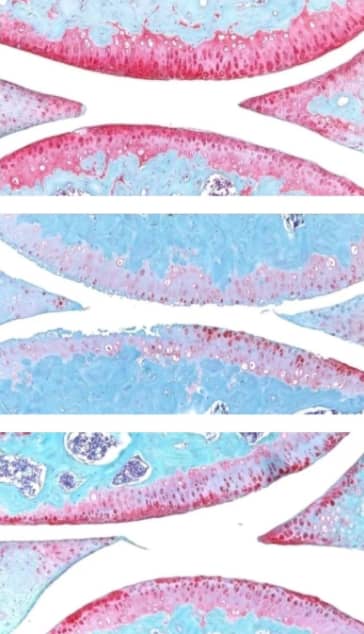
Top to bottom: knee joint of a young mouse, deteriorated knee joint of an elder mouse, and knee joint of the elder mouse after cartilage treatment. The red indicates cartilage, and the bottom image shows significant cartilage restoration.
Photo by Nidhi Bhutani, PHD, seen in Science. DOI: 10.1126/science.adx6649
Early results in human tissue
To assess whether the treatment could work beyond animal models, researchers tested it on human knee tissue collected during joint replacement surgeries. Within a week, treated samples showed signs of new cartilage formation and reduced tissue breakdown.
While this does not yet prove the treatment will work in living patients, the results suggest that aging human cartilage may still have the capacity to repair itself under the right conditions.
Implications for knee injuries
Arthritis does not affect only older adults. Sports-related knee injuries often lead to joint damage years later. About half of people who tear an ACL develop osteoarthritis in the same knee within 15 years, even after surgery.
In animal models, repeated injections of the experimental drug after injury significantly reduced the likelihood of arthritis and helped restore more natural movement. Researchers say this raises the possibility that early treatment could protect joints before long-term damage sets in.
What comes next
The therapy remains experimental and is not yet available to patients. Although a pill-based version of the same drug is being tested in early-stage clinical trials for age-related muscle weakness, trials focused specifically on arthritis have not begun.
Researchers caution that further testing is needed to confirm safety, effectiveness, and long-term outcomes in humans, noting that not all treatments that work in animals translate directly to people.

Current treatment for arthritis includes relieving and managing pain and regaining mobility. Further treatments could mark significant improvements in quality of life of patients.
Photo from shutterstock.
A possible shift in arthritis treatment
Despite the early stage, the findings point to a potential shift in arthritis care. Rather than managing pain until joint replacement becomes necessary, future treatments may aim to restore joint health by addressing aging at the cellular level.
If successful, this approach could delay or reduce the need for joint replacement surgery. For now, the research offers cautious optimism that cartilage loss may not always be permanent.