
Roasted, revered, and possibly haunting me: Thoughts on the lechon
The lechon sits at the centre of our holiday tables...and in my uneasy thoughts.
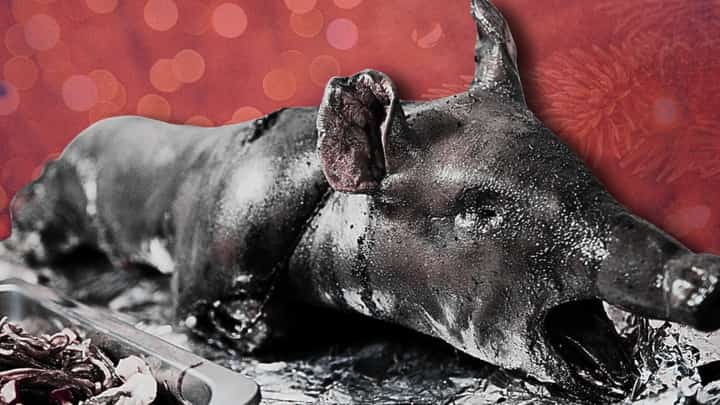
THE LECHON is just one of the many pork-based dishes in the Philippines, highlighting the pig's significance to local cuisine. But the pig is also a spiritual motif amongst our ancestors, especially in the Cordilleras.
Banner by Chynna Basillaje for Daily Tribune.
During the holiday season, Filipinos prepare a luscious feast both as a celebration for the past year and a hopeful welcome to the next, and perhaps also as a symbol of prosperity and abundance. At every Filipino table, the lechon often claims centre stage, surrounded by a riot of flavours, textures, and dishes that seem to overflow the table itself.
The lechon is a whole pig, tied and skewered, slow-roasted over gentle flames or smouldering embers that give off white, puffy smoke. It is stuffed with aromatic herbs such as lemongrass, garlic, onions, and bay leaves, and goes through an extensive process of meticulous basting, turned over steady heat for hours, until the meat emerges tender, richly flavoured, and the skin crisp. Watching people feast on it, I cannot help but feel a morbid curiosity about the pig, its cultural significance, particularly in the Cordilleras, and what it means to consume such a ritualised animal during a holiday like Christmas.
When I was a freshman in university, I had the pleasure of interviewing Dr. Maria Luisa Camagay from the University of the Philippines for a course requirement. I learned from her that pre-colonial Filipino families primarily based their economic status on how many animals they owned, which were directly related to how capable they were of feeding their families. Amongst these animals was the pig. In Filipino culture, almost every part of it was used to extract maximum value: the skin and the meat, but also the fat, which other countries might discard, but which we have turned into a delicacy called chicharrón. Philippine cuisine today still reflects that pragmatism, with pork anchoring dishes such as adobo, sinigang, lechon, lumpia, barbecue, and more. But the pig's significance goes beyond mere food and delicacy.
Later, in my college years, I stumbled upon Jon Henrick Remme's book Pigs and Persons in the Philippines: Human-Animal Entanglements in Ifugao Rituals. This book provided more context and layers to my fascination and unease toward the animal. After all, I grew up seeing trucks of live pigs, their beady eyes meeting mine sometimes, and the unsettling realization that these animals were being shipped off to slaughter for my belly and for countless other Filipinos. My discomfort was less about compassion and more a kind of revulsion, as I think the pig seems to occupy the liminal space between human and animal. There is something uncanny in them, which the early Ifugao people also recognised.
Between 1600 and 1700 CE, the Ifugao people saw an increase in ritual feasting. This came alongside their resettling in the interior of the Cordillera Mountains, after being driven away by the Spanish conquest of the Magat Valley. The Ifugao found shelter and safety in the mountains, during which they transitioned from cultivating taro to wetland rice, as evidenced by the rice terraces in the region. But aside from feasting on rice, they also saw a rise in the consumption of domesticated pigs, which came after sacrificing their animals to the spirits they believed also inhabited their world.
An Ifugao myth explains the ritual of sacrificing a life to appease spirits responsible for the health of their people and their crops—the myth of Igon. Narciso Tan writes in his book Púgot: Head Taking, Ritual Cannibalism, and Human Sacrifice in the Philippines:
“It began when crops had failed and illnesses had fallen upon the people. To appease the spirits, the Ifugao conducted a ritual sacrifice. (...) First, a rat was sacrificed, and then a snake. But that was not enough for the deities, so the Ifugao continued to suffer. Then the Ifugao decided to kill and offer a certain man named Igon. This time, the spirits were appeased” (Tan 143).
However, the myth also explains that while the human sacrifice was successful in appeasing the spirits, the Ifugao had also “committed an evil thing in spilling human blood” and that when they needed to sacrifice to the gods, “do not offer rats, snakes, or your children, but take pigs and chickens only” (144).
John Henrick Remme, in his 2014 ethnographic study of Batad culture in Ifugao, wrote that humans had ownership of domestic animals in the earthly plane, which meant that domestic animals (the pig included) were extensions of humans and appropriate substitutes for human sacrifices. In Ifugao culture, the pig, alongside other domesticated animals, was considered under human control. Wild animals were under the control of spirits called bā’i. Wild animals were not to be used in blood sacrifices to the bā’i, because sacrificing them meant offering something to the spirits that were already their property. This explains why the sacrifice of rats and snakes did not appease the spirits in the Ifugao myth.
The pigs then became sacred in their role as intermediaries between humans and the divine. Remme writes, they “are appropriate sacrificial substitutions, and as objects of exchange they are, we could say, part of the person who sacrifices them.” The people “are” the pigs they own and sacrifice (Remme 60). However, with this narrative in mind, I cannot help but ask: If the sacrificial pig is an extension of its sacrificer, eaten afterward, where does sacrifice end and selfhood begin? How do we distinguish pig from person, if they are one?
This lens casts the lechon in a new, unsettling light when we consider it as the centrepiece of Christmas feasts. Christmas, for Christians, celebrates the birth of Jesus Christ, who is widely considered the ultimate sacrifice given to redeem humanity of their sins. It's hard not to draw symbolic parallels between the pig and Jesus, though of course, I do not intend to offend nor belittle the latter's role in spirituality and religion. In the Bible, the story of the Gadarene swine (Matthew 8, Mark 5, Luke 8) recounts pigs into which Jesus casts demons, only for them to rush into the sea and perish. Pigs were also considered unclean in Jewish law, yet this uncleanliness is central to the narrative. There is a faint echo of this irony in our holiday feasts, however unintended.
Far be it from me to police diets or haunt merriment with macabre tales of slaughter, sacrifice, and spiritual law. Yet I cannot fully dismiss my unease. I shall stay away from the lechon, eyeing it warily as though the pig might sense my prejudices against it and rise from the dead to haunt me. Given the course of my life, a ghostly or demonic pig seems neither unlikely nor wholly implausible. But I digress.
Happy holidays, and may your celebrations be joyful—though perhaps less so for the dead lechon being picked clean in your merriment.
References:
De la Cruz, Aaron Philip. "The pigs that therefore I am." Review of Pigs and Persons in the Philippines: Human-Animal Entanglements in Ifugao Rituals, by Jon Henrik Remme. AGHAMTAO: Journal of the Ugnayang Pang-Aghamtao, vol. 26, 2018, pp. 175–180.
Lapeña, Queeny G., and Stephen B. Acabado. "Resistance through rituals: The role of Philippine 'native pig' (sus scrofa) in Ifugao feasting and socio-political organisation." Journal of Archaeological Science: Reports, vol. 13, June 2017, pp. 583–594, https://doi.org/10.1016/j.jasrep.2017.05.009.
Remme, Jon Henrik Ziegler. Pigs and Persons in the Philippines: Human-Animal Entanglements in Ifugao Rituals. Lexington Books, 2014.
Tan, Narciso C. Púgot: Head Taking, Ritual Cannibalism, and Human Sacrifice in the Philippines. Vibal Foundation, Inc., 2021.