
Imee Marcos’ drug allegations shake political landscape


On 17 November 2025, the second day of the massive Iglesia ni Cristo rally in Manila, Senator Imee Marcos made a startling and shocking public allegation: her brother, President Ferdinand “Bongbong” Marcos Jr., along with First Lady Liza Araneta-Marcos and their son, Sandro, are drug users. She claimed that the substance abuse started long ago and has persisted until the current day. She also said that she personally witnessed it in her and Bongbong’s youth, and the revelation also came with it a grave accusation. According to Imee, Bongbong’s drug abuse has fueled corruption at the very heart of his administration. This isn’t just a sibling rivalry anymore. This charge calls into question the president’s fitness, accountability, and moral standing.
Her revelation is deeply political and disturbingly personal. Mental health as a whole, and in particular substance abuse, is rarely discussed in the Philippines without quick recourse to stigma, punishment, or scandal. The public discourse on drugs tends to dwell not on care or recovery of those involved, but rather on control, condemnation, and punishment. So when Imee Marcos raised her voice, she forces a confrontation with the uncomfortable overlap between drug policy, privilege, and power.
A legacy of punitive drug discourse
To understand the weight of Imee’s accusation, we must first understand how the Philippines’ drug discourse has been shaped in history.
The framework of “drug menace,” as critics have pointed out, dates back to the early years of the Marcos Sr. (Bongbong and Imee’s father) dictatorship. In Drugs and the Marcos Dictatorship: The Beginnings of the Philippines’ Punitive Drug Regime (1970–1975), scholars Gideon Lasco and Vincen Gregory Yu argue that the elder Marcos regime deliberately constructed a narrative of drug users as "enemies of the state." Drug use and addiction was intertwined with crime, communist insurgency, and social decay. This allowed the administration to justify heavy-handed policies with authoritarian rule.
This punitive model did not disappear after the fall of Marcos Sr. It has since affected following administrations, and even evolved into something more violent ⸺ Rodrigo Duterte's violent "war on drugs" that left thousands of people dead and/or detained. It was mostly the marginalised and the urban poor who bore the brunt of law enforcement's worst excesses. This approach to substance use led to human rights violations, and Rodrigo Duterte is currently on trial with the International Criminal Court for his sanctioned killings and nationwide crackdown.
With the Marcos Sr. and the Duterte administrations contributing to the history and perception of illegal drug policies the Philippines has today, it is shocking that Bongbong Marcos is now associated with drug use himself. The irony is stark. The same family that ⸺ in its past iterations of power⸺ championed and capitalised on a punitive drug narrative is now being confronted with allegations from within.
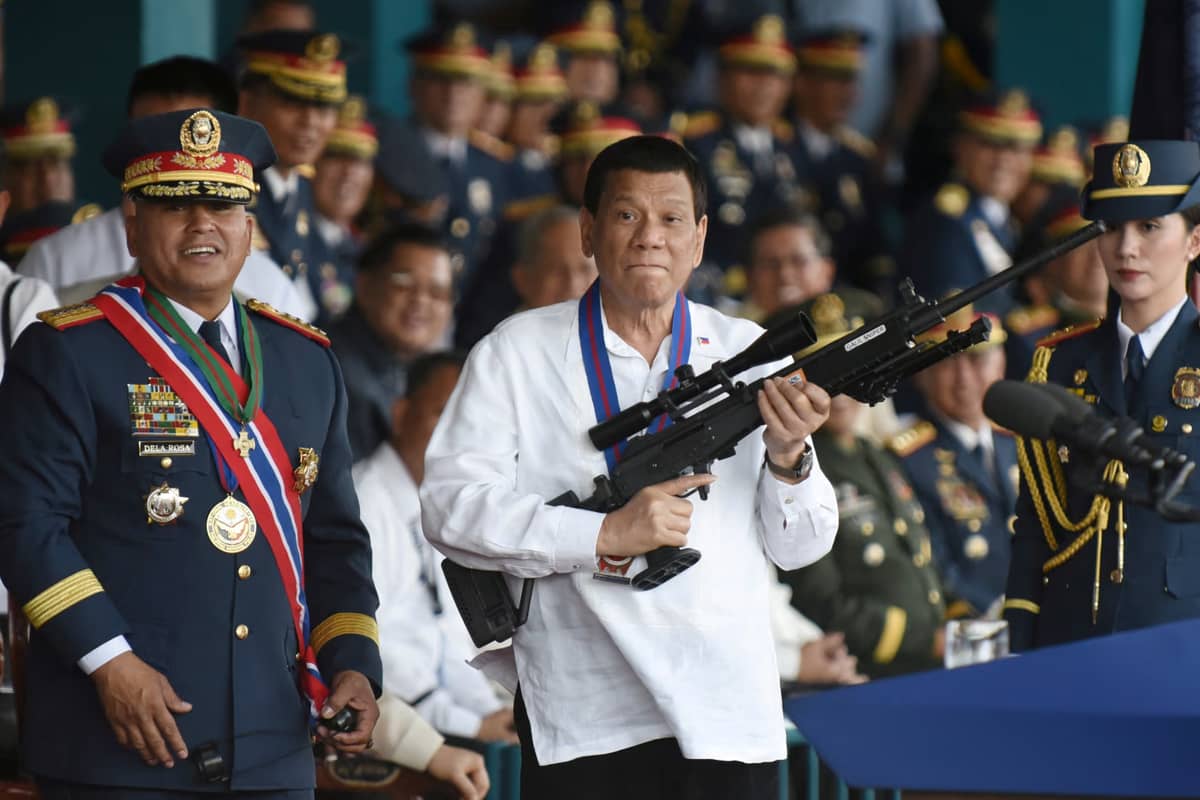
Philippine President Rodrigo Duterte holds a rifle next to outgoing Philippine National Police Chief Ronald Bato Dela Rosa in April.
Reuters

The First Family: Sandro Marcos (left), Bongbong Marcos (middle), and Liza-Araneta Marcos.
RTVM
The explosive accusation
Imee's claims, delivered before a crowd estimated in the hundreds of thousands, were unflinching and bold-faced. She said that the Marcos family had known about Bongbong's drug use since she and her brother were young. She described confronting her brother, urging him to change and seek help to get drugs out of his system, and even suggested that his marriage to Liza Araneta-Marcos would be a stabilising move to help him get his life together. But then, Imee later stated that this suggestion was a mistake, as the marriage had exacerbated the couple's shared addiction.
According to Imee, Bongbong’s son, Ilocos Norte 1st District Representative Sandro Marcos, is also involved. She painted a picture of a powerful family entrenched in susbtance abuse, not merely as a personal vice, but also as a potential driver of poor governance. She linked her brother's alleged drug habit to corruption and bad decision-making that has affected and resulted in the flood control projects investigation we know today.
Malacañang swiftly pushed back. Attorney Claire Castro, Undersecretary of the Presidential Communications Office, called the revelations a "desperate" and "baseless" move. Castro questioned Imee's motives, especially given ongoing corruption investigations. The Presidential Palace also pointed to a negative cocaine test from 2021, which was conducted at St. Luke's Medical Center, insisting that the accusations against the president have already been "disproven."
Sandro Marcos has also spoken out, saying that his Tita Imee's accusations are "a web of lies aimed at destabilizing the government." Furthermore, he said that this was an attempt to "advance her own political ambitions."
In the past, former Rodrigo Duterte also called Bongbong Marcos a "drug addict."
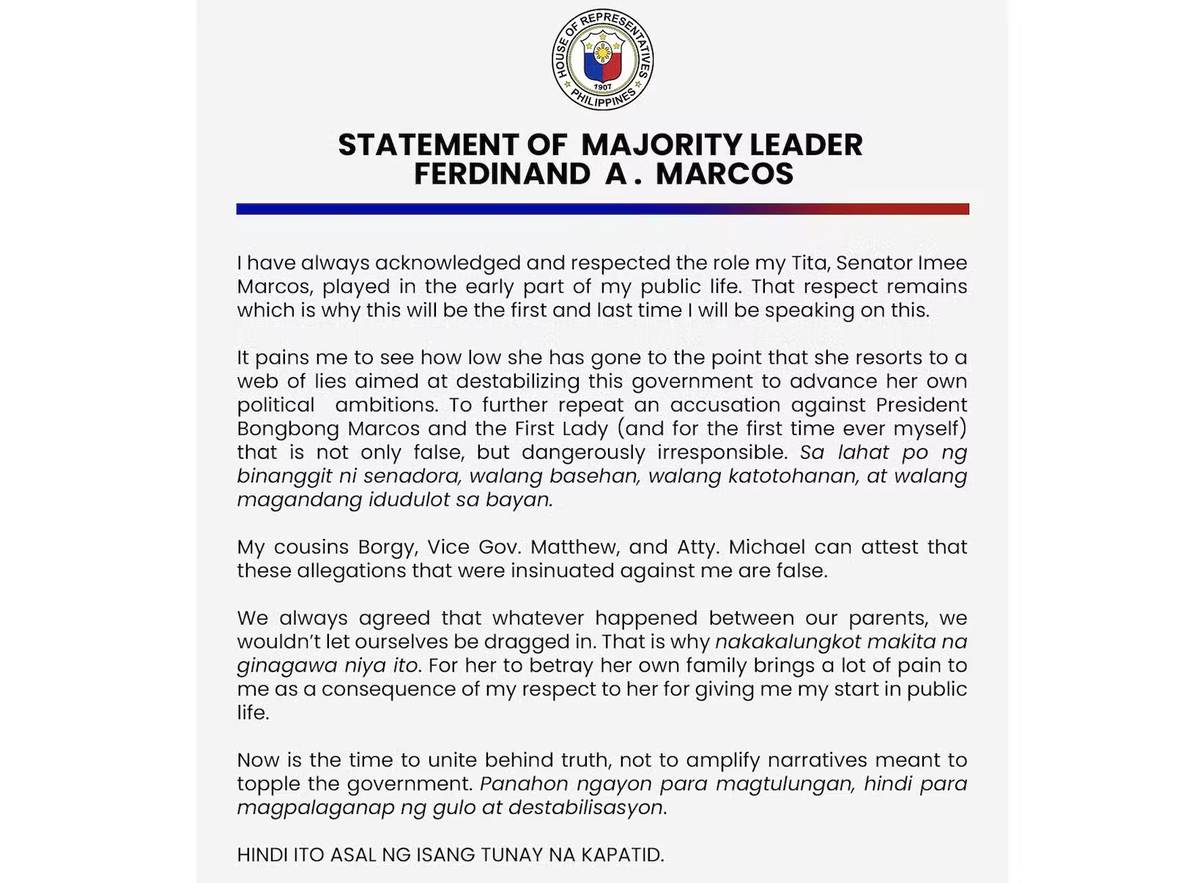
House Majority Leader Sandro Marcos has issued a statement denying allegations by his aunt, Sen. Imee Marcos.
Sandro Marcos on Facebook
Why this is more than a family feud
At first glance, this might look like just a bitter sibling rivalry. Another spectacle in the drama of Philippine politics. But this scandal taps into much deeper currents.
Firstly, it challenges the double standard in how drug use is treated in Philippine society. Over decades, drug users ⸺ particularly the poor ⸺ have been demonised, criminalised, and even killed. But the Marcos family occupies a different echelon of society, one where wealth and power afford protection and insulation from negative consequences. There is even an ilicit suspicion that any medical issues can be swept under the rug.
Bongbong Marcos is not the sole example. A separate scandal involving Kitty Duterte, Rodrigo Duterte's youngest daughter, happened earlier this year. Netizens exposed Kitty's alleged drug use which she posted on a private (and now deacticated) Instagram @Purplekushbakie. In this Instagram account, Kitty Duterte was said to have a dedicated highlight reel of her "wake and bake" moments, titled "killa KU$Hla." She posted about how frequently she used cannabis, even in public, and had even mocked the parents of Kian Delos Santos, a 17-year-old brutally murdered in 2017 during her father's war on drugs. She even wrote in two separate posts: “as someone who’s never felt guilty in her entire life, I'm telling you I have no conscience," and "mga inggrata kayo. and ejk my ass btw."
("You are all ingrates. And EJK (extra-judicial killings) my ass by the way.")

An account on Instagram allegedly belonging to Kitty Duterte showed a highlight reel of Kitty using illegal drugs.
@ThisIsForKian on Twitter/X
These cases ⸺ both the Marcos family's and Kitty Duterte's ⸺ reflect a government where consequence is selective. Where accountability is not the standard, but rather something that is implemented only when it benefits those who are on top. We can call these cases ironic all we want, but the truth is much more sinister. This is a result of a moral impairment in those who are supposed to lead us. A disconnect from their duty to serve, and the privilege and power that they abuse.
Secondly, Imee's words draw attention to the political risk of substance abuse in public office. If her allegations are true, they raise legitimate concerns: how does alleged long-term drug use affect a head of state's decision-making? Can addiction compromise judgement? Does it impair accountability? These are questions that do not simply indicate moral personal failings. They could have very real implications for governance and national interest. Political continuity and stability rely on the actions and integrity of a country's constitutional agents.
The president’s decisions affect billions. If his cognitive or emotional capacity is impaired because of substance use, the public deserves transparency. Moreover, if the allegations are true ⸺ that important decisions were made under influence ⸺ Bongbong Marcos must be held accountable. A doctor who operates on a patient while under the influence will face legal and professional repercussions such as loss of license and malpractice lawsuits. Public officials, especially the head of state, must also face repercussions if drug use accusations are proven true. Imee claims that Bongbong's drug use resulted in the flood control corruption. This is a heavy accusation.
Whether or not Imee made this claims to create scandal, organise a destabilisation attempt, or to further her own political agenda, the government must investigate and look deeper, treating this as seriously as they would if a lower member or an ordinary citizen was accused. We must not let the First Family's status, any diagnosed or undiagnosed substance use disorders, or patriotism claims excuse any irresponsible behaviour and allow them to evade accountability. Furthermore, government structures are usually underpinned by constitutional conventions, rather than enforceable legal frameworks. Reforms must then be made in holding a member of the state accountable.
Finally, this scandal forces a reckoning with how stigma around drug use prevents meaningful discussions about treatment. If the President is indeed using, will he be offered help or shamed? Will there be a path to recovery, or wil this become a purely political sideshow?
The Marcos family, because of its influence, has an opportunity here to lead by example: seeking treatment publicly, de-stigmatising addiction, and opening a national conversation about mental health and substance use among the elite as well as the marginalised.
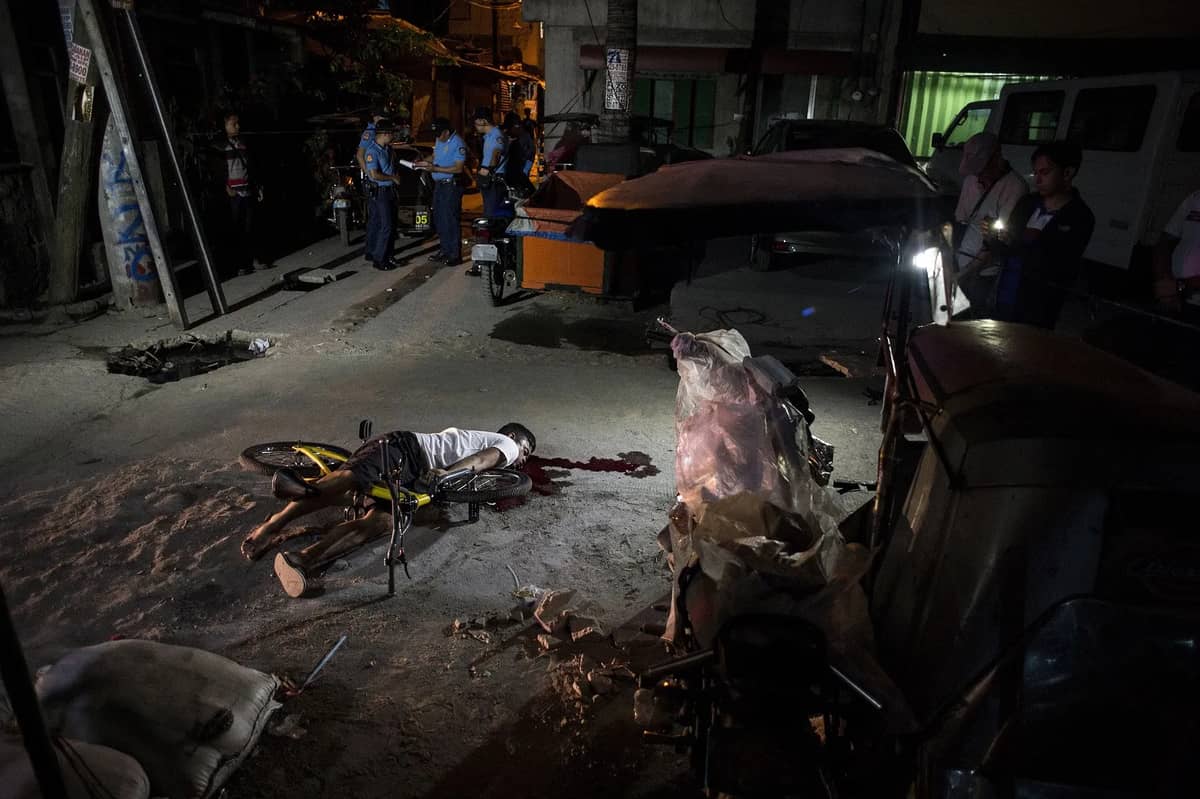
The body of an alleged drug dealer lies on the ground after he was killed by an unidentified assailant in Manila on 23 March 2018.
Getty Images
Substance use: A complicated reality
Understanding why people use drugs ⸺ and why it matters ⸺ requires empathy, neuroscience, and public-health insight.
Many turn to substances because of trauma, stress, or socioeconomic pressure. Others do so out of curiosity, boredom, or peer influence. At the neurological level, addictive drugs hijack the brain’s reward circuitry, flooding it with neurotransmitters like dopamine in ways far stronger than natural rewards. Over time, the brain adapts, making normal pleasures feel dull and pushing people to chase ever more intense highs. Withdrawal, cravings, and even long-term conditioning can make quitting extremely difficult.
Substance Use Disorder (SUD), then, is not a simple moral failing. It’s a complex condition that affects brain function, behaviour, and social life. Yet, because of stigma, many people with SUD avoid seeking treatment. In health-care settings, they may face discrimination. And in society, they are often viewed through the lens of criminality, rather than care.
There are models elsewhere in the world that the Philippines might look to. Many countries including Denmark, France, Germany, and Norway have adopted some form of decriminalisation of drugs and treatment procedures. Portugal is the most cited in case studies for drug reforms. In For instance, having small amounts of drugs for personal use is treated not as a crime, but as an administrative offense. Offenders are referred to “dissuasion commissions” made up of health, legal, and social work professionals ⸺ not prisons. Those with more serious use are offered treatment, not punishment. Such a system rests on the belief that addiction is a public health issue, not a purely criminal one. And it works: by focusing on harm reduction, Portugal has been able to significantly reduce overdose deaths, HIV transmission, and stigma.
If the Marcos scandal prompts real reform, that could be its silver lining. But if it's only treated as a political weapon ⸺ or worse, ignored ⸺ then it risks reinforcing existing inequalities: where the privileged escape real consequences, while the poor continue to pay the price.
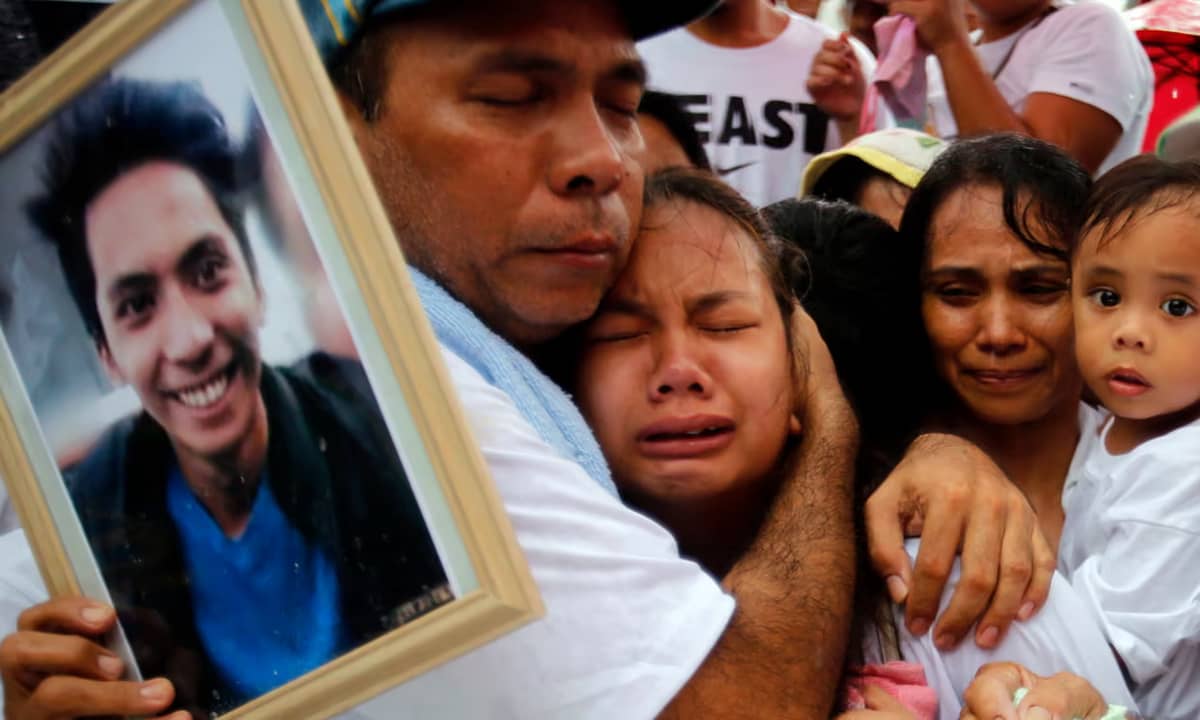
Relatives mourn Ephraim Escudero, the victim of an extrajudicial killing, in San Pedro city, Philippines.
EPA
References:
Alcohol and Drug Foundation, Decriminalisation vs legalisation: International models, 2025.
Alexander J. Smith et al., Mental health, medical incapacity, and political leadership in the United Kingdom: A multidisciplinary analysis of the intersections between psychiatry and constitutional law, 2025.
Edjen Oliquino, Sandro slams Imee over drug-use remarks on first family, 2025.
Gideon Lasco, Political constructions of people who use drugs in the Philippines: A qualitative content analysis, 2024.
Gideon Lasco & Vincen Gregory Yu, Drugs and the Marcos Dictatorship: The Beginnings of the Philippines’ Punitive Drug Regime (1970–1975), 2023.
International Criminal Court, Duterte Case: The Prosecutor vs. Rodrigo Roa Duterte, 2025.
National Institute on Drug Abuse, Drugs, Brains, and Behavior: The Science of Addiction, 2025.
National Institute on Drug Abuse, Stigma and Discrimination, 2022.
National Institute on Drug Abuse, The Science of Drug Use: A Resource for the Justice Sector, 2022.
Nymia Simbula et al., The Manila Declaration on the Drug Problem in the Philippines, 2019.
Raffy Ayeng, Sen. Imee claims PBBM has long-standing drug issues at INC-backed rally, 2025.
Rebecca Ratcliffe, Duterte calls Philippine president ‘a drug addict’ as rift deepens, 2024.
Richbon Quevedo, Imee’s claim of brother’s cocaine use called ‘desperate move’ says Castro, 2025.
Sónia Félix et al., Going after the Addiction, Not the Addicted: The Impact of Drug Decriminalization in Portugal, 2017.
Ted Regencia, Arrested on ICC warrant: What was Duterte's 'war on drugs'?, 2025.
ThisIsForKian, Kitty Duterte is an addict, 2025.
Wethepvblic, Kitty Duterte’s private Instagram stories have allegedly been leaked, 2025.