
Reb Belleza’s voyage into the cosmos within in latest exhibit


Joining the artist in opening the exhibit were Hugo Bunzl, Cid Reyes, Jia Santos Estrella, Alliance Française de Manille executive director Olivier Dintingier, Gus Albor, French Ambassador Marie Fontanel, Rowena Ocampo-Ejercito and DepED Secretary Sonny Angara.
Photographs courtesy of Reb Belleza
Recently mounted at the Alliance Française de Manille, “The Reflex and the Seven Astronauts” marked a very ambitious exhibition of artist Reb Belleza, a painter whose canvases have long seemed to orbit between dream and delirium. This new body of work — 35 abstract paintings ranging from intimate two-by-two-foot studies to expansive four-by-four-foot portals — extends Belleza’s ongoing poetic novel of the same title into the visual realm.
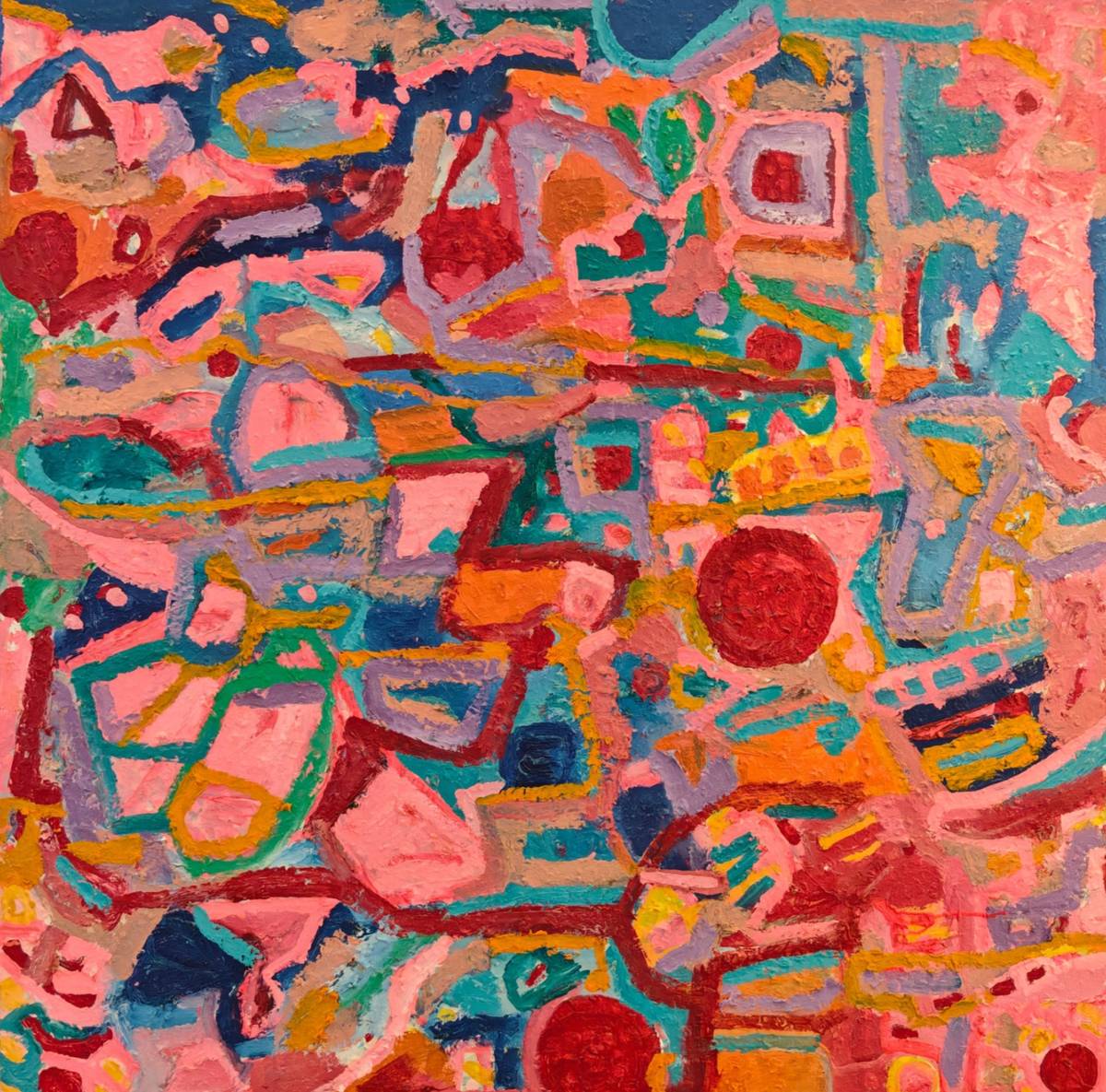
‘The Reflex 35’ (oil on canvas, 4 by 4 feet, 2025).
“Each canvas is like a portal in itself, a fragment of a larger constellation that completes the story of The Reflex and the Seven Astronauts,” Belleza said. The result is a universe of shifting color fields and textured frequencies where pigment seems to breathe, hum and dissolve into light.
The exhibit signaled a decisive evolution for Belleza. “This exhibit is my turning point,” he shared. “Under the mentorship of Gus Albor, I ventured into full abstraction — a complete departure from my earlier figurative and representational work.”
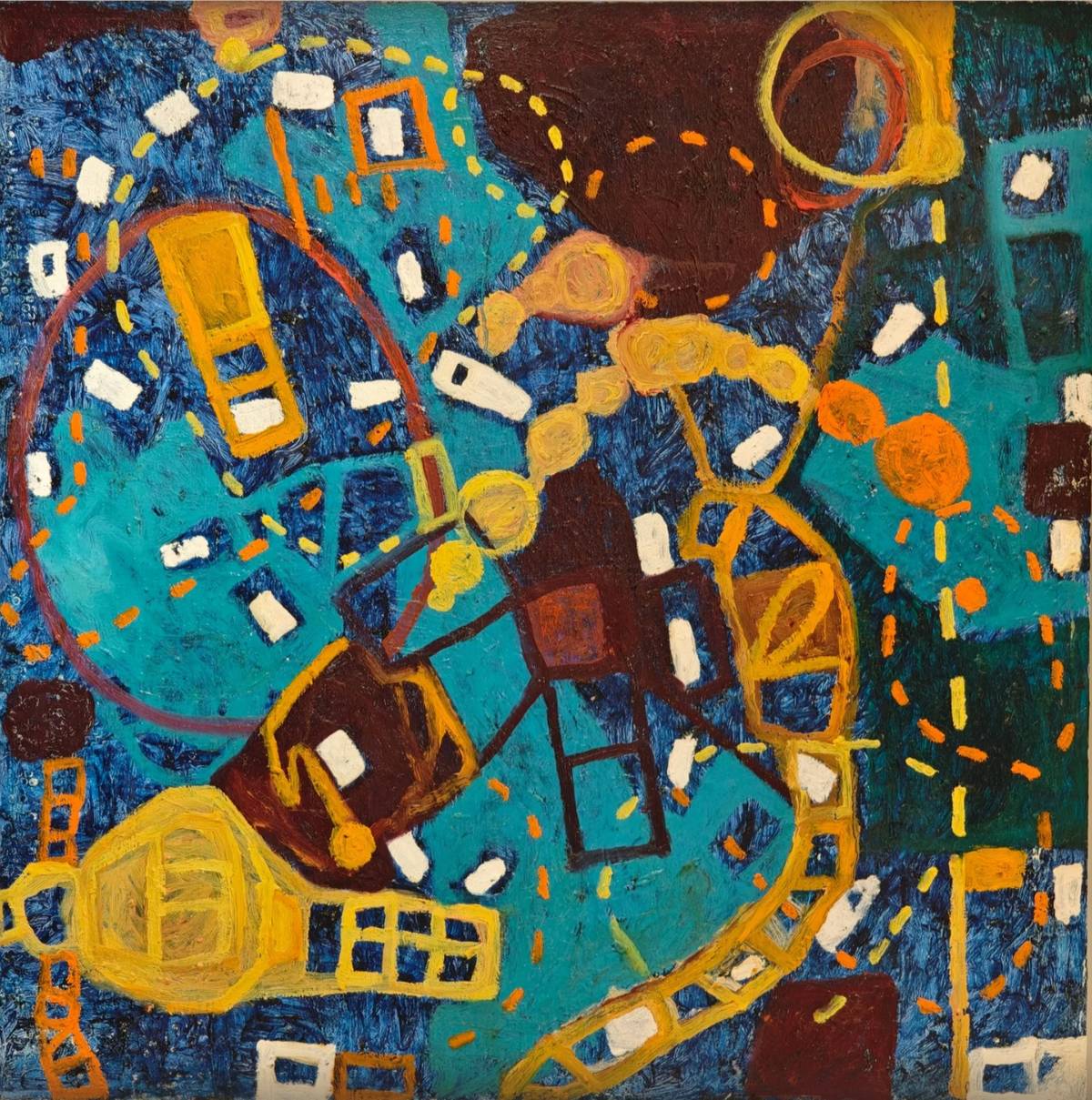
‘The Reflex 24’ (oil on canvas, 4 by 4 feet, 2025).

Belleza with art critic Cid Reyes.
Albor’s quiet influence ran through the show: the restraint of space, the meditation on tone, the courage of silence. Yet Belleza’s canvases retained their signature pulse — a rhythm of color that seems both cosmic and corporeal.
“Some paintings dissolve into color fields; others pulse with impasto and texture,” he explained. “I was drawn to the frequencies of blue, green, purple, and flesh tones — as if these hues carried the memory of skin, sea, and ether.”
In this transition from figure to field, Belleza has found a new language — less theatrical, more distilled, yet charged with emotional gravity. The seven astronauts of the title, he suggested, are not literal voyagers but vessels of human longing, trauma and rebirth.
If the exhibition title recalls the 1980s synthpop of Duran Duran, that is no accident. Belleza traces the project’s origins to his teenage fascination with the British band.

Olivier Dintinger, executive director of Alliance Française de Manille.
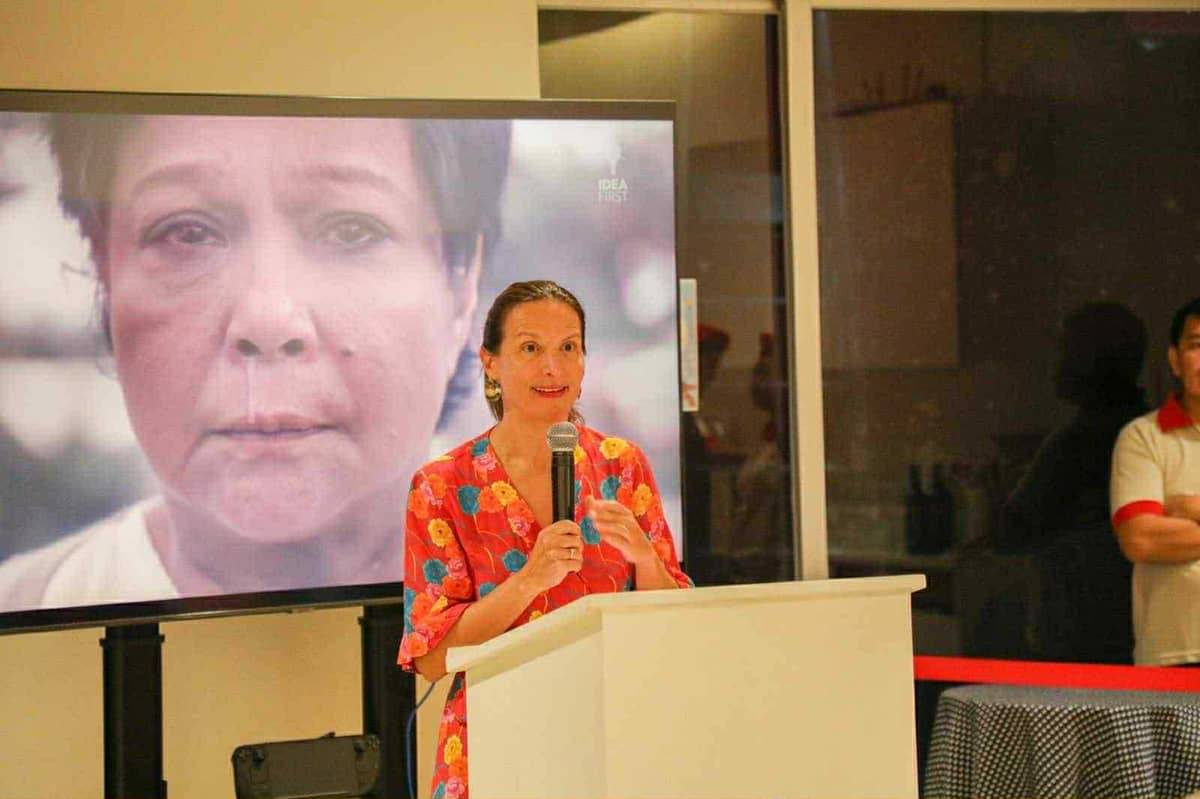
Marie Fontanel, French Ambassador to the Philippines.
“I met them in 1988 when they first came to the Philippines, and I still remember speaking to Nick Rhodes and John Taylor,” he recalled. “Listening again to ‘The Reflex’ and their reunion album Astronaut, I began painting to their rhythm — each brushstroke echoing a lyric, a pulse.”
From this soundtrack of memory emerged both his paintings and his poetic novel The Reflex and the Seven Astronauts, which continues to unfold — “I am in Chapter Twelve,” he said with a smile, “and the astronauts are still searching for home.”
Science, in Belleza’s cosmology, is not a distant construct but a living metaphor. “Science has always fascinated me — not just as a discipline but as poetry,” he mused. “It is about cures, about artificial intelligence, about the fear and hope of our age. We either resist the machine or embrace it; either way, it defines our time.”
Thus, the exhibition’s abstract planes become both landscapes and “thoughtscapes” — meditations on technology, spirit, and the boundless arena of human perception.
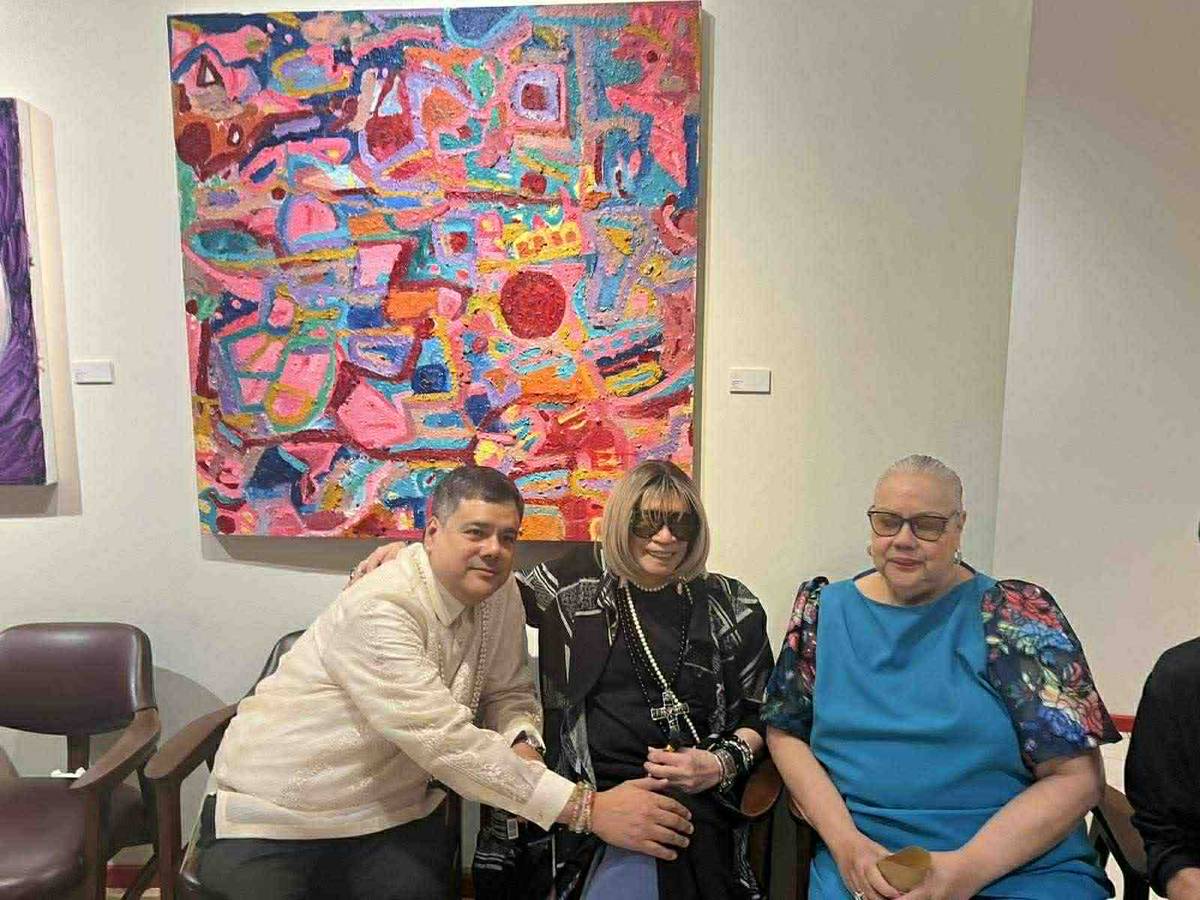
The artist with Oskar Peralta and Divina Valencia-Quesada.
The exhibit, luminous with cosmic energy, found an unexpected anchor in a haunting video installation: a close-up of Nora Aunor, drawn from an outtake of Dementia by Perci Intalan. At first overlooked amid Belleza’s painted galaxies, Aunor’s still face gradually dominated the room. Her eyes — piercing, unblinking — seemed to judge and forgive in equal measure.
.The artist’s explosions of color celebrated imagination and resilience, but Aunor’s gaze restored the gravity of conscience. Her image became an indictment and a prayer, a reminder that even as we dream beyond the world, we remain accountable to it.
Belleza himself understood this paradox. His show might orbit stars and astronauts, but it also returned us to earth—to history, politics, and moral reckoning. “The Reflex” became both cosmic mirror and moral pulse.
Behind Belleza’s celestial bravado lies a deep humility toward his mentor, Gus Albor. “He has become both mentor and moral compass — a foster tío, even a foster father,” Belleza said. “His wisdom often arrives as quiet sentences about art and life, about patience, honesty, and restraint.”
“Gus and I speak often, sometimes in person, sometimes through long text exchanges. I’ve known him since the mid-1980s, when Penguin Café in Malate was our haunt,” he recalled.
Albor’s minimalist sensibility resonates in Belleza’s new clarity: color reduced to essence, gesture to necessity. “Perhaps, someday, I will walk nearer his palette,” he reflected. “Maybe in my shows in Madrid or Milan next year, or at my Brut Collective exhibit at Altro Mondo this July. For now, he remains my sensei — a guide through both silence and color.”
Belleza created the entire series over five months — “a feverish stretch of time,” as he put it. Each work bore the residue of that intensity: layers of paint breathing over each other, textures like shifting atmospheres.
“The challenge was to unlearn myself,” he said. “To erase traces of the last exhibit while painting toward the unknown. Every canvas demanded new rhythm, new silence, new courage.”
In “The Reflex and the Seven Astronauts,” Belleza painted neither planets nor portraits but the unseen vibration that connects them — the space between science and spirit, guilt and grace. His works orbited the questions that never rest: Where does identity end and infinity begin? What remains of us when the color fades?
The answers, perhaps, are not meant to be found. As Belleza reminded us, “Each work is an echo of that universal hum — the dialogue between solitude and infinity. It is about memory orbiting light, about humanity suspended between science and spirit.”
In this balance of vision and vulnerability, Reb Belleza has found his new orbit.