




New power triangle shapes up
Whether these potentials can be adequately realized will depend on ASEAN, the GCC, and China overcoming structural and regulatory differences, and identifying areas for cooperation.

Text size
Whether these potentials can be adequately realized will depend on ASEAN, the GCC, and China overcoming structural and regulatory differences, and identifying areas for cooperation.
President Ferdinand R. Marcos Jr. is set to fly to Kuala Lumpur to take part in the ASEAN Summit to be hosted by Malaysia on 26-27 May. At the summit, Marcos and the other ASEAN leaders will be taking part in a trilateral meeting with China and representatives of member countries comprising the Gulf Cooperation Council (GCC), that is, Bahrain, Kuwait, Oman, Qatar, Saudi Arabia, and the United Arab Emirates.
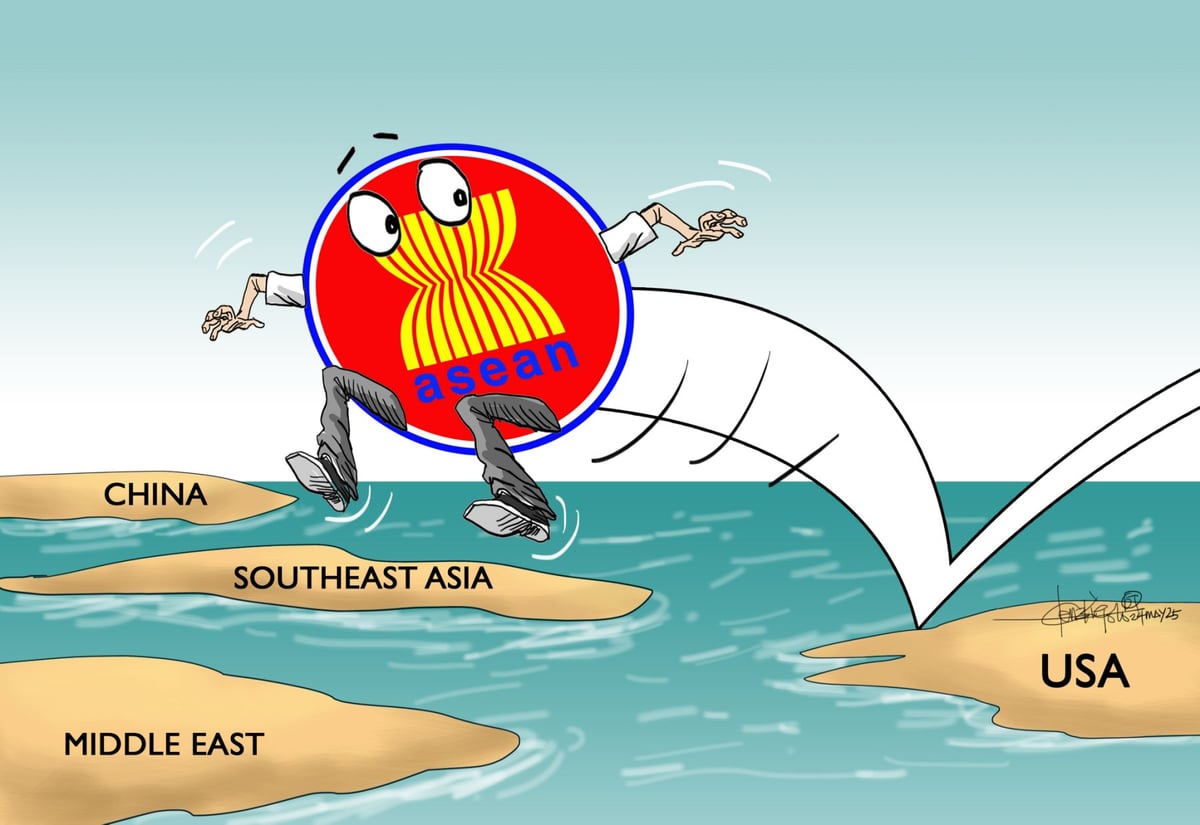
The meeting between ASEAN, China and the GCC marks a milestone in ASEAN diplomacy — in the face of escalating US protectionism.
This year’s summit chair, Malaysian Prime Minister Anwar Ibrahim, has been quick to dispel the notion a power triangle is taking shape.
“There’s no such issue (power triangle),” he said at a pre-summit briefing. “I just want to use this (summit) as an opportunity to get people to build a consensus and work together.”
Still, there is no denying that Ibrahim’s bold move in bringing together his confreres in the ASEAN to meet with the GCC — the first this year, and the second since the ASEAN-GCC meeting in Riyadh in 2023 — and China indicates the Malaysian leader’s aim to elevate his own country’s international profile, grow larger his economic ties with China and the Middle East, and assert even stronger his leadership within ASEAN amid a shifting global order.
The US’ waning influence in the Global South, along with increasingly polarizing US policies in the Middle East, have presented ample opportunities for alternative alignments between ASEAN, China, and the Middle East.
Likewise, the summit in Kuala Lumpur on Monday comes at a time when the imposition of excessive tariffs on Southeast Asian exports under US President Donald Trump’s second term has further emphasized the urgency for ASEAN to diversify beyond Western markets for its products.
Broadly, Anwar Ibrahim says, the 2025 Summit is aimed at “ensuring the strategic relevance of the region in a multipolar world.”
In other words, what will take place in Kuala Lumpur on 26-27 May is really all about a trilateral summit promoting ASEAN centrality, creating a new South-South economic alliance and forging a new partnership to neutralize the geo-economic impact of the tariff war being waged by the Trump administration against the world.
Analysts see the 2025 Summit as providing an opportunity to further integrate ASEAN into the global economy and reinforce its centrality in global economic relations.
It aligns with the Global Vision under the ASEAN Community Vision 2045 — a plan that puts emphasis on an outward-looking ASEAN and one that would make it a more resilient, sustainable, and thriving regional bloc by 2045 as well.
The summit will also provide a platform for ASEAN and GCC and China to explore the potentials of a deeper, more active collaboration through a trilateral framework beyond existing bilateral relations.
World Bank data reveals that the combined annual GDP of the ASEAN, GCC and China in 2023 totaled a whopping $23.70 trillion, equivalent to 22.3 percent of the total world GDP.
Put together, the three blocs — ASEAN, the GCC and China — with their combined total population of some 2.15 billion people form one extremely humongous market.
The summit is aimed at enabling ASEAN, the GCC, and China to harness each other’s economic strengths in trade, investments, and supply chains, and exploiting all possibilities towards forming a power trilateral summit that would unlock more economic cooperation — building on existing bilateral ties — among the three groups.
The trilateral arrangement, in terms of economic potential, is huge. For instance, trade between China and the ASEAN in 2023 was, roughly, some $700 billion. That same year, ASEAN-GCC trade was some $130.7 billion, mostly in oil, gas, energy, and financial services. Meanwhile, GCC-China trade came to a total $316.4 billion in 2022.
Where investments are concerned, foreign direct investment (FDI) in ASEAN in 2023 totaled $17.7 billion; FDI from the GCC into ASEAN grew from $265.8 million in 2018 to $390.2 million in 2023, mainly in terms of wholesale and retail trade and financial services.
All these present vast opportunities for further trade and investments as well as creating new economic activities in areas such as clean and renewable energy, digital economy, electric vehicles, financial markets, infrastructure, among many others.
Whether these potentials can be adequately realized will depend on ASEAN, the GCC, and China overcoming structural and regulatory differences, and identifying areas for cooperation.
The trilateral summit could potentially counter export restrictions and additional tariffs imposed by the US through the creation of new markets for ASEAN products and services, and providing opportunities in accessing technologies restricted by the US.
Establishing new or enhanced arrangements with both the GCC and China could provide ASEAN an opportunity to leverage its relations with both these entities, and function as a counterweight to other major powers.
At this time, the trilateral summit in Kuala Lumpur next week need not be seen as a geopolitical pivot but rather a practical platform for effecting economic and functional cooperation among the participating countries.
A lot of factors would depend on its success, but if deftly managed, the summit could very well serve as a critically vital link between Southeast Asia, China, and the Middle East, expanding ASEAN’s trade and economic reach in an increasingly complex polarized world.
Three decades after the Marcopper mining disaster devastated Marinduque’s waterways, the province is again pressing the…
Housing is probably the biggest issue affecting people the world over.
Malacañang on Monday called for a more thorough investigation into the questioned flood control projects in Taguig…
The defense on Monday backed the move by senator-judges to exclude a prosecution witness who testified on the firearms…
