




Survival strategy
There must be a conscious effort to improve service delivery, infrastructure, healthcare and economic initiatives to maintain public trust through tangible results.

Text size
There must be a conscious effort to improve service delivery, infrastructure, healthcare and economic initiatives to maintain public trust through tangible results.
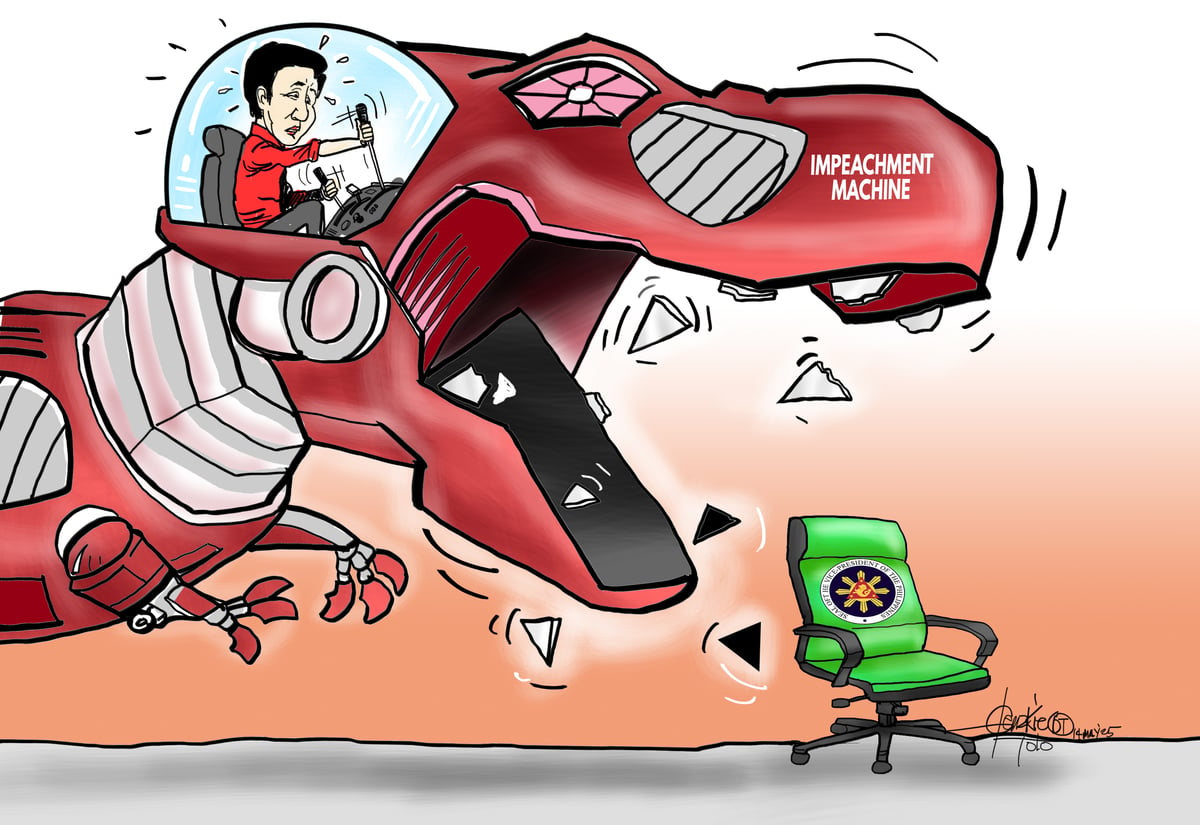
The Marcos administration better have a strategy for what measures to take if the Senate impeachment court in July fails to convict Vice President Sara Duterte.
The canvass of votes cast for senators in the midterm elections last Monday isn’t over, but from the looks of it, the administration just might come up short of allies in the Senate who could be relied upon to kick Duterte out of her post once the impeachment court is convened.
Among the senatorial candidates who ran in the midterm elections, only two — non-administration bets Bam Aquino and Kiko Pangilinan — would most likely join Senator Risa Hontiveros and vote for conviction. Sixteen votes are needed to convict Duterte and there’s no telling, at this point, if the administration could muster that.
To recall, the House of Representatives impeached the Vice President on 5 February 2025 for alleged culpable violation of the Constitution, betrayal of public trust, graft and corruption, among other high crimes.
Earlier, in November 2024, seething with rage she revealed that she had gotten someone to liquidate the President, his wife, and House Speaker Martin Romualdez should something happen to her.
Estranged from the administration, the Vice President has become the President’s arch-enemy.
Left to her own devices, she is currently perceived as posing one of the strongest dangers to the President and members of his family.
If she escapes conviction, public perception of the Senate’s bias, especially if Duterte’s allies dominate the chamber, would reinforce concerns that highly placed government officials, no matter how overwhelming the evidence of their crimes, could get away with criminality, fueling distrust of government institutions.
Failure to convict, again, despite credible allegations, would also undermine efforts to uphold accountability among the country’s high ranking officials. It could signal to the public that political loyalty and influence could shield officials from consequences, thus encouraging impunity.
At this point, things could go one way or the other. While failure to convict the Vice President might give her temporary protection, ongoing allegations can very well undermine her political reputation.
They could very well influence the presidential elections in 2028, with the Marcos-supported candidate leveraging unresolved allegations of high crimes to rally support and/or cast doubt on the legitimacy of the Vice President as Philippine president, that is, if she decides to run.
Getting the Vice President off the hook could likewise have implications internationally. It could taint the Philippines’ reputation, particularly among countries and organizations that emphasize anti-corruption and good governance as bases for foreign investments or even diplomatic relations, if domestic institutions are seen as unable or unwilling to hold corrupt officials to account.
To be sure, it could impact negatively on President Marcos’s ability to govern effectively for the remainder of his term.
A non-convicted Vice President, despite strong evidence of corruption, could bolster perceptions of an effete leadership at the top, undermining Marcos’s moral and political authority, making it more challenging for him to push for reforms, and legislative measures.
Other government branches as well would appear incapable of reining in corrupt powerful officials, emboldening corrupt practices and debilitating the rule of law.
This could result in a cycle of corruption and enfeebled governance that would be difficult to stem over the course of the President’s administration.
International observers, investors and diplomatic partners may view the Philippines as lacking in political will to combat corruption, and the country could lose favor among those looking for a safe and conducive haven for foreign investments.
To mitigate the challenges arising from the failure to convict the Vice President, the administration could consider strengthening institutional integrity and the rule of law by ensuring the independence of such agencies as the Office of the Ombudsman and Sandiganbayan to continue investigating and prosecuting corrupt officials effectively.
The judiciary should be made to expedite high-profile cases to demonstrate its commitment to accountability, even as transparency in government transactions, procurement, and public spending are increased through online portals and regular disclosures.
Serious moves should be effected by the government to leverage public support through collaborative action with civic groups, NGOs and media to monitor government actions, keeping issues of corruption in the public discourse, and pressure officials to uphold integrity in public service.
At the same time, there must be a conscious effort to improve service delivery, infrastructure, healthcare, and economic initiatives to maintain public trust through tangible results.
The sum of all these efforts is a government whose image would be burnished as an exemplar of ethical conduct and integrity, a government that is accountable for its actions, and one that serves to prioritize the public good.
A combination of transparency, adherence to the rule of law, civic engagement, a demonstrable prioritization of the public good, and effective governance can help the Marcos administration maintain the public trust amid controversial or unresolved issues, and vastly bolster the chances of whomever it fields to run against anyone — be it Sara Duterte or someone else — in 2028.
Three decades after the Marcopper mining disaster devastated Marinduque’s waterways, the province is again pressing the…
Housing is probably the biggest issue affecting people the world over.
Malacañang on Monday called for a more thorough investigation into the questioned flood control projects in Taguig…
The defense on Monday backed the move by senator-judges to exclude a prosecution witness who testified on the firearms…
