




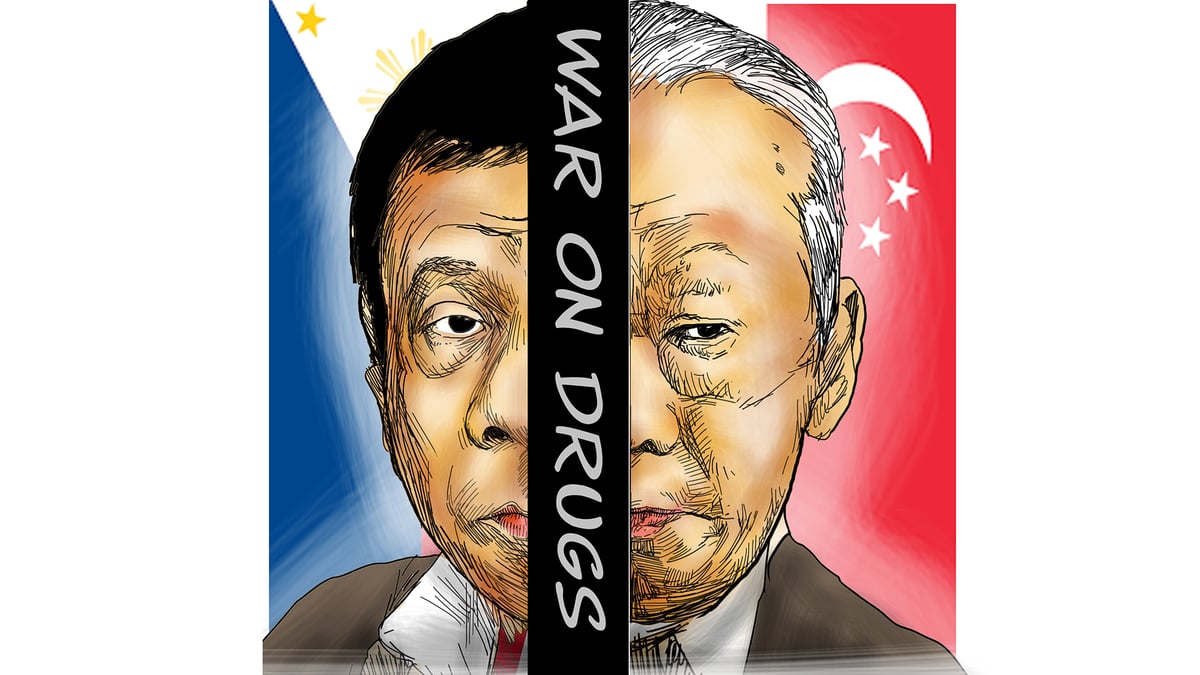
Duterte, LKY fight same war
A distinct point that Lee made was that Western critics ignore the cultural and contextual differences of Asian nations in battling crime, particularly drug use.

Text size
A distinct point that Lee made was that Western critics ignore the cultural and contextual differences of Asian nations in battling crime, particularly drug use.
Guess who made this statement with conviction: “If we could kill drug traffickers a hundred times, we would because they are destroying whole families.”
The statement associated with former President Rodrigo Duterte, now detained at the International Criminal Court in The Hague, was not even originally his as it was frequently said in interviews by the legendary Singapore Prime Minister Lee Kuan Yew.
Lee and Duterte had the same view on drugs as potentially destroying society by corrupting its basic unit, which is the family. Destroy the family and the nation’s downfall follows was the shared view of the two leaders.
The difference, however, is that Singapore has capital punishment, while the Philippines does not. Thus, harsh rhetoric delivered in vicious language became the primary weapon of Duterte in his signature war on drugs.
Lee, who died in 2015, left an unmatched legacy of development as Singapore was turned into a nation that is among the most prosperous and peaceful in the world.
Lee did not mince words when it came to narcotics smuggling into his country.
“They may believe that if you’re kind to drug traffickers, you’ll get a better society. In Singapore, before you land, the airline hostess will announce that there are very heavy penalties if you are found with more than a stated number of grams of certain prohibited drugs, and if you still come in with a few kilos which will destroy hundreds of thousands of families, one death is too kind,” Lee said.
In a BBC interview, Lee said that a single trafficker’s actions could destroy thousands of families by spreading addiction, emphasizing that the execution of one trafficker was a necessary trade-off to prevent widespread societal damage.
In a separate 2003 interview with US Public Broadcasting Service’s Charlie Rose, Lee addressed Singapore’s strict laws, including the death penalty for drug trafficking.
He justified the policy by highlighting Singapore’s vulnerability as a small, densely populated nation with a significant port, making it an ideal transshipment point for drug smuggling.
He said, “If we don’t act decisively, drugs will flood our society and we’ll lose an entire generation.”
Lee stressed that the death penalty was a deterrent, pointing to Singapore’s low drug abuse rates compared to Western nations with more lenient policies.
The ICC complaint of crimes against humanity against Duterte is heavily bent toward dealing with the narcotics problem based on Western standards.
Lee, like Duterte, dismissed criticism from human rights groups, arguing that the state’s duty is to protect its citizens from the evil of drugs over sparing individual traffickers.
In a 1994 speech at the Asian Leadership Conference, excerpts of which were published in his memoirs, From Third World to First (2000), Lee made clear his uncompromising position against drug syndicates.
He elaborated on the death penalty’s role in maintaining social order, stating, “The drug peddler who destroys lives and families deserves no mercy. One execution saves thousands from ruin.”
He cited Singapore’s success in keeping drug-related crimes low, contrasting it with the United States, where he said lax enforcement led to rampant addiction and social decay.
A distinct point that Lee made was that Western critics ignore the cultural and contextual differences of Asian nations in battling crime, particularly drug use.
He said in The New York Times interview: “We’ve seen what happens in societies that tolerate drugs — families broken, communities destroyed. We won’t let that happen here.”
However, the two leaders’ identical positions resulted in Duterte falling into the hypocritical hands that Lee loathed because of the vicious politics that Singapore fortunately does not have.
Three decades after the Marcopper mining disaster devastated Marinduque’s waterways, the province is again pressing the…
Housing is probably the biggest issue affecting people the world over.
Malacañang on Monday called for a more thorough investigation into the questioned flood control projects in Taguig…
The defense on Monday backed the move by senator-judges to exclude a prosecution witness who testified on the firearms…
