




ASEAN scrambles in response top unitive U.S. tariffs
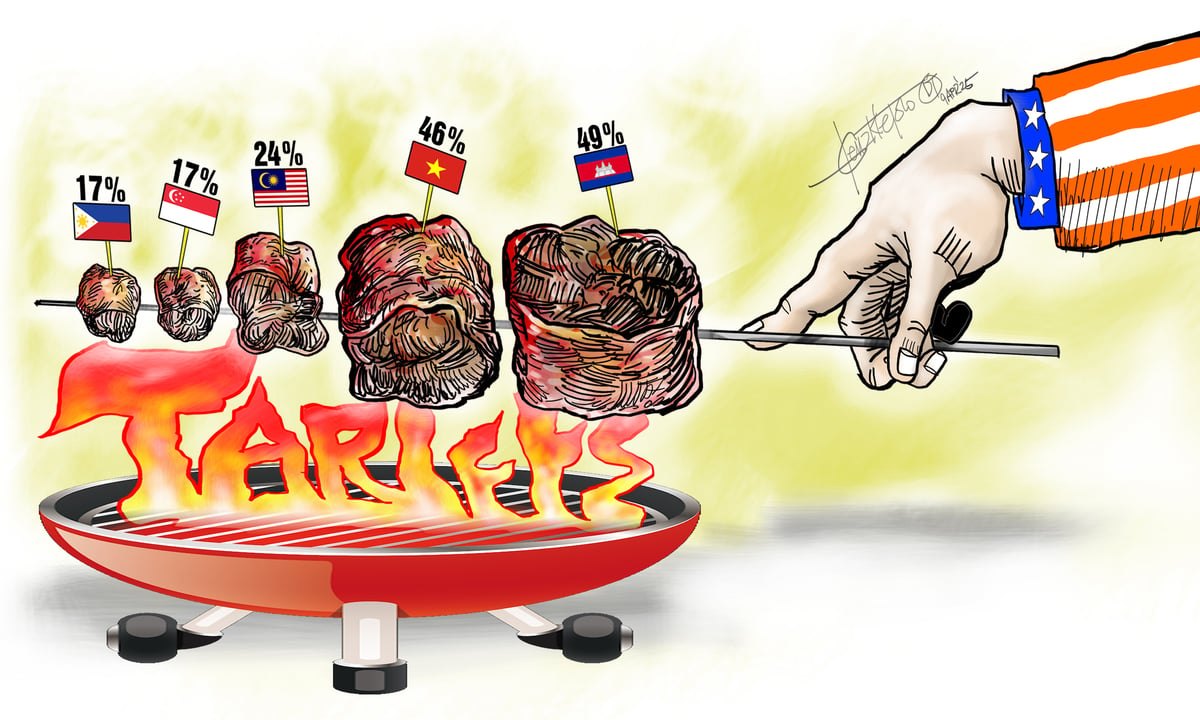
ASEAN’s collective grouping of 10 countries was among the hardest hit, with Cambodia slapped the highest tariff at 49 percent and Vietnam at 46 percent.

Text size
ASEAN’s collective grouping of 10 countries was among the hardest hit, with Cambodia slapped the highest tariff at 49 percent and Vietnam at 46 percent.
Malaysian Prime Minister Anwar Ibrahim, who currently chairs the Association of Southeast Asian Nations (ASEAN), has called for a concerted response by the regional bloc to the new tariffs imposed by US President Donald Trump on countries across the globe.
In all, some 190 countries and territories — from economic powerhouses like China to the ASEAN member countries and such far-flung Pacific Island nations like Vanuatu — were hit with tariffs.
ASEAN’s collective grouping of 10 countries was among the hardest hit, with Cambodia slapped the highest tariff at 49 percent and Vietnam at 46 percent. Malaysia was levied 24 percent, while the Philippines and Singapore were imposed the lowest tariffs, at 17 percent and 10 percent, respectively.
Ibrahim, warning that the tariffs were only the start of greater challenges to come, said he will initiate efforts to present a united regional front, maintain open and resilient supply chains, and ensure that ASEAN’s collective voice is “heard firmly and clearly on the international stage.”
He said Malaysia could withstand the economic impact of the new tariffs, but only if the regional bloc is united and coordinated in its response with other ASEAN member states.
Taking care that he wouldn’t be misconstrued as hinting at retaliation, Ibrahim asked for a united ASEAN in responding to the tariffs, but was careful to stress that “we must not act rashly.”
Anwar said Malaysia could withstand the economic impact of the tariffs imposed by the US but “Malaysia alone, or Thailand, or Indonesia alone” won’t be strong unless ASEAN’s full strength as an economic bloc is harnessed in making a collective response to the tariffs.
And such a response will be done through negotiation, if at all still possible with Trump’s America. Other ASEAN leaders have likewise shunned retaliation as a response to the tariffs.
Earlier this week, Singapore’s Prime Minister, Lawrence Fong, addressed Singaporeans, saying the tariffs imposed by Trump on the world marks a “seismic change” in the global order.
“The era of rules-based globalization and free trade is over,” said Wong, lamenting that the US, under Trump, has “abandoned” its role as a bedrock for free market economies, a global champion of free trade which had led in the building of a multilateral global trading system — the World Trade Organization — that had brought unprecedented stability and prosperity to the world, including the US itself.
Today, he said, America under Trump has virtually abandoned the entire system it had created.
The US imposition of reciprocal tariffs, country by country, said Wong, is a complete rejection of the WTO framework, and if other countries adopt that same approach, abandoning the WTO and trading only on their own preferred terms it will spell trouble, especially for small nations like Singapore.
“We risk being squeezed out, marginalized, left behind,” Wong said.
In all likelihood, the tariff-hit countries will undertake some sort of response to the new measures effected by the US.
For its part, Singapore will heed the ASEAN chair’s declaration that a response to the US tariffs won’t be in the form of retaliatory tariffs.
“But,” emphasized Wong, “other countries may not exercise the same restraint.”
What the world is currently going through could very well explode into a full-blown global trade war — the impact of the higher tariffs along with the uncertainty of what other countries may do next weighing heavily on the global economy.
Wong notes that the last time something like this was experienced by the world was in the 1930s with trade wars escalating into armed conflict and eventually into a world war.
There’s no telling, he said, how the current situation will unfold. In the meantime, Wong told his fellow Singaporeans, “We must be clear-eyed about the dangers that are building up.”
Such is the harsh reality gripping the world. “The global calm and stability we once knew will not be returning anytime soon,” said the Singaporean leader.
“We cannot expect that the rules that had protected small states will still hold. Let us not be lulled into complacency. The risks are real, the stakes are high, the road ahead will be harder,” Wong said.
That admonition could very well have likewise been aimed at Filipinos.
Three decades after the Marcopper mining disaster devastated Marinduque’s waterways, the province is again pressing the…
Housing is probably the biggest issue affecting people the world over.
Malacañang on Monday called for a more thorough investigation into the questioned flood control projects in Taguig…
The defense on Monday backed the move by senator-judges to exclude a prosecution witness who testified on the firearms…
