




Not just thunder but lightning, too
“Until recently, responses were limited to diplomatic notes, Coast Guard deployments, and appeals to the international community. These were necessary but insufficient.

Text size
“Until recently, responses were limited to diplomatic notes, Coast Guard deployments, and appeals to the international community. These were necessary but insufficient.
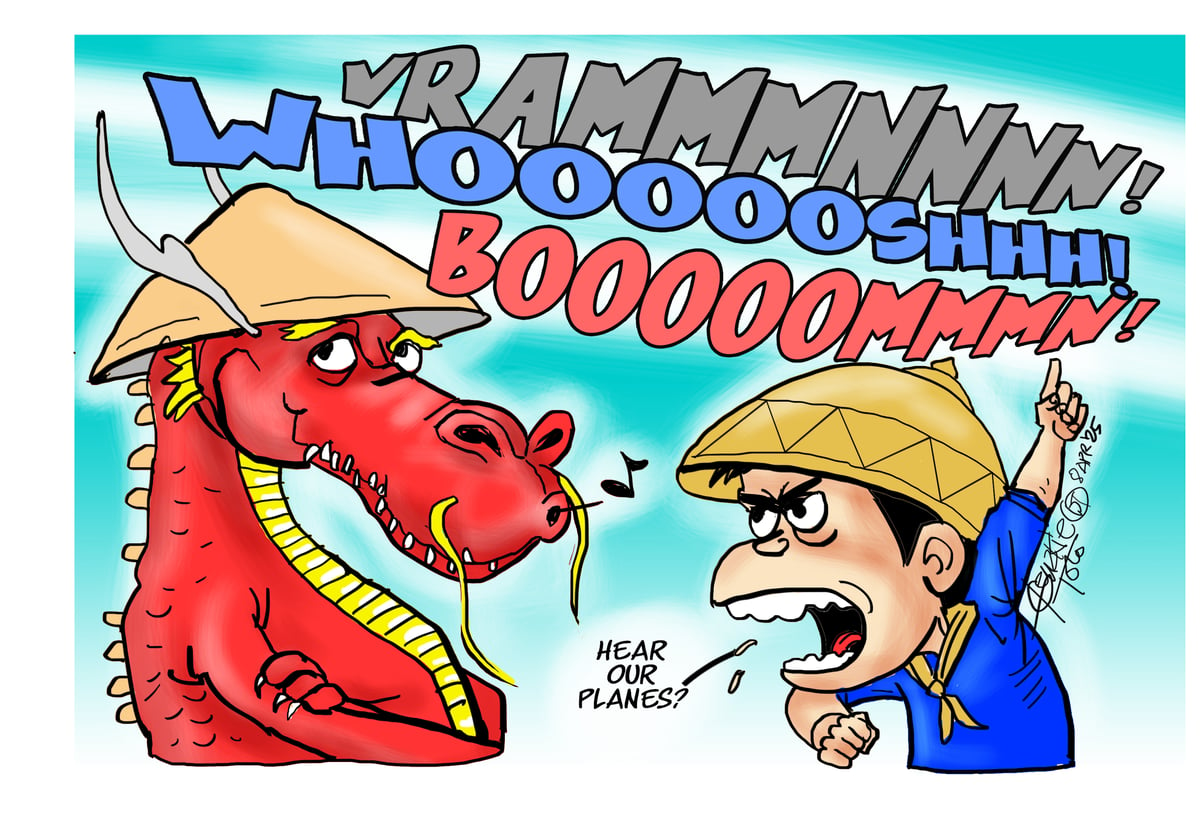
The Philippine Air Force’s participation in Cope Thunder 2025 with the United States, and later this month’s Balikatan exercises involving Japan and Australia, sends an unmistakable message: the Philippines is no longer content with token protests or timid diplomacy in the face of China’s unrelenting aggression in the West Philippine Sea.
But while the roar of jet engines and the choreography of drills may signal resolve, the more important question is whether the Philippines is moving beyond the noise — beyond the thunder — towards real, credible lightning: a defensive capability that can withstand regional coercion.
For years, China has trampled on Philippine sovereignty within our own 200-nautical-mile exclusive economic zone (EEZ) despite a landmark 2016 arbitral ruling that struck down Beijing’s sweeping nine-dash line claim. That ruling, handed down by the Permanent Court of Arbitration in The Hague, clearly upheld Manila’s rights to fish, drill for oil, and navigate freely around areas such as the Spratly Islands and Scarborough Shoal.
China, however, has treated the ruling with contempt, continuing to build and militarize artificial islands across the South China Sea—seven of them in the Spratlys alone.
These outposts — Fiery Cross Reef (Yongshu), Subi Reef (Zhubi), Mischief Reef (Meiji), Gaven Reef (Nanxun), Johnson South Reef (Chigua), Hughes Reef (Dongmen), and Cuarteron Reef (Huayang) — are not just concrete symbols of occupation. They are forward-operating military bases equipped with runways, radar systems, missiles, and garrisons — tools of intimidation to enforce China’s unlawful claims and harass smaller claimant states like the Philippines.
Is it any wonder that in America, talk is growing louder about the need to install permanent forward bases in countries such as the Philippines, where it used to have Clark Air Base in Pampanga and Subic Bay Naval Base until they were closed down in 1991 after a treaty revocation and the wrath of Mount Pinatubo.
In the face of this creeping annexation by China, the Philippines has often been caught flat-footed.
Until recently, responses were limited to diplomatic notes, Coast Guard deployments, and appeals to the international community. These were necessary but insufficient. What was missing was the ability to deter — genuinely deter — the acts of aggression.
The recent flurry of activity with the United States and other allies offers a major shift in posture. The Cope Thunder exercises focus on enhancing asymmetric warfare capabilities — an essential component in dealing with a more powerful adversary.
Balikatan will broaden that foundation, involving not only more troops and equipment but also a wider cast of like-minded nations that have a stake in keeping the sea lanes free and international law respected.
Still, exercises are not the end goal — they are merely the training wheels. As welcome as the proposed sale of F-16s to the country may be, the real test lies in what kind of sustained investment the Philippines is willing to make in its own air and naval defense, and how quickly it can close the wide gaps in surveillance, intelligence, and rapid response.
Just as important is strategic clarity. The Philippines must articulate not only what it is defending but also what lines cannot be crossed. China has banked on the assumption that the Philippines will not push back, fearing economic reprisal or military escalation. That calculation must be changed.
The Philippines is not alone in this struggle. Its Enhanced Defense Cooperation Agreement (EDCA) with the US now covers nine military sites across the country, including bases in northern Luzon, close to Taiwan. This not only enhances interoperability with US forces but also situates the Philippines within a broader regional framework of deterrence, with Australia, Japan, and potentially others.
Yet, as China continues its blockade simulations around Taiwan and steps up harassment of Philippine vessels at sea, time is of the essence. Deterrence delayed is deterrence denied.
The military drills, the visiting defense officials, the pledges of support—they are all part of the thunder.
But let us not stop there. Let there be lightning. Let the Philippines emerge with the credible capability to protect its waters, its sovereignty, and its people — not just in joint statements but in actual strength.
For in this long-running contest in the West Philippine Sea, credibility is not spoken — it is demonstrated.
Three decades after the Marcopper mining disaster devastated Marinduque’s waterways, the province is again pressing the…
Housing is probably the biggest issue affecting people the world over.
Malacañang on Monday called for a more thorough investigation into the questioned flood control projects in Taguig…
The defense on Monday backed the move by senator-judges to exclude a prosecution witness who testified on the firearms…
