
THEATER REVIEW: Tanghalang Pilipino’s ‘Kisapmata’ is conceptual and expository
If De Leon’s film centers on Mila, Luarca shifts the focus to Noel. We follow his journey as he gets to know his ‘fascist-in-law,’ Dadong.


Tanghalang Pilipino’s Kisapmata, by playwright and director Guelan Varela-Luarca, takes a conceptual approach to Mike de Leon’s 1981 psychological-horror film of the same title. De Leon’s film, lest we forget, is inspired by Nick Joaquin’s true-crime reportage The House on Zapote Street, about an ex-cop who gunned down his own household.
Like the film, Luarca’s adaptation runs for approximately an hour and thirty minutes. He employs minimalist staging with Brechtian elements for this story of tyranny at the CCP Blackbox Theater.
The stage, square and mossy green, is elevated, allowing the actors to circle around it offstage. Like an isolated island, it is also surrounded by tall, dry grass to evoke a sense of confinement. A narrow doorway floats in the background, overlooking a pitch-black sky beyond the dry, overgrown grass, as if echoing the absence of an outside world—or a lack of freedom.
The only props onstage are cubes, the design seemingly cut out from the stage itself and used as chairs and flexible set pieces for smooth transitions. These cubes complement the rectangular checkered canopy draped above the stage, an architectural and lighting tool that casts a grid-like pattern of light and shadow on the stage. This adds to the visual sense of control and surveillance. And with no additional props aside from the cubes (and, later, weapons), the actors mime actions like making phone calls and taking showers, accompanied only by sound effects.
The four actors—Jonathan Tadioan as the tyrannical Dadong, Lhorvie Nuevo as his wife Dely, Toni Go as their daughter Mila, and Marco Viana as Mila’s fiancé Noel—all wear beige outfits. This prison-like uniformity heightens the sense of authoritarianism, conformity, and systemic control.
If de Leon’s film centers on Mila, Luarca shifts the focus to Noel. We follow his journey as he gets to know his “fascist-in-law,” Dadong. Meanwhile, Dely sometimes serves as a narrator, breaking the fourth wall to explain what is going on or foretell events. This treatment interrupts the story’s suspense by spoon-feeding the audience rather than letting them experience the oppression organically.
This device also makes Dely a mouthpiece for the playwright instead of allowing the audience to interpret the scenes on their own. Dely repeatedly uses the authoritarian rhetoric "Ang batas ay pagmamahal" to illustrate abuse and psychological control—extending the play’s critique beyond Dadong’s household into socio-political commentary.
Dely is puzzling. Her poetic monologues about despair—"Walang Diyos, mga pader at hangin lang"—seem at odds with her later actions, such as making the sign of the cross and praying for salvation. Is this madness, the result of abuse, or a script inconsistency?
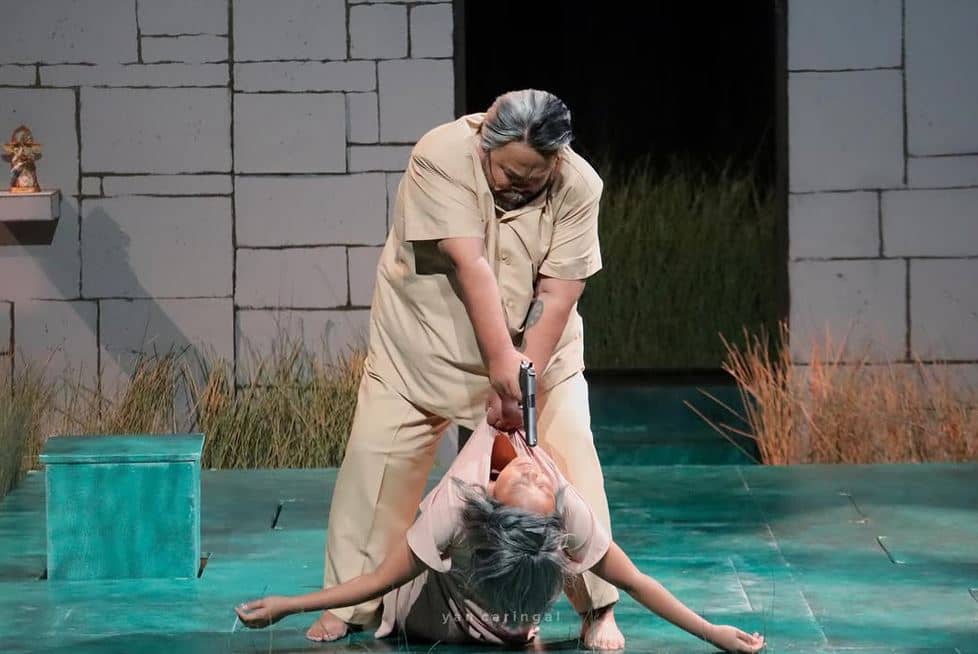
Jonathan Tadioan in a scene. in Co-Love.
The storytelling is fragmented, with abrupt jumps between vignettes instead of a natural flow, shattering any sense of momentum. The passage of time is displayed in an overhead projection around the stage ("Bukas," "Nobyembre," etc.), reminiscent of the film’s timestamps. This feels unnecessary, as the passage of time should be understood through the scenes. Also, from a center seat, craning your neck to read the thin strip of projected text is a hassle.
Tadioan’s portrayal of Dadong, with his high-pitched, hoarse voice and bulky frame, creates an eerie presence but sometimes leans into caricature rather than a deeply inhabited role. Mila, meanwhile, lacks a psychological arc to justify her sudden shift from loyalty to rebellion. There is no gradual sense of unease. She goes from being devoted to her father to wanting to escape without emotional buildup.
The lack of real doors and barriers onstage makes the fear of entrapment feel abstract rather than immediate. Dadong, for example, stands outside an invisible doorway to Mila’s bedroom, glaring through the closed door that we cannot see, which can come off as funny rather than scary. Or Noel, desperately banging against an invisible locked door.
Without actual barriers, the tension of being trapped is weakened. However, one could argue that Dadong’s eyes “seeing through” doors symbolize his omnipresent evil and control and remain consistent with the minimalist staging.
The play ends with the nationalistic slogan "Ang mamatay para sa Filipino," but it feels like a forced insertion to link Kisapmata’s crime story to the broader state of the nation and our history.
Tanghalang Pilipino’s staging is both conceptual and expository, offering a distinct interpretation of the material. While its stylistic choices may divide audiences, Luarca’s approach succeeds in transforming the story into an allegory rather than a straightforward domestic thriller.
Kisapmata is playing at the CCP Blackbox Theater until 30 March 2025.