




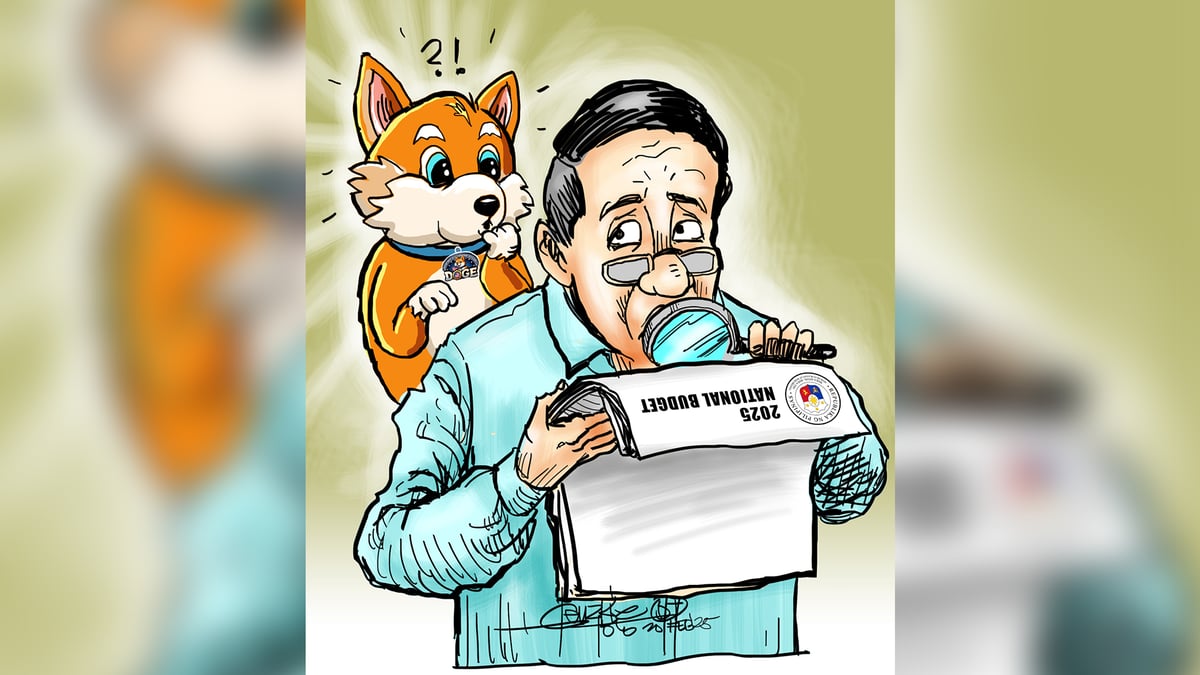
Bite like a DoGE
Recently, DoGE uncovered an anomaly in the US budget in which a line item, accounting for nearly $4.7 trillion in payments, is oftentimes left blank.

Text size
Recently, DoGE uncovered an anomaly in the US budget in which a line item, accounting for nearly $4.7 trillion in payments, is oftentimes left blank.
The incessant denials by officials regarding the blank items in the Bicameral Conference Committee report on this year’s national budget make the allegations more believable.
Senate President Francis “Chiz” Escudero refuted allegations of blank items in the Bicam report, saying that he didn’t see any discrepancies.
“I don’t see my signature there, so I don’t know what that is,” Escudero said, referring to the documents made public by Davao City 3rd District Representative Isidro Ungab.
Yet Escudero parroted the line of the House Appropriations Committee regarding alterations to the Bicam report, which he signed, that had a provision that allowed the committee on appropriations and finance to “correct and fill” items that might have been overlooked, noting that there were 200,000 line items in the budget measure.
A provision also stated that “if there are differences in the [General Appropriations Act] and the Bicameral Conference Committee report, the enrolled copy of the General Appropriations Act will be followed,” Escudero said.
The confusion only underscored the need for the government to establish an agency similar to the recently formed Department of Government Efficiency (DoGE) by US President Donald Trump.
Recently, DoGE uncovered an almost identical anomaly in the US budget in which a line item, accounting for nearly $4.7 trillion in payments, is oftentimes left blank.
“The Treasury Access Symbol (TAS) is an identification code linking a Treasury payment to a budget line item (standard financial process),” DoGE posted on X.
It indicated that the TAS field was optional for some $4.7 trillion in payments and was often left blank, making the money trail hard to trace.
“As of Saturday, this is now a required field, increasing insight into where money is going,” DoGE indicated.
All financial transactions made by the federal government are classified by TAS when reporting to the Treasury and the Office of Management and Budget (OMB).
DOGE.gov, as of Monday evening, said the total estimated savings since the establishment of the department totaled about $55 billion.
Escudero claimed the version of the budget that could only be questioned is the one that was enacted and signed by the President.
DoGE, headed by Elon Musk, has been at the forefront of initiatives to cut waste, fraud, and abuse in US federal government expenditures. The interim body was created via an executive order and will spend 18 months carrying out its mission.
It, however, has faced criticism over its access to federal systems, including the Treasury Department’s payment system, as well as moves to cancel federal contracts and make cuts at various agencies.
The bottom line, however, is the amount that DoGE, on its website, says it has found — $55 billion in savings through a combination of efforts, including a reduction in the federal workforce.
Savings were attained through canceling or renegotiating leases and contracts, selling assets, canceling grants, finding regulatory savings, making program changes to the government and reducing the workforce.
Among the federal projects that DoGE flagged thus far are $10 million for circumcisions in Mozambique and $25 million for biodiversity in Colombia.
In the Philippines, these projects are similar to the flood control deals and farm-to-market roads which are inserted in the yearly budget at a cost of billions to taxpayers — without providing any real benefit.
The provisional body led by the private sector to clean up the government has a local counterpart called the Private Sector Advisory Council, which should be institutionalized and given temporary teeth like DoGE.
A traditional dish called zongzi is served during China’s Dragon Boat Festival, which falls in June. It is a rice…
Divina credited the firm’s achievements to its members, thanking them for their ‘hard work, dedication, teamwork, and…
‘Sec. Vince Dizon, please explain how this finding of your own team should not be flagged as a ghost project in Taguig.’
