




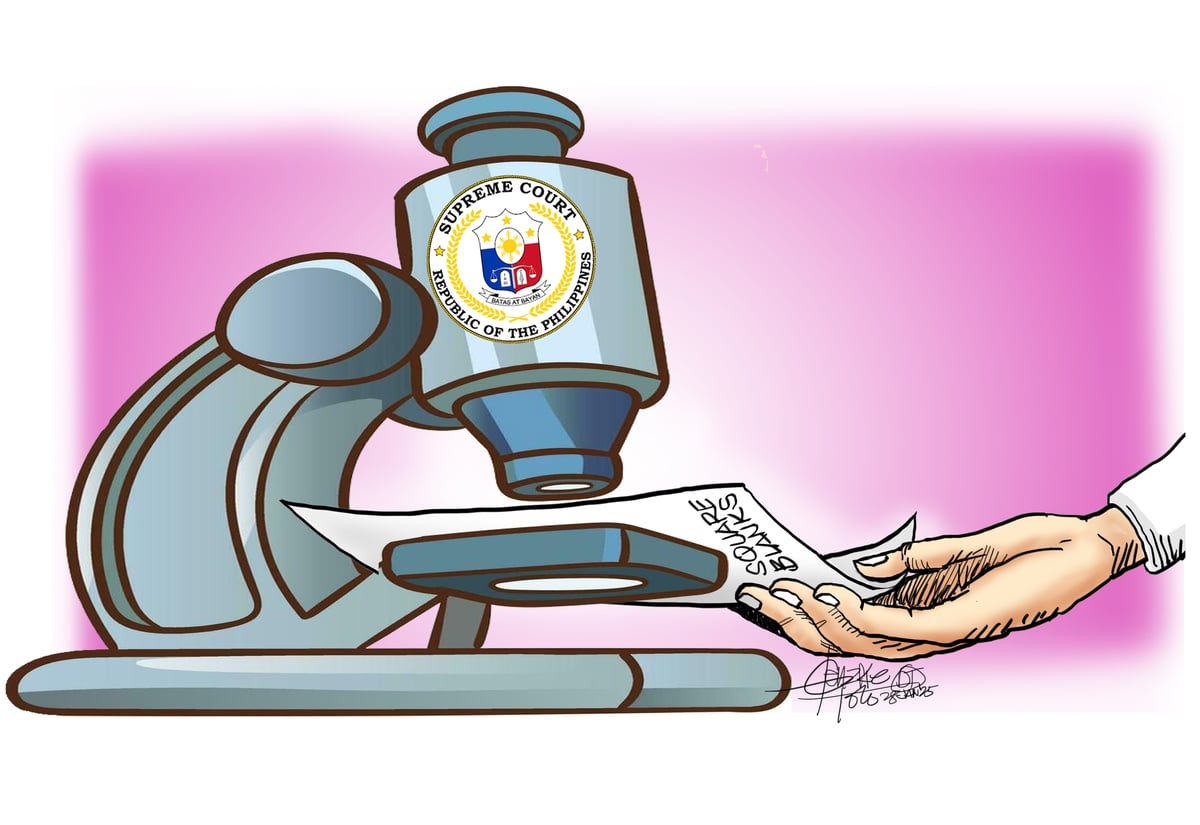
Square blanks before the SC
“ Ungab asked his colleagues in Congress to review their emails and look back to 11 December and read its content so they’ll know who’s telling the truth.

Text size
“ Ungab asked his colleagues in Congress to review their emails and look back to 11 December and read its content so they’ll know who’s telling the truth.
A Supreme Court (SC) confrontation looms over the questions over missing items in the Bicameral Conference Committee (Bicam) report on the 2025 national budget and the secretive process in the body.
The main question in the court challenge would be: “Who filled up the blanks?”
The Bicam is composed of select members of the Senate and the House of Representatives who are almost always behind the bastardization of the budget since their proceedings are held behind closed doors.
Budget watchdogs are also questioning the absence of records, through minutes of its meetings.
Davao City Representative Isidro Ungab, who exposed the blank items in the budget, said the issue should be brought before the Supreme Court.
Ungab asked his colleagues in Congress to review their emails and look back to 11 December and read its content so they’ll know who’s telling the truth. The blanks in the report will be there, he said.
He stressed that if the public is vigilant and will always scrutinize the events in Congress, it will not be easy for public officials to manipulate the use or allocation of taxpayers’ money or public funds.
The public should be deeply involved in the discussions since it is taxpayers’ money that is at stake, he added.
“We pay taxes on every action that we take so it behooves upon us to know what is happening,” the former chairperson of the House Appropriations Committee said.
University of the Philippines School of Economics professor and former Department of Finance (DoF) Undersecretary Cielo Magno said it should be Ungab who should initiate the case with the SC since he has the standing to challenge the budget process as a member of Congress.
Magno, an advocate of transparency in the budget process, said the blank items in the Bicam report are beyond partisan issues.
“Ungab may have close ties with former President Rodrigo Duterte but he raised a valid issue that needed to be answered,” she said.
“Who filled up the missing figures in the bicameral conference committee report as these disappeared in the General Appropriations Act (GAA) that President Ferdinand Marcos Jr. signed?” according to Magno.
“Suppose the blanks have been removed from the enrolled bill. In that case, it means that the one who completed the bill was in Congress, who is either in the House of Representatives or in the Senate, but if the bill sent to the President was still unfilled, it means that the figures were provided in the Executive branch,” according to Magno.
“If a member of the Executive provided the missing figures, that would be usurpation of the power of Congress.” Thus, the blank items in the Bicam report are an issue that the public has an interest in, he pointed out.
“Sometimes we don’t like the messenger so we focus on the message but we have to do our research and study the data that was provided so we can form our own opinion,” Magno said.
Assuming that the blanks were the result of sloppy staff work and the Bicam report was mistakenly signed, the reference, according to Magno, should be the minutes of the panel’s meeting.
“If the committee has a complete record of the proceedings, then it could provide the accurate figures, so the Bicam should be asked if there’s such meeting minutes and they should be made public,” Magno continued.
It is important to bring the matter of the blank items in the report, including the lack of transparency in the Bicam process, to the Supreme Court, insisted Magno.
The Bicam procedures are largely based on the internal rules of the Senate and the House of Representatives, thus, if both chambers of Congress do not want to make the process transparent then it would remain opaque.
Only through a Supreme Court challenge can many of the defects in the process be addressed, and those responsible for manipulating the budget be held accountable.
Three decades after the Marcopper mining disaster devastated Marinduque’s waterways, the province is again pressing the…
Housing is probably the biggest issue affecting people the world over.
Malacañang on Monday called for a more thorough investigation into the questioned flood control projects in Taguig…
The defense on Monday backed the move by senator-judges to exclude a prosecution witness who testified on the firearms…
